
XRP's Slow Growth vs. Noomez's Presale Momentum: Strategic Diversification into High-Velocity Presales
XRP's Institutional Momentum and Regulatory Hurdles
XRP's Q3 2025 performance was nothing short of explosive. The token surged 27% to $2.85, propelling its market cap to $170.3 billion-outpacing BitcoinBTC--, EthereumETH--, and SolanaSOL-- combined, according to a Coinpedia report. This growth was fueled by corporate adoption, including Ripple-backed Evernorth's $1 billion XRP purchase and institutional investments from Citadel Securities and Fortress Investment Group, as reported by the same Coinpedia report. Meanwhile, the XRP Ledger (XRPL) saw a 9% rise in daily transactions and a 46% increase in new wallet addresses, underscoring its growing utility, according to the Coinpedia report.
However, XRP's progress is shadowed by lingering legal uncertainties. Despite the SEC's limited capacity during a government shutdown, Franklin Templeton's removal of the 8(a) clause from its XRP ETF filing has accelerated approval timelines, according to a Coinpedia report. Analysts project a potential $1,000 price target by 2030, but 2025's trajectory remains cautious, with current technical indicators showing consolidation around $2.3–$2.5, according to a CryptoNewsLand analysis.
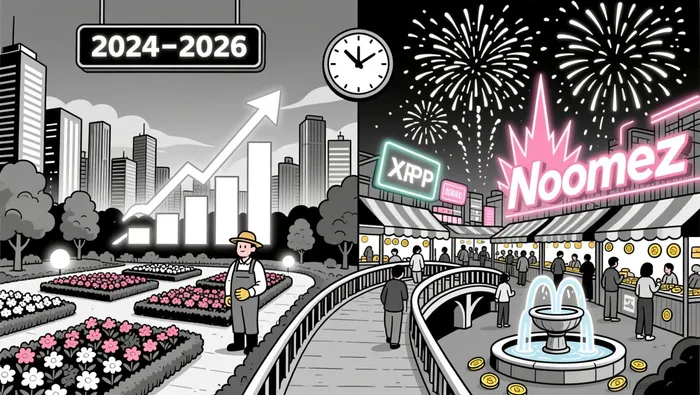
Noomez's High-Velocity Presale Model
Noomez ($NNZ) is redefining early-stage crypto investing with its 28-stage presale structure. Each stage lasts up to seven days or until tokens sell out, with unsold tokens burned in real time to reduce supply, according to a LiveBitcoinNews analysis. Starting at $0.00001, the price escalates to $0.0028 in the final stage, offering early buyers up to 280x potential growth, according to a CryptoNewsLand analysis. As of Stage 2, the project has raised $9,700 toward its $164,719 cap, with transparent on-chain tracking via the "Noom Gauge," according to a LiveBitcoinNews analysis.
The presale's mechanics are designed to incentivize early participation. A "Stage X Million" airdrop rewards one lucky investor per stage with tokens equal to the stage number (e.g., 28 million in Stage 28), according to a CryptoNewsLand analysis. Additionally, 50% of the 280 billion NNZ tokens are allocated to the presale, while 15% is locked for liquidity and 5% reserved for strategic burns, according to a CryptoNewsLand analysis. This deflationary framework, combined with real-time verification, has attracted investors seeking alternatives to traditional speculative tokens, according to a LiveBitcoinNews analysis.
Strategic Diversification: Balancing Institutional and Speculative Bets
For investors, the contrast between XRP and Noomez highlights a key diversification strategy: pairing institutional-grade assets with high-velocity presales. XRP's regulatory progress and corporate adoption make it a "blue-chip" play, albeit with slower growth. Noomez, meanwhile, offers explosive potential but requires a higher risk tolerance.
Data from 2025 shows that XRP's price prediction hovers around $2.65–$3.01 by year-end, according to a CryptoNewsLand analysis, while Noomez's presale velocity suggests it could outperform in the short term. For example, Noomez's Stage 2 price of $0.0000123 implies a 230x return if it reaches $0.0028 by Q3 2026, according to a LiveBitcoinNews analysis. This creates a compelling case for investors to allocate capital to both assets, balancing long-term institutional bets with near-term speculative gains.
Risks and Considerations
Critics argue that XRP's legal uncertainties could delay ETF approvals, while Noomez's presale model is inherently volatile. XRP's price is currently below its 50-day SMA at $2.78, with key resistance at $2.85, according to a CryptoNewsLand analysis. For Noomez, the lack of a public token launch until Q3 2026 means its value remains untested in broader markets, according to a LiveBitcoinNews analysis.
Conclusion
In 2025, the crypto landscape is defined by two narratives: XRP's institutional ascent and Noomez's presale frenzy. For strategic diversification, investors should consider both. XRP offers stability and regulatory clarity, while Noomez provides high-velocity growth potential. By allocating capital to both, investors can hedge against market volatility while capitalizing on emerging opportunities.






Comentarios
Aún no hay comentarios