
XRP's Short-Term Vulnerability Amid Whale Distribution and Post-ETF Profit-Taking
Whale Distribution and Profit-Taking: A Bearish Catalyst
Whale activity has been a dominant force in XRP's recent price action. In late October 2025, large holders accumulated 1.27 billion XRP ($3.15 billion value), signaling institutional confidence amid anticipation of ETF approvals, according to a Timestabloid article. However, this optimism was short-lived. Post-ETF launches, particularly the REX-Osprey XRPR ETFXRPR-- and pending filings from Franklin Templeton, triggered a wave of profit-taking. Over 500,000 XRP tokens were offloaded in 48 hours after November 13, reducing whale holdings from 6.9 billion to 6.23 billion tokens and pushing the price to $2.30, as noted in a Coinotag report.
This sell-off reflects a classic bearish pattern: large holders liquidating positions after key milestones, such as ETF approvals, to secure gains. The 90 million XRP sold during a 72-hour period in November 2025 further exacerbated downward pressure, coinciding with a 30% price drop from $3.30 to $2.30, according to a Bravenewcoin article. While some analysts argue such whale activity often precedes short-term bottoms, the absence of sustained accumulation raises concerns about further distribution.
Technical Breakdowns and On-Chain Sentiment
XRP's technical structure highlights growing fragility. The Relative Strength Index (RSI) has entered oversold territory (below 30), a potential exhaustion signal for selling pressure, as noted in a Coinotag report. However, recovery hinges on volume confirmation, which has been lacking, according to the same Coinotag report. Transaction volume has plummeted below 1 billion, a stark contrast to the 6 billion XRP transacted during the November sell-off, as noted in the Coinotag report. This divergence suggests waning market enthusiasm and a risk of prolonged consolidation.
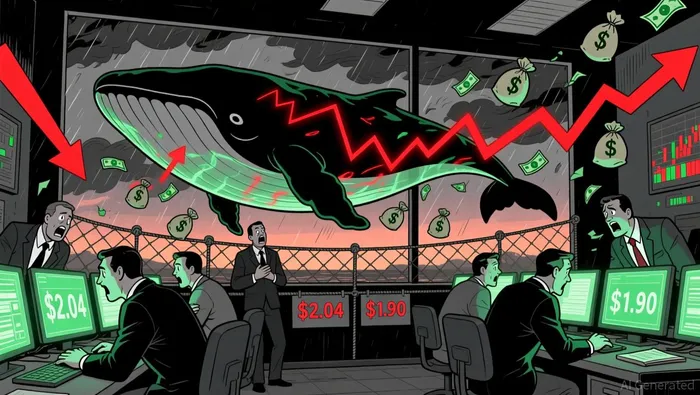
Price action is also testing critical support levels. XRP is currently trading near $2.04, with resistance clustered between $2.40 and $2.60. A failure to break above this range could trigger a retest of lower supports, potentially extending the correction to $1.90–$2.00, as the Coinotag report noted. On-chain data from Glassnode reveals a 240% surge in profit realization rates (from $65 million to $220 million per day) as prices declined, alongside realized losses exceeding $470 million, according to a Coinotag analysis. These metrics indicate a psychological shift, with traders prioritizing risk mitigation over bullish bets, as the Coinotag analysis noted.
ETF-Driven Volatility: A Double-Edged Sword
The launch of the REX-Osprey XRPR ETF and pending approvals for products from Franklin Templeton and Bitwise have introduced new dynamics. While ETFs could unlock institutional liquidity, they also amplify volatility. For instance, a whale on Hyperliquid recently shorted $20 million worth of XRP at $2.30 with 20x leverage, betting against a post-ETF rebound, according to a CryptoBasic report. This bearish positioning underscores market skepticism about XRP's ability to sustain gains despite Ripple's institutional partnerships and RLUSD stablecoin developments, as noted in the Timestabloid article.
Moreover, the ETF-driven narrative has created a divergence between fundamental progress and price action. Ripple's growing institutional presence has not translated into sustained token appreciation, as traders remain cautious about regulatory uncertainties and profit-taking cycles, according to the Coinotag analysis. This disconnect highlights a structural challenge: even with improved accessibility via ETFs, XRP's price may remain range-bound until on-chain activity and whale behavior align with bullish trends, as the Coinotag analysis noted.
Risk of a Deeper Correction
The risk of a deeper correction to $1.90–$2.00 hinges on two factors: the resumption of whale accumulation and the resolution of technical bottlenecks. Current data suggests neither is assured. Whale holders reduced their positions by 900,000 XRP tokens over five days in late November, signaling ongoing distribution, as reported in a Coinotag report. Meanwhile, the RSI's oversold condition lacks volume validation, and the $2.40–$2.60 resistance zone remains unbroken, as the Coinotag report noted.
If accumulation fails to resume, XRP could face a cascading sell-off. Historical patterns indicate that whale-driven corrections often extend to 50–60% of prior gains, which would align with the $1.90–$2.00 range. Retail interest, evidenced by an 8-month high in new wallet creation (21,595 wallets in 48 hours), may provide some floor support, as noted in the Coinotag report. However, this alone is unlikely to counteract institutional selling pressure.
Conclusion
XRP's short-term vulnerability is a product of whale distribution, technical exhaustion, and ETF-driven volatility. While the token's long-term fundamentals-such as Ripple's institutional adoption and RLUSD's utility-remain intact, near-term holders face elevated risks. A resumption of whale accumulation or a breakout above $2.60 could reverse this bearish trajectory. Until then, the market structure and on-chain sentiment suggest a high probability of further downside.





Comentarios
Aún no hay comentarios