
XRP's Short-Term Price Stability: Regulatory Clarity and Market Sentiment in November 2025
Regulatory Clarity: A Catalyst for XRP ETFs
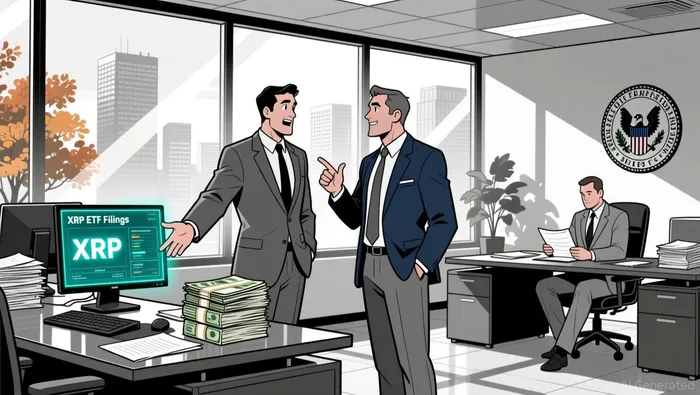
The SEC's reduced operational capacity has inadvertently created a procedural window for XRP ETFs to bypass traditional regulatory hurdles. According to a Trading News report, S-1 filings for spot XRP ETFs can now become effective automatically after 20 days if no objections are raised by the SEC. This has prompted major asset managers like Canary Capital, Grayscale, and Franklin Templeton to remove delay clauses from their filings, with Canary Capital targeting a November 13, 2025, launch date, as Coinpaper reported. These moves signal growing confidence in the token's regulatory status, even as the SEC vs. Ripple lawsuit remains unresolved, as noted by Coinotag.
The SEC's inaction has also aligned with recent court rulings favoring XRP, which have clarified its non-security classification in certain contexts, as the Trading News report observed. This legal clarity is critical for institutional investors, who are now more willing to allocate capital to XRP-based products. Ripple's strategic acquisition of Hidden Road Partners and the launch of Ripple Prime further underscore its commitment to institutional liquidity, enabling banks and asset managers to trade XRP alongside traditional assets, according to the same Trading News coverage.
Market Sentiment and Institutional Adoption
Institutional demand for XRP is surging, driven by both ETF momentum and real-world use cases. As stated by CryptoFront News, the tokenization of real-world assets (RWAs) on the XRP Ledger has reached a cumulative market capitalization of $364.2 million by September 30, 2025-a 215% increase from the prior year. This growth, particularly in tokenized U.S. Treasury bills (T-Bills), highlights XRP's expanding role in decentralized finance (DeFi) and cross-border payments.
Analysts project that XRP ETFs like NASDAQ: XRPIXRPI-- and BATS: XRPRXRPR-- could see price recovery toward $20–$22 by early 2025, with potential expansion to $25–$30 by 2026 once regulatory clarity stabilizes, according to Trading News. Ripple's ecosystem is also gaining traction in traditional finance, with institutions leveraging its blockchain for cost-effective, real-time transactions. This adoption is critical for price stability, as it diversifies XRP's utility beyond speculative trading.
Bearish Pressures and the $0 Scenario
Despite these positives, bearish indicators persist. As of late October 2025, XRP trades near $2.48, with technical metrics like the Spent Output Profit Ratio (SOPR) and declining futures open interest (OI) signaling weak retail demand, as reported by the Economic Times. A breakdown below the $2.6051 support level could push the price toward $2.58, with long-term corrections potentially reaching $1.80–$2.20 under macroeconomic pressures or regulatory delays, according to Finbold's forecast.
However, the likelihood of a $0 price scenario remains low. Institutional factors-such as ETF approvals and Ripple's cross-border payment infrastructure-act as a floor for XRP's value. Even in a worst-case scenario, analysts predict a rally to $3.10–$3.20 by year-end if ETFs launch successfully, according to Finbold. This resilience is further reinforced by XRP's role in tokenized RWAs, which provide intrinsic value beyond market volatility.
Conclusion: Balancing Risks and Opportunities
XRP's short-term price stability hinges on the interplay between regulatory momentum and institutional adoption. While bearish technical indicators suggest near-term volatility, the token's fundamentals-driven by ETF launches, RWA tokenization, and cross-border utility-mitigate the risk of a $0 price collapse. Investors should monitor the SEC's response to S-1 filings and the pace of institutional onboarding, as these factors will determine XRP's trajectory in the coming months.







Comentarios
Aún no hay comentarios