
XRP's Short-Term Bullish Momentum vs. Bitcoin: On-Chain and Institutional Insights
The cryptocurrency landscape in 2025 is defined by two distinct narratives: Bitcoin's entrenched dominance as a digital store of value and XRP's rapid institutional adoption as a utility-driven asset. While BitcoinBTC-- continues to benefit from regulatory clarity and ETF-driven inflows, XRP's on-chain dynamics and treasury-driven demand suggest a compelling short-term bullish case. This analysis examines the interplay of these factors to assess which asset holds stronger momentum in the current market cycle.
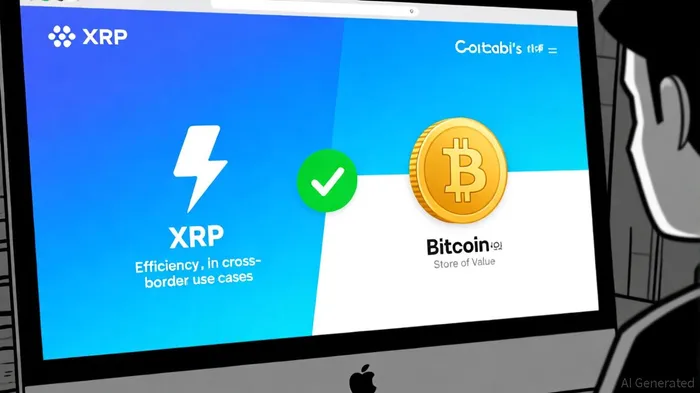
On-Chain Flow Dynamics: Efficiency vs. Entrenchment
XRP's on-chain performance in late 2024 and early 2025 underscored its role as a high-throughput, low-cost solution for financial infrastructure. The XRPXRP-- Ledger (XRPL) processed 167 million transactions in Q4 2024, with 77% attributed to AMM swaps, while decentralized exchange (DEX) volume exceeded $1 billion for the first time, according to a Bitget report. This surge was driven by institutional adoption of Ripple's On-Demand Liquidity (ODL) service, which processed $1.3 trillion in cross-border payments, according to a Sosovalue analysis. However, recent data reveals a divergence: daily XRP Ledger transactions fell by 37.06%, and new wallet creation dropped by 40.28% in early 2025, according to a Currency Analytics report. This suggests that while trading volume remains robust, organic usage of the XRPL may be plateauing.
Bitcoin, by contrast, maintains a slower but more stable on-chain profile. Its 7 TPS and 10-minute block times prioritize security over speed, with network fees fluctuating based on congestion, according to a PowerDrill analysis. Despite this, Bitcoin's transaction volume has surged due to its adoption as a corporate treasury asset. For instance, BlackRock's IBIT ETF alone holds $50 billion in assets under management, reflecting a structural shift in how institutions allocate capital, as noted in the Sosovalue analysis. The U.S. Strategic Bitcoin Reserve, established in March 2025, further institutionalizes Bitcoin's role as a hedge against macroeconomic volatility, a trend covered in the Bitget report.
Treasury-Driven Demand: ETFs and Corporate Allocations
Bitcoin's institutional adoption in 2025 has been nothing short of explosive. Global ETPs and corporations collectively acquired 944,330 BTC in 2025, surpassing the total mined in the same period, as detailed in the PowerDrill analysis. Regulatory milestones, including the approval of spot ETFs and the SEC's dismissal of its case against Ripple, have normalized Bitcoin as a strategic asset. For example, MicroStrategy's 257,000 BTC holdings and the U.S. government's Bitcoin reserve illustrate a broader trend of treating Bitcoin as a "digital gold" equivalent, a dynamic explored in the Sosovalue analysis.
XRP's institutional narrative, however, is rooted in utility. Over $471 million has been allocated to XRP treasuries by firms like VivoPower and Trident Digital Tech Holdings, leveraging the token's speed and low fees for cross-border settlements, as reported in the Bitget report. The SEC's August 2025 ruling, which classified XRP as a digital commodity, catalyzed the launch of ETPs like ProShares Ultra XRP ($1.2 billion AUM) and REX-Osprey XRP ($30 million AUM in three days), noted in the Sosovalue analysis. Additionally, XRP's integration into DeFi protocols-such as Flare Network's $236 million TVL-enables yield generation, further solidifying its appeal, a development covered in the Bitget report.
Short-Term Momentum: A Tale of Two Use Cases
While Bitcoin's long-term value proposition remains intact, XRP's short-term bullish momentum is fueled by its dual role as both a payment rail and a treasury asset. The XRP Ledger's Q4 2024 surge in DEX volume and AMM swaps demonstrated its capacity to scale, even as on-chain metrics dipped in early 2025, as noted in the Currency Analytics report. This discrepancy suggests that XRP's demand is increasingly driven by speculative trading and institutional allocations rather than organic usage.
Bitcoin, meanwhile, benefits from a self-reinforcing cycle: ETF inflows drive price appreciation, which in turn attracts more institutional buyers. The 6.2% of total Bitcoin supply now held by corporations-a 21x increase since 2020-reflects a shift toward treating Bitcoin as a core asset class, an allocation trend highlighted in the Bitget report. However, this entrenchment also exposes Bitcoin to regulatory and macroeconomic risks, such as potential U.S. tax policies on digital assets.
Conclusion: Complementary or Competitive?
XRP and Bitcoin occupy different niches in the crypto ecosystem. Bitcoin's dominance as a store of value is underpinned by regulatory clarity and institutional trust, while XRP's momentum stems from its utility in financial infrastructure and treasury strategies. In the short term, XRP's institutional adoption and regulatory tailwinds position it to outperform Bitcoin in specific use cases, particularly cross-border payments and yield generation. However, Bitcoin's broader market capitalization and role as a macro hedge ensure it remains the cornerstone of institutional portfolios.
For investors, the key lies in balancing exposure to both assets. XRP's efficiency and treasury-driven demand offer high-growth potential, while Bitcoin's stability provides downside protection. As the crypto market matures, the interplay between these two narratives will shape the next phase of institutional adoption.






Comentarios
Aún no hay comentarios