
XRP's Short-Term Breakout and Long-Term Catalysts: Is Now the Time to Buy?
In late 2025, XRPXRP-- finds itself at a critical juncture, balancing bearish technical momentum with a backdrop of transformative macroeconomic catalysts. The asset's price action has been defined by a prolonged consolidation phase, with bulls and bears locked in a tug-of-war around key psychological and technical levels. For investors, the question remains: does the current environment present an opportunity to capitalize on XRP's potential, or is the bearish tide too strong to counteract in the near term?
Technical Momentum: A Bearish Setup with Signs of Exhaustion
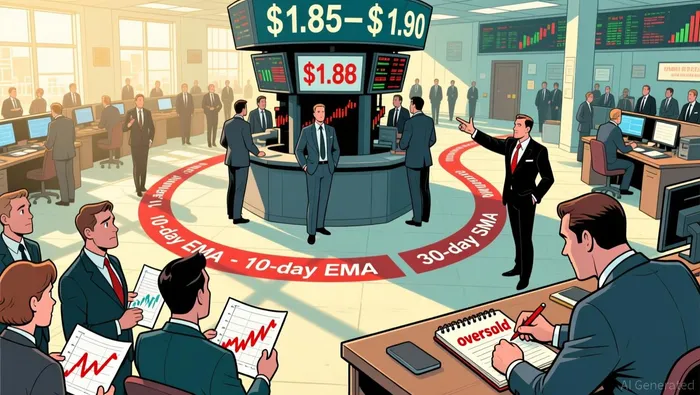
As of December 2025, XRP's price has retreated to approximately $1.84, a stark contrast to its July 2025 peak near $3.66. Technical indicators reinforce a bearish bias, with the Relative Strength Index (RSI) below 50 and the Moving Average Convergence Divergence (MACD) in the bearish zone, signaling accelerating downside momentum. On the hourly chart, XRP trades near the lower Bollinger Band, with RSI in deep oversold territory at 28.59, suggesting short-term exhaustion among sellers.
However, cracks are beginning to form in the bearish narrative. The asset has failed to break below critical support levels, consolidating within a $1.85–$1.90 range. The 10-day EMA at $1.96 acts as dynamic resistance, while the 30-day SMA near $2.06 underscores the bearish bias.
Crucially, 24-hour trading volume has dipped to $3–$4 billion, a decline that may indicate waning selling pressure.
Macro Catalysts: Regulatory Clarity and Institutional Adoption
While technicals paint a cautious picture, macroeconomic developments in 2025 have laid the groundwork for XRP's long-term resurgence. The resolution of the SEC's legal case against Ripple Labs in late 2025 provided much-needed regulatory clarity, enabling U.S. exchange listings and boosting institutional confidence. This shift catalyzed a surge in institutional demand, with XRP ETFs absorbing $1.3 billion in just 50 days by early 2026.
Structural supply-side dynamics further bolster the case for XRP. Exchange-held XRP has plummeted by 45% since 2025, tightening the available float and potentially amplifying price action as demand persists. Meanwhile, the Federal Reserve's anticipated rate cuts in 2026 could reduce the opportunity cost of holding risk assets, providing additional tailwinds for XRP.
Yet, the disconnect between institutional accumulation and retail sentiment remains a wildcard. While institutions have been net buyers at weak price levels, retail traders have offloaded holdings at higher prices, creating a fragmented market dynamic. This divergence raises questions about whether institutional demand alone can propel XRP to $4–$5 by year-end 2026.
Balancing Short-Term and Long-Term Dynamics
The interplay between technical exhaustion and macroeconomic optimism creates a nuanced investment landscape. On one hand, the formation of a death cross-a bearish signal where the 50-day EMA crosses below the 200-day EMA-suggests prolonged bearish momentum could persist. If XRP fails to break above $2.28, further declines toward $1.25 may materialize before stabilization in Q2 2026.
On the other hand, Standard Chartered's bullish projection of $8 by year-end 2026 hinges on sustained ETF inflows and broader institutional adoption. A potential BlackRock XRP ETFXRPI-- filing, mirroring the success of its Bitcoin counterpart, could inject conservative institutional capital into the market, further tightening the supply-demand imbalance.
Risks and Considerations
Investors must remain cognizant of macroeconomic headwinds. A global downturn or Fed policy reversal could cap XRP's upside, confining it to a $1.50–$2.00 range. Additionally, the technical death cross pattern historically signals extended bearish trends, requiring a disciplined approach to risk management.
Conclusion: A Calculated Entry Point?
For risk-tolerant investors, XRP's current price action and macroeconomic tailwinds present a compelling case for cautious optimism. The technical signs of bearish exhaustion, coupled with institutional demand and regulatory tailwinds, suggest a potential inflection point. However, the path to $4–$5 remains contingent on near-perfect execution of macro catalysts and a successful breakout above $2.28.
Now may be the time to buy-but only for those prepared to navigate the volatility and hold through a potential short-term correction. As always, diversification and strict risk management remain paramount in this high-stakes environment.





Comentarios
Aún no hay comentarios