
XRP's Scarcity Premium: How Strategic Supply Dynamics Cement Its Resilience in Volatile Markets
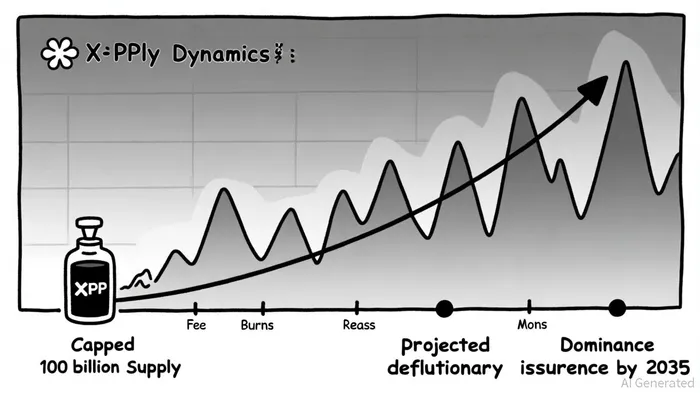
In the ever-shifting landscape of cryptocurrency, XRPXRP-- has emerged as a standout asset, defying conventional volatility patterns and carving a unique path through strategic supply dynamics. As of October 2025, XRP's circulating supply stands at approximately 59.6 billion tokens, with Ripple Labs retaining control over 42% of the total supply through escrow arrangements, according to an XRP supply analysis. This controlled release mechanism-issuing 1 billion tokens monthly while relocking unused amounts-has become a cornerstone of XRP's stability, preventing market saturation while maintaining a delicate balance between supply and demand, as shown in a supply concentration analysis.
Deflationary Mechanics: A Structural Edge
XRP's deflationary design is a critical differentiator. Every transaction on the XRP Ledger permanently burns a small amount of XRP (typically 0.00001 XRP), gradually reducing the total supply, per the XRP burn mechanism. While this burn rate currently lags behind monthly issuance, the long-term trajectory is clear: once Ripple completes its escrow releases by 2035, the burn rate will become the sole driver of supply reduction, as projected in a 2025 price prediction. This structural deflation contrasts sharply with Bitcoin's inflationary block rewards, which persist until 2140, and Ethereum's variable burn rate tied to gas fees. Analysts, including crypto researcher SMQKE, argue that XRP's fixed supply cap and permanent burn mechanism create a scarcity premium that could drive significant price appreciation as adoption scales, as highlighted in a deflationary report.
Regulatory Clarity: A Catalyst for Institutional Adoption
Regulatory developments in 2025 have been transformative. The SEC's August 2025 ruling, which dismissed its case against Ripple and affirmed XRP's non-security status, marked a turning point, according to legal coverage. This clarity spurred the launch of the first U.S. XRP Spot ETF by REX-Osprey, amassing $33.57 million in assets within days, as reported in a spot ETF launch. Institutional confidence has surged, with over $1.1 billion in XRP purchases recorded in 2025 alone, per an Analytics Insight report. Ripple's strategic moves-such as acquiring Hidden Road, a prime broker, and pursuing a national bank charter-have further solidified its infrastructure, enabling seamless integration into traditional finance systems, according to a CoinEdition analysis. Partnerships with Santander, American Express, and BNY Mellon underscore XRP's utility in cross-border payments, where its speed and low cost outperform legacy systems like SWIFT, as detailed in a partnerships overview.
Price Resilience: Outperforming BitcoinBTC-- and Ethereum
XRP's performance during the 2022–2025 market cycles highlights its unique resilience. While Bitcoin and EthereumETH-- faced bearish pressures in early 2025, XRP broke an 8-year descending trendline against Bitcoin, forming bullish patterns like a pennant, as noted in a trendline break. Over three years, XRP delivered a 72.86% return, outpacing Bitcoin and Ethereum's 16.68% and 12.68% respectively, according to a performance comparison. This outperformance is attributed to XRP's dual advantages: a deflationary model that inherently supports scarcity and institutional adoption driven by regulatory clarity. For instance, a $10,000 investment in XRP in September 2024 would have grown to over $40,000 by March 2025, far exceeding returns from Bitcoin and Ethereum, per a ROI analysis.
The Road Ahead: Scarcity, Demand, and Macro Factors
Looking forward, XRP's trajectory hinges on three pillars:
1. Supply Dynamics: As the escrow releases near completion, the deflationary burn rate will dominate, accelerating scarcity. By 2035, XRP's supply could shrink to below 90 billion tokens, with projections suggesting price targets of $10–$36.42 if adoption mirrors Bitcoin's 2021–2024 trajectory, as projected in the 2025 price prediction.
2. Institutional Demand: The pending approval of multiple XRP ETFs by October 18, 2025, could inject up to $5 billion into the asset, driving demand and reducing circulating supply through institutional purchases, per an Elevenews report.
3. Regulatory Momentum: Ripple's national bank charter application and RLUSD stablecoin integration into tokenized funds (e.g., BlackRock's BUIDL) position XRP as a bridge between crypto and traditional finance, as noted by The Financial Analyst.
While risks remain-such as macroeconomic headwinds from Fed policy and potential "sell the news" effects post-ETF approval-the fundamentals are robust. XRP's technical indicators, including a descending wedge pattern, suggest a potential breakout toward $3.61 if key resistance levels are cleared, as outlined in a BeInCrypto preview.
Conclusion
XRP's strategic supply dynamics-combining controlled issuance, deflationary mechanics, and regulatory validation-have positioned it as a resilient asset in volatile markets. Unlike Bitcoin and Ethereum, which rely on external factors like halvings or EIP upgrades, XRP's scarcity is baked into its design. As institutional adoption accelerates and the SEC's stamp of approval gains traction, XRP is poised to transition from a speculative token to a mainstream financial instrument. For investors, the interplay of these forces creates a compelling case for XRP's long-term value, particularly in a world where scarcity and utility increasingly drive asset performance.






Comentarios
Aún no hay comentarios