
XRP's Role in the Emerging Crypto Super Cycle: Strategic Positioning Amid Regulatory Clarity and Institutional Adoption
The cryptocurrency market is on the cusp of a new era, driven by macroeconomic tailwinds, technological innovation, and a critical shift in regulatory clarity. At the heart of this emerging "crypto superSUPER-- cycle" lies XRPXRP--, the digital asset powering Ripple's blockchain network. After years of legal uncertainty, the resolution of the SEC vs. Ripple case in late 2025 has catalyzed a surge in institutional adoption, strategic partnerships, and market confidence. This analysis explores how XRP is uniquely positioned to capitalize on the convergence of regulatory progress and institutional demand, solidifying its role as a cornerstone of the next phase of crypto adoption.
Regulatory Clarity: A Foundation for Growth
The 2025 settlement between Ripple and the SEC marked a watershed moment for XRP and the broader crypto industry. By reducing the penalty to $50 million and dissolving the injunction, the ruling effectively affirmed XRP's status as a digital asset rather than a security in public exchanges. This outcome not only resolved a four-year legal battle but also set a precedent for how regulators might approach similar cases in the future.
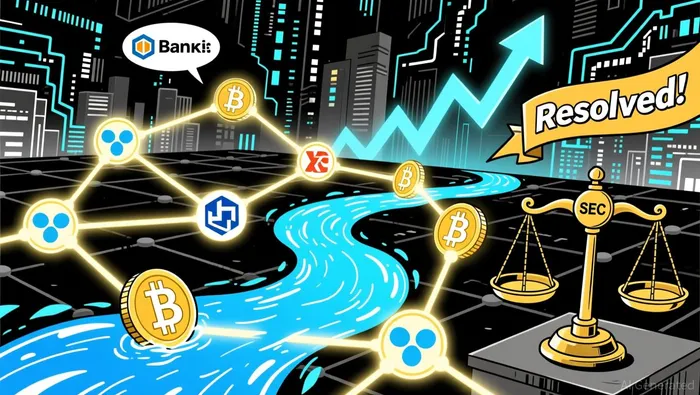
The immediate market impact was profound. XRP's price surged to a seven-year high of $3.65, while U.S. exchanges began relisting the asset, unlocking new liquidity and trading volume. This regulatory clarity also enabled Ripple to expand its financial services offerings, including the launch of RLUSD, a dollar-backed stablecoin that reached a $1.3 billion market cap within a year. The resolution of the SEC case thus transformed XRP from a legal liability into a legitimate asset class, attracting both retail and institutional investors.
Institutional Adoption: From Partnerships to Tokenized Infrastructure
With regulatory hurdles cleared, XRP's institutional adoption has accelerated through strategic partnerships and innovative use cases. Ripple now collaborates with over 300 global financial institutions, including PNC, American Express, and Santander, leveraging XRP for cross-border payment solutions. These partnerships are not merely experimental-they reflect a growing recognition of XRP's efficiency in reducing transaction costs and settlement times compared to traditional systems like SWIFT.
A landmark development in 2025 was Ripple's collaboration with BNY Mellon, a financial giant managing $50 trillion in assets under management (AUM). BNY launched tokenized deposits for institutional clients, with Ripple Prime selected as an early adopter. This partnership underscores XRP's role in enabling a "digital dollar" ecosystem, where institutional funds can be tokenized and traded 24/7. By bridging traditional finance and blockchain, Ripple is positioning XRP as the backbone of a new financial infrastructure.
Institutional demand has also been amplified by the launch of XRP ETFs. These funds accumulated $1.3 billion in assets under management within 50 days of their mid-November 2025 debut, signaling robust confidence from large asset managers like Franklin Templeton. The ETFs' success reflects XRP's growing legitimacy as an institutional asset, particularly in a market where macroeconomic trends-such as inflation hedging and diversification-drive capital flows.
Strategic Positioning in the Crypto Super Cycle
The convergence of regulatory clarity and institutional adoption positions XRP to thrive in the emerging crypto super cycle. Unlike speculative assets, XRP's value proposition is rooted in utility: it solves real-world problems in cross-border payments, stablecoin issuance, and tokenized cash flows. This utility-driven model aligns with the macroeconomic tailwinds of 2025–2026, including a shift toward digital assets for liquidity management and a global push for faster, cheaper financial infrastructure.
Moreover, Ripple's expansion into stablecoins and financial services- bolstered by acquisitions like Hidden Road and GTreasury-has diversified its revenue streams and strengthened its ecosystem. As central banks and financial institutions experiment with CBDCs and tokenized assets, XRP's role as a bridge between traditional and decentralized finance becomes increasingly critical.
Conclusion: A Strong Investment Thesis
XRP's journey from legal uncertainty to institutional adoption exemplifies the transformative potential of crypto in the post-2025 regulatory landscape. The SEC's resolution not only cleared the path for XRP's reintegration into U.S. markets but also validated its utility as a digital asset. With institutional partnerships, ETF-driven demand, and a robust ecosystem, XRP is uniquely positioned to lead the next wave of crypto adoption. For investors, this represents a rare opportunity to participate in an asset with both speculative upside and foundational infrastructure value.
As the crypto super cycle gains momentum, XRP's strategic positioning-anchored by regulatory clarity and institutional trust-makes it a compelling case study in the evolution of digital finance.







Comentarios
Aún no hay comentarios