
XRP's Road to Relevance: Analyzing Market Position and Institutional Adoption in 2025
Regulatory Clarity: A New Foundation for XRP
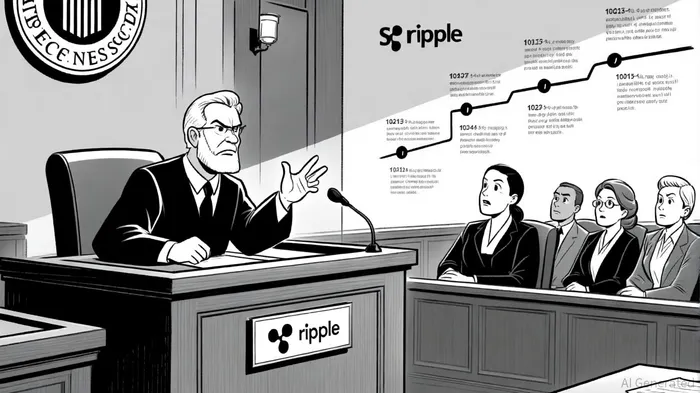
The SEC's ruling was nuanced but transformative. While institutional sales of XRP were deemed unregistered securities, secondary market retail transactions were not, a distinction noted in Coincub's timeline. This distinction allowed Ripple to settle the case with a $125 million civil penalty-a fraction of the original $2 billion demand-and secure a $75 million partial refund after the SEC dropped its appeal, according to a FinancialContent report. The outcome created a legal framework that distinguishes XRP's use cases, enabling exchanges to relist the token and institutional players to engage without fear of regulatory reprisal.
This clarity has already triggered a bullish shift in market sentiment. XRP's price surged above $3.29 immediately following the ruling, reported by Brave New Coin, and the token now enjoys a unique position as the only major cryptocurrency with a court-sanctioned regulatory definition. For the broader crypto industry, the case offers a roadmap: tokens can avoid securities classification if they operate in secondary markets and avoid direct involvement in fundraising.
Network Utility: From Cross-Border Payments to Institutional Staking
Regulatory clarity alone is not enough to drive long-term value. XRP's resurgence in 2025 is also fueled by its expanding utility in corporate finance and decentralized finance (DeFi). Ripple's On-Demand Liquidity (ODL) service, which uses XRP to facilitate cross-border payments, processed $1.3 trillion in transactions in Q2 2025 alone, serving over 300 financial institutions, as Coincub's timeline documents. This real-world application underscores XRP's role as a bridge between traditional and digital finance, particularly in markets where speed and cost efficiency matter most.
Meanwhile, the Flare Network's FXRP framework has unlocked new avenues for value generation. By enabling staking and lending, Flare has attracted $236 million in Total Value Locked (TVL), creating a decentralized ecosystem that complements XRP's core use cases, according to the Coincub timeline. Institutional investors are taking notice: firms like VivoPower International and Trident Digital Tech are leveraging XRP for yield generation, treating it as a strategic treasury asset, as noted by Coincub.
Institutional Adoption: The Next Catalyst
The most significant development in 2025 has been XRP's institutional adoption. Ripple's RLUSD stablecoin, custodied by BNY Mellon, has integrated XRP into platforms like AaveAAVE-- Horizon, enabling seamless transitions between traditional and digital assets; this integration was reported in the FinancialContent article. This synergy is further amplified by Evernorth Holdings Inc., a Ripple-backed firm planning a $1 billion public XRP treasury and a Nasdaq listing, which the FinancialContent article also describes. Such moves signal a shift from retail speculation to institutional-grade infrastructure, with XRP positioned as a cornerstone of tokenized finance.
Ripple's 2025 blueprint, as outlined by CTO David Schwartz, prioritizes institutional foundations. The company is building compliance-ready automated market makers (AMMs), asset tokenization tools, and an EVM-compatible sidechain to facilitate mass adoption, as detailed in an Elevenews piece. These developments are not just technical upgrades-they are strategic moves to align XRP with the needs of institutional investors, who demand robust infrastructure and regulatory safeguards.
Market Outlook: Price Targets and ETF Potential
With regulatory hurdles cleared and institutional demand surging, XRP's price trajectory is gaining momentum. Analysts note that breaking above the $3.65 resistance level could propel the token toward $3.50–$4.00 by year-end 2025, driven by ETF inflows and continued adoption, a projection referenced in Coincub's timeline. The approval of an XRP ETF, now more plausible due to the SEC's ruling, could further accelerate this trend, attracting a new wave of capital from traditional investors.
However, risks remain. While XRP's regulatory clarity is a win, most digital assets still lack definitive legal status. The industry must continue to navigate evolving frameworks, and XRP's success will depend on its ability to maintain its first-mover advantage in institutional adoption.
Conclusion
XRP's road to relevance in 2025 is paved with two critical catalysts: regulatory clarity and network utility. The SEC's ruling has transformed XRP from a legal liability into a digital commodity, while its expanding role in cross-border payments, staking, and institutional treasuries has solidified its value proposition. As Ripple and its ecosystem partners build infrastructure for the next phase of adoption, XRP is no longer just a speculative asset-it is a foundational piece of the crypto-native financial system.






Comentarios
Aún no hay comentarios