
XRP's Resilience Amid Broader Crypto Outflows: A Contrarian Opportunity?
Market Resilience in a Downturn
The third quarter of 2025 was a tale of two crypto markets. U.S. spot Bitcoin ETFs, including BlackRock's IBIT, faced a record $3.79 billion in outflows, with single-day redemptions exceeding $900 million as Bitcoin slumped below $95,000. Meanwhile, XRP closed Q3 at an all-time high of $2.85, a 27% surge from the prior quarter. This resilience was not a fluke. In November alone, XRP rallied 5.24% in 24 hours amid a broader crypto market rebound, buoyed by the launch of U.S.-listed XRP ETFs like Franklin Templeton's XRPZXRPZ--.
The contrast is stark. While Bitcoin ETFs saw a 20% price drop in November-the worst monthly performance since 2022-XRP's market cap held steady at $134 billion, even as the total crypto market cap contracted to $3.18 trillion. This suggests XRP's appeal is decoupling from the traditional crypto narrative, driven instead by institutional adoption and regulatory clarity.
Institutional Adoption and Network Utility
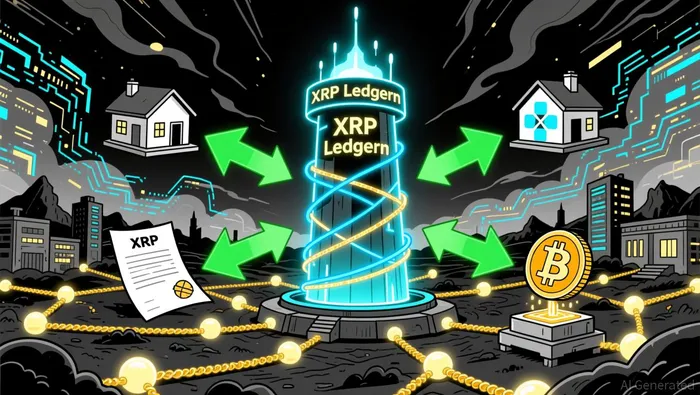 XRP's growth is underpinned by real-world utility. The XRP Ledger (XRPL) processed 1.8 million daily transactions in Q3 2025, a 9% increase, while new wallet addresses grew by 46% to 447,000. Ripple's ecosystem expanded through innovations like RLUSD, a USD-pegged stablecoin whose market cap surged 34.7% to $88.8 million. Meanwhile, real-world asset (RWA) tokenization on XRPL exploded by 215% to $364.2 million, with tokenized treasuries and real estate leading the charge.
Institutional confidence is also rising. Major corporations like Evernorth and Trident Digital have deepened their XRP exposure, while Franklin Templeton's XRP ETF (XRPZ) added a regulated layer to institutional access. These developments align with XRPL's technical upgrades, including multipurpose tokens and zero-knowledge proofs for privacy, which position it as a scalable infrastructure for global finance.
Regulatory Tailwinds and ETF Momentum
Regulatory clarity has been a game-changer. XRP's listing on derivatives exchanges like Coinbase and CME in early 2025 laid the groundwork for potential U.S. spot ETF approval by year-end 2025. This momentum is already materializing: Canary Capital's XRP ETF outperformed all new ETFs in 2025, while Bitwise and Franklin Templeton's funds attracted $422 million in combined inflows.
The ETF tailwinds contrast sharply with Bitcoin's struggles. While BlackRock's IBIT faced a $523 million single-day outflow in November, XRP ETFs drew capital from institutional investors seeking alternatives to Bitcoin's bearish trajectory. This shift reflects a broader reallocation toward assets with tangible use cases and regulatory alignment-a niche XRP is filling.
Contrarian Allocation in a Bearish Market
The case for XRP as a contrarian play hinges on its ability to thrive amid broader outflows. While the crypto market shed $230 billion in value during Q3 2025, XRP's market cap expanded by $47 billion. This divergence is not just a function of price but of fundamentals: XRP's ecosystem is growing in transaction volume, institutional adoption, and RWA innovation.
Critics may argue that XRP's gains are speculative, but the data tells a different story. The XRP Ledger's 46% increase in new wallet addresses and the 215% surge in RWA tokenization suggest a maturing ecosystem. Moreover, the Abu Dhabi Investment Council's tripling of its Bitcoin ETF stake in Q3 2025 highlights the fragility of Bitcoin's institutional base-a vulnerability XRP appears to avoid.
Conclusion
XRP's performance in Q3 2025 is a masterclass in contrarian investing. While the crypto market grappled with outflows and regulatory uncertainty, XRP leveraged institutional adoption, regulatory progress, and real-world utility to outperform. For investors seeking exposure to a crypto asset that is both resilient and innovative, XRP offers a compelling case. As the U.S. regulatory landscape clarifies and RWA adoption accelerates, XRP's position as a bridge between traditional finance and blockchain could become its most valuable asset.





Comentarios
Aún no hay comentarios