
XRP's Resilience in a Bearish Crypto Market: A Strategic Diversification Tool for 2026 Portfolios
The 2025 bear market tested the mettle of crypto assets, exposing stark contrasts in price resilience and volatility. While BitcoinBTC-- and EthereumETH-- faced significant headwinds, XRPXRP-- emerged as an intriguing case study. Despite its higher volatility- realized at 80% over the past 365 days compared to Bitcoin's 43% and Ethereum's 77%-XRP demonstrated a unique ability to absorb institutional capital and regulatory clarity, positioning it as a potential diversification tool in digital portfolios. This analysis explores how XRP's evolving institutional narrative, regulatory tailwinds, and weaker correlations with Bitcoin and Ethereum make it a strategic asset for risk management in 2026.
Price Resilience Amid Volatility
XRP's price trajectory in 2025 was marked by sharp swings, yet it outperformed Bitcoin and Ethereum in certain bearish scenarios. For instance, during late 2025's macroeconomic turbulence, XRP declined by 2.7% compared to Bitcoin's 3.1% and Ethereum's 6.8% drop. This relative stability, though modest, highlights XRP's potential to act as a buffer in diversified crypto portfolios. The U.S. SEC's 2025 settlement, which cleared legal uncertainties around XRP, further bolstered institutional confidence, enabling ETF inflows of $1.3 billion since their November 2025 launch. These inflows, however, were not matched by robust on-chain activity, creating a divergence between market sentiment and network fundamentals.
On-Chain Activity and Institutional Adoption
While XRP ETFs absorbed $483 million in December 2025 alone, on-chain metrics tell a mixed story. Exchange-held XRP balances fell by 57%, signaling reduced immediate sell-side pressure. However, the XRP Ledger's Total Value Locked (TVL) remained stagnant at $72.76 million, and decentralized exchange (DEX) volumes declined sharply. This disconnect underscores XRP's growing reliance on derivatives and ETFs, where open interest reached $4.5 billion and futures volumes exceeded $13 billion.
Institutional adoption, meanwhile, has been a bright spot. Ripple's expansion into the UK and Japan-where it partnered with financial institutions to build cross-border payment infrastructure-signals a shift toward on-chain utility. The company's stablecoin, Ripple USD (RLUSD), further cements its role in global financial ecosystems. Regulatory progress, including the EU's MiCA and the U.S. GENIUS Act, has also created a more favorable environment for institutional participation.
Diversification Through Weaker Correlations
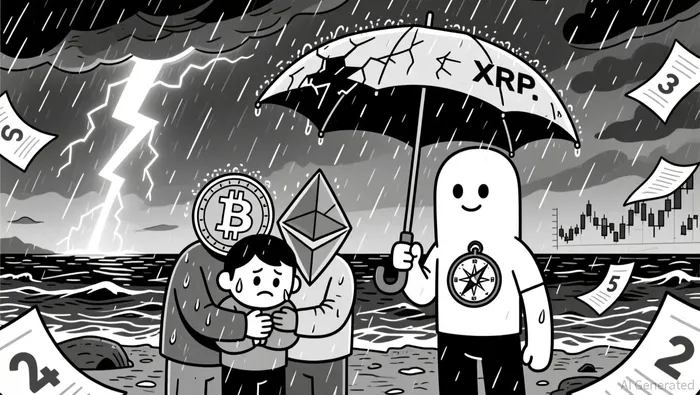
A critical argument for XRP lies in its weaker correlations with Bitcoin and Ethereum. During the 2025 bear market, XRP's price movements diverged from Bitcoin's, particularly during macroeconomic-driven sell-offs. For example, while Bitcoin ETFs saw $457 million in daily inflows during late 2025, XRP's price dipped due to profit-taking and outflows. This decoupling suggests XRP could serve as a hedge in portfolios where Bitcoin and Ethereum dominate.
Data from 2025 shows that XRP attracted 500% more inflows than Bitcoin, which saw a 35% decline in institutional interest. This shift reflects a maturing market where investors are allocating capital to mid-cap assets like XRP and SolanaSOL--, which offer exposure to innovation without full exposure to Bitcoin's volatility. Analysts recommend a 40–60% allocation to Bitcoin and Ethereum, 25–35% to mid-cap altcoins like XRP, and 10–20% to emerging projects, with stablecoins acting as a liquidity buffer.
Risks and Structural Challenges
XRP's long-term success hinges on converting institutional demand into on-chain utility. Its large supply, weak fee capture, and reliance on external markets for stablecoin liquidity remain risks. Additionally, macroeconomic factors-such as Federal Reserve rate cuts-will influence risk-on environments in 2026. If leveraged correctly, however, XRP's regulatory clarity and infrastructure-driven use cases could mitigate these challenges.
Conclusion
In a crypto market increasingly defined by structured diversification, XRP's unique position as a high-volatility, low-correlation asset offers strategic value. While its on-chain metrics lag behind its institutional narrative, regulatory progress and global adoption efforts provide a foundation for long-term resilience. For investors seeking to hedge against broader crypto volatility, XRP's 2025 performance and 2026 potential make it a compelling addition to diversified portfolios-provided macroeconomic and on-chain dynamics align.






Comentarios
Aún no hay comentarios