
XRP's Relative Resilience Amid Post-Liquidation Crypto Volatility
The cryptocurrency market in Q3 2025 experienced a wave of volatility, with liquidation events reshaping risk profiles across major assets. Amid this turbulence, XRPXRP-- demonstrated a unique trajectory, recovering faster than BitcoinBTC-- and EthereumETH-- despite facing significant short-position liquidations. This analysis explores XRP's strategic positioning for short-term recovery, focusing on institutional-driven demand, regulatory clarity, and leveraged trading dynamics in a market environment characterized by liquidity constraints and shifting capital flows.
Post-Liquidation Performance: XRP vs. BTC and ETH
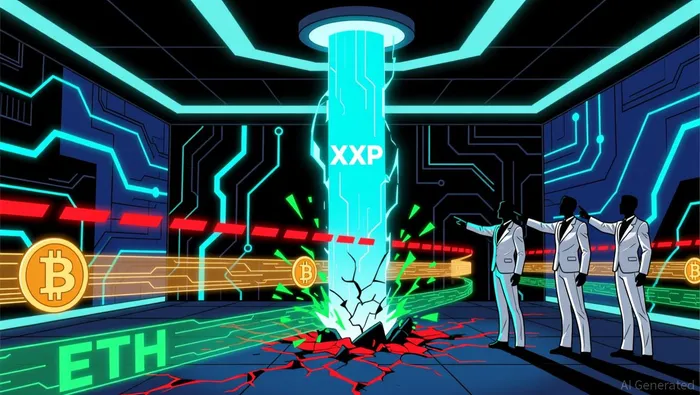
In Q3 2025, XRP endured $13.54 million in 24-hour liquidations, with short positions accounting for $8.66 million of the total according to analysis. This contrasts with Bitcoin and Ethereum, where liquidations were more evenly split between long and short positions during similar volatility spikes. Notably, XRP's price rebounded above $2.08 post-liquidation, signaling early buying pressure as bulls regained control. In contrast, Bitcoin stabilized above $87,000 after a 20% drop to $80,600, while Ethereum rebounded from a critical support cluster near $2,749 but remained below key overhead levels according to analysis. These divergent recoveries highlight XRP's ability to absorb short-term shocks more effectively, potentially due to its unique market structure and institutional tailwinds.
Institutional Tailwinds: ETFs and Regulatory Clarity
A critical factor in XRP's resilience was the introduction of institutional XRP ETFs in Q3 2025, which began draining OTC reserves and creating liquidity imbalances. These products, including Grayscale's GXRP and Bitwise's offerings, provided institutional access under a more transparent regulatory framework under SEC Chair Gary Gensler. While Bitcoin and Ethereum also attracted ETF inflows, XRP's smaller market size amplified the impact of ETF-driven demand, creating a "rarity premium" as liquidity constraints persisted.
Institutional activity further underscored XRP's appeal: CoinShares reported $89.3 million in XRP inflows during the quarter, contrasting with Bitcoin's $151.08 million in outflows and Ethereum's $96.67 million in inflows. This reallocation of capital was fueled by Ripple's improved legal standing and XRP's cross-border utility, which positioned it as a "regulatory safe haven" amid broader market uncertainty. For instance, XRP ETFs recorded $21.81 million in inflows on November 27, contributing to an 8.6% price surge to $2.20.
Leveraged Trading and Market Structure
XRP's leveraged trading environment also distinguished it from Bitcoin and Ethereum. While all three assets faced sharp liquidation events, XRP's futures and derivatives markets saw surging open interest and trading volume, signaling growing institutional and retail participation. This surge was partly driven by XRP's smaller market size, which allowed leveraged positions to exert outsized influence on price action. For example, FeFe's model projected that $10 billion in ETF inflows could push XRP to $47, though skeptics cautioned that broader market weakness-Bitcoin's 25% decline since October and $1 trillion in total crypto market value wiped out-remained a headwind according to analysis.
Strategic Positioning for Short-Term Recovery
XRP's post-liquidation resilience suggests a strategic advantage in a leveraged market environment. Its institutional adoption, regulatory progress, and liquidity dynamics create a self-reinforcing cycle: ETF inflows drain OTC reserves, amplifying price sensitivity to demand shifts, while leveraged traders capitalize on volatility to drive further momentum. This dynamic contrasts with Bitcoin and Ethereum, where larger market sizes and more mature infrastructure dilute the impact of individual capital flows.
For investors, XRP's positioning offers both opportunities and risks. The asset's susceptibility to liquidity constraints could accelerate short-term gains but also exacerbate drawdowns during renewed volatility. However, its regulatory clarity and cross-border utility provide a durable foundation for long-term value, even as leveraged traders navigate the immediate aftermath of Q3's liquidation-driven chaos.
Conclusion
XRP's relative resilience in Q3 2025 underscores its strategic positioning as a leveraged market darling. While Bitcoin and Ethereum grappled with broader outflows and uneven recovery, XRP's institutional adoption and regulatory tailwinds enabled a faster rebound. For short-term investors, the asset's liquidity dynamics and ETF-driven demand present a high-risk, high-reward proposition. However, its long-term success will depend on sustaining institutional interest and navigating the broader crypto market's structural challenges.






Comentarios
Aún no hay comentarios