
XRP's Regulatory Uncertainty and Strategic Position in 2025: A Framework for Preemptive Risk Management and Long-Term Value Retention
The year 2025 marks a pivotal inflection pointIPCX-- for XRPXRP--, driven by the U.S. Securities and Exchange Commission's (SEC) landmark settlement with Ripple, which reclassified XRP as a commodity[1]. This resolution, after a five-year legal battle, has not only eliminated a critical overhang for institutional investors but also redefined XRP's role in the global financial ecosystem. However, the path to long-term value retention remains contingent on navigating residual risks and leveraging strategic advantages that distinguish XRP from its peers.
Regulatory Clarity: A Catalyst for Institutional Adoption
The SEC's 2025 ruling removed the “security” label from XRP, a decision that has catalyzed a surge in institutional interest. Ripple's On-Demand Liquidity (ODL) service, which processed $1.3 trillion in cross-border transactions in Q2 2025[1], now operates under a clearer legal framework. This clarity has enabled major banks like BBVABBAR--, SantanderSAN--, and SBI Holdings to integrate XRP into their settlement systems, leveraging its sub-5-second transaction times and $0.0002 fees[1].
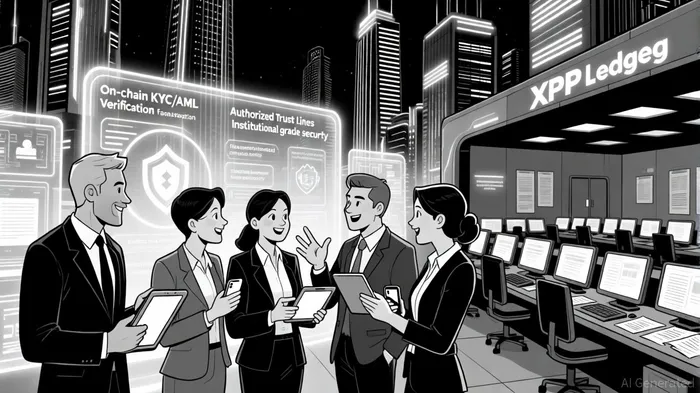
The XRP Ledger's recent activation of the credentials amendment further strengthens its institutional appeal. This update allows for native KYC and AML compliance verification on-chain, reducing the friction traditionally associated with regulatory checks[3]. For investors, this innovation signals a shift toward blockchain solutions that align with global compliance standards, such as ISO/IEC 27001 and SOC 2[1].
Strategic Positioning: XRP vs. BitcoinBTC-- and Ethereum
While Bitcoin's dominance as “digital gold” and Ethereum's smart contract ecosystem remain formidable, XRP's value proposition is rooted in real-world utility. Unlike Bitcoin's energy-intensive Proof-of-Work model or Ethereum's gas-driven transaction costs, XRP's consensus mechanism prioritizes scalability and cost efficiency. For instance, XRP's $0.0002 fee and 3–5-second settlement times outperform traditional systems like SWIFT, which can take days and cost hundreds of dollars[1].
Ethereum's DeFi integration and tokenized asset infrastructure offer broader programmability, but XRP's focus on cross-border payments and tokenized real estate settlements[1] positions it as a specialized solution for institutional clients. Ripple's controlled supply strategy—releasing XRP through escrow accounts—also provides supply predictability, mitigating inflationary risks compared to Bitcoin's fixed supply or Ethereum's variable issuance model[3].
Residual Risks and Preemptive Mitigation
Despite regulatory clarity, XRP faces three key risks:
1. Macroeconomic Volatility: A global recession or tightening monetary policy could dampen demand for risk assets, including XRP.
2. Competition from Emerging Chains: Blockchains like SolanaSOL-- and Ethereum's Layer 2 solutions may erode XRP's cross-border payment market share.
3. Geopolitical Shifts: Regulatory changes in non-U.S. jurisdictions (e.g., the EU's MiCA framework) could reintroduce compliance complexities[2].
Investors should prioritize diversification and liquidity management to mitigate these risks. For example, allocating a portion of crypto portfolios to XRP's utility-driven use cases (e.g., tokenized real estate) can hedge against speculative volatility. Additionally, monitoring Ripple's partnership pipeline—such as its MiCA-compliant collaboration with BBVA[2]—offers early signals of institutional adoption trends.
Conclusion: A Case for Strategic Allocation
XRP's 2025 trajectory underscores its evolution from a regulatory liability to a compliance-ready asset. With over 11 spot XRP ETFs under review and a projected $5–$8 billion in institutional inflows by year-end[1], the token's market capitalization of $178 billion (as of late August 2025[3]) reflects growing confidence. However, long-term value retention hinges on maintaining XRP's edge in cross-border utility and compliance innovation.
For investors, the key takeaway is clear: XRP's strategic advantages in regulatory alignment and institutional adoption make it a compelling addition to a diversified crypto portfolio—provided risks are proactively managed through continuous due diligence and adaptive allocation strategies.





Comentarios
Aún no hay comentarios