
XRP's Regulatory Uncertainty and Its Implications for Long-Term Holders
The resolution of the U.S. Securities and Exchange Commission (SEC) vs. Ripple lawsuit in August 2025 marked a watershed moment for XRPXRP--, eliminating a decade-long regulatory overhang and reshaping the token's risk profile for long-term holders. According to a report by CoinPaper, the settlement-reducing Ripple's penalty to $50 million and lifting the injunction on institutional XRP sales-provided clarity that had been absent since the 2020 lawsuit initiation[1]. This development not only validated XRP's non-security status under U.S. law but also signaled a shift in regulatory attitudes toward digital assets, offering a blueprint for future enforcement actions[3].
Regulatory Clarity and Market Reactions
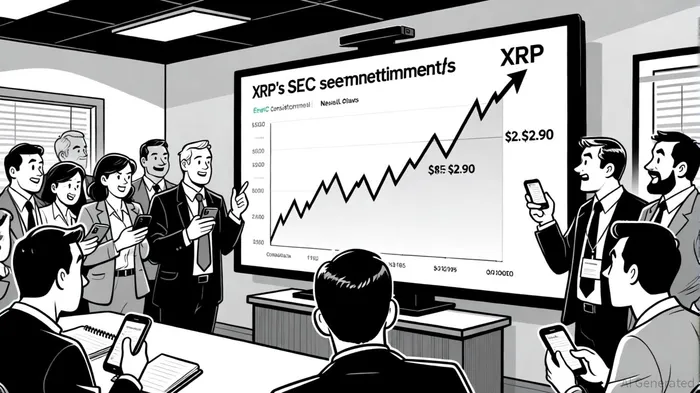
The immediate market response was robust. XRP surged over 10% in the days following the settlement, reaching $3.30, with institutional trading volume spiking by 208%[4]. However, this optimism was tempered by profit-taking, causing the price to consolidate between $3.15 and $3.20[2]. Analysts at Financemagnates noted that technical indicators pointed to critical support at $3.10–$3.20 and resistance at $3.35–$3.40, with a sustained breakout potentially driving the price toward $4.00 or higher[5]. The settlement also spurred speculation about spot XRP ETF approvals, with some experts forecasting a price target of $5–$10 if institutional adoption accelerates[5].
Yet, the post-settlement environment is not without risks. Whale activity, including daily sales of up to $50 million in XRP, has introduced volatility[1]. While accumulation by medium-sized wallets has partially offset this pressure, the token's price remains sensitive to macroeconomic shifts. For instance, rising inflation or a "risk-off" market sentiment-triggered by events like unexpected CPI data-could dampen investor appetite for volatile assets like XRP[6].
Strategic Risks for Long-Term Holders
Despite regulatory clarity, XRP faces structural challenges that could undermine its long-term resilience. First, competition in cross-border payments remains fierce. Stablecoins like USDCUSDC-- and emerging central bank digital currencies (CBDCs) are encroaching on XRP's core use case, offering similar speed and cost advantages without the token's price volatility[7]. Ripple's RLUSD stablecoin, launched in early 2025, aims to address this by providing a bridge between XRP's utility and fiat-backed stability[6], but its adoption remains unproven.
Second, technical limitations persist. The XRP Ledger's automated market maker (AMM) has faced execution risks, including liquidity bottlenecks during high-volume periods[1]. While Ripple has prioritized infrastructure upgrades, these issues could delay broader institutional adoption.
Third, regulatory tail risks linger. Although the SEC's settlement resolved the immediate dispute, future legislative changes-such as stricter crypto advertising rules or tax reporting requirements-could reintroduce uncertainty[7]. For example, the approval of XRP ETFs, while bullish for demand, hinges on ongoing SEC scrutiny of spot crypto products[4].
Macroeconomic and Institutional Dynamics
XRP's trajectory is also intertwined with broader macroeconomic trends. Tight monetary policies, particularly in the U.S., have historically reduced liquidity in risk assets, including cryptocurrencies[6]. However, XRP's real-world utility in RippleNet-facilitating remittances in emerging markets-provides a stable demand floor[3]. This is further reinforced by growing institutional interest, with asset managers exploring XRP-based exchange-traded funds (ETFs) and exchange-traded products (ETPs)[1].
Conclusion: Balancing Opportunity and Caution
For long-term holders, XRP presents a compelling but nuanced case. The SEC settlement has transformed the token from a regulatory pariah to a mainstream asset, with institutional adoption and ETF speculation offering significant upside potential. However, strategic risks-including competition, technical fragility, and macroeconomic headwinds-demand careful monitoring. Investors should prioritize diversification, hedging against volatility while capitalizing on XRP's role in cross-border payments and tokenized assets. As Forbes noted, XRP's price could reach $5–$7 by 2030 under conservative scenarios, but achieving more aggressive targets like $10 will require sustained innovation and regulatory tailwinds[7].
In the end, XRP's post-settlement journey is a testament to the evolving interplay between regulation, technology, and market forces-a dynamic that will define its long-term resilience.







Comentarios
Aún no hay comentarios