
XRP's Regulatory Rebound and Long-Term Value Catalysts
The cryptocurrency market has long been a theater of regulatory uncertainty, but 2025 marked a pivotal turning point for XRPXRP--. After a four-year legal battle with the U.S. Securities and Exchange Commission (SEC), Ripple Labs secured a landmark settlement in May 2025, resolving the case with a $50 million civil penalty-a sharp reduction from the initial $125 million demand. This outcome, coupled with the Trump administration's pro-crypto regulatory shift, has redefined XRP's trajectory, unlocking institutional adoption and market re-rating potential. For investors, the question now is whether XRP can sustain its newfound momentum in a post-Gensler crypto environment.
Regulatory Clarity: A Catalyst for Re-Rating
The SEC's 2025 settlement with Ripple was more than a legal victory-it was a regulatory reset. Judge Analisa Torres' 2023 ruling had already hinted at a nuanced approach, distinguishing between public XRP exchanges (deemed non-securities) and institutional sales (classified as violations). The final settlement, however, erased lingering ambiguity, with Ripple's CEO Brad Garlinghouse declaring it a "resounding victory" and a concession by the SEC.
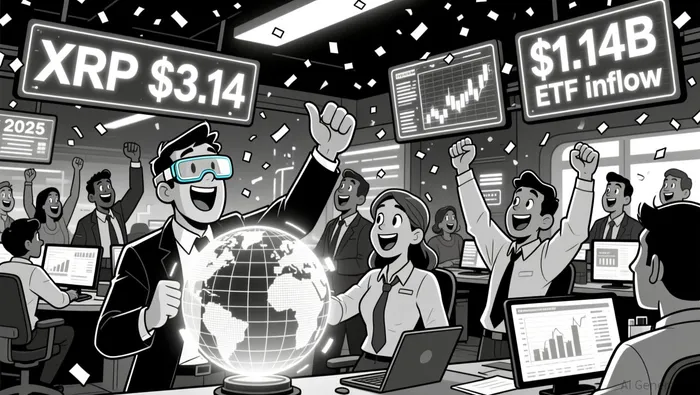
This clarity immediately reshaped XRP's market dynamics. By late 2025, the token surged above $3, driven by renewed institutional interest and the launch of seven spot XRP ETFs that attracted $1.14 billion in assets within six weeks. The ETFs, combined with the SEC's withdrawal of appeals, removed a critical barrier for institutional players, who now could engage with XRP without fear of regulatory reprisal. As one analyst noted, "The settlement didn't just resolve a lawsuit-it created a framework for XRP to be treated as a commodity, not a security."
Institutional Adoption: From Prime Brokerage to Stablecoin Utility
Ripple's strategic moves post-settlement have further solidified XRP's value proposition. The acquisition of Hidden Road, rebranded as Ripple Prime, positioned the firm as the first crypto-native global prime brokerage, tripling its institutional activity. This expansion into traditional finance infrastructure underscores XRP's role as a bridge between decentralized and centralized systems.
Meanwhile, Ripple's RLUSD stablecoin has added real-world utility. Backed by the U.S. dollar and integrated into cross-border payment networks, RLUSD leverages XRP's speed and low cost to compete with legacy systems like SWIFT. For institutional investors, this means XRP is no longer just a speculative asset-it's a functional tool for global transactions.
Market Realities: Headwinds and Optimism
Despite these positives, XRP faced a 13% price decline in 2025, driven by macroeconomic headwinds, profit-taking post-SEC resolution, and competition from faster blockchains. Yet, the token outperformed BitcoinBTC-- and EthereumETH-- during this period, suggesting underlying resilience. Analysts project a base-case price range of $3.00–$5.00 by 2026, contingent on sustained ETF inflows and macroeconomic stability.
The key risk lies in regulatory consistency. While the Trump-era SEC has taken a hands-off approach, future administrations could reintroduce scrutiny. However, Ripple's legal victory has set a precedent: XRP's classification as a non-security in public markets creates a durable floor for its value.
Conclusion: A Post-Gensler Re-Rating Play
XRP's 2025 re-rating is a case study in regulatory risk mitigation and institutional adoption. The SEC settlement, ETF launches, and strategic expansions have transformed XRP from a legal liability into a foundational asset for cross-border finance. For investors, the token now represents a hybrid opportunity-part speculative play on crypto's future, part utility-driven infrastructure play.
As the crypto market matures, XRP's ability to balance regulatory compliance with technological innovation will determine its long-term success. But one thing is clear: the post-Gensler era has already begun, and XRP is no longer just a token-it's a test case for how crypto assets can coexist with traditional finance.






Comentarios
Aún no hay comentarios