
XRP's Regulatory Crossroads: Flash Crashes and the Legal Defense of Market Integrity
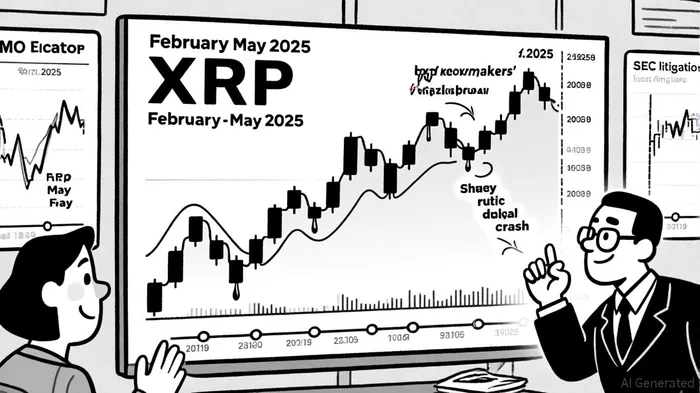
The XRPXRP-- market has become a case study in the intersection of regulatory uncertainty and liquidity fragility. Recent flash crashes-most notably a 40% plunge in February 2025 and a 22% drop in May-have intensified debates about whether XRP's volatility stems from structural market flaws or legal ambiguity. Pro-XRP counsel, however, argues that these events reflect broader crypto market dynamics rather than inherent flaws in XRP itself. Their defense hinges on two pillars: the distinction between primary and secondary market regulation and the assertion that institutional adoption will ultimately stabilize XRP's trajectory.
The February 2025 Flash Crash: Liquidity, NotNOT-- Manipulation
The February 2025 crash, which saw XRP lose over 40% of its value in hours, was attributed to a "lack of buy-side liquidity" as market makers withdrew bids, leaving the order book "essentially empty," according to a TimeStabloid analysis. Critics speculated about coordinated manipulation, but Pro-XRP lawyer Fred Rispoli countered that such volatility is common in crypto assets with low trading volumes. "This wasn't a unique event to XRP," he stated, pointing to similar crashes in other tokens during periods of macroeconomic stress, according to Finbold. Rispoli emphasized that secondary market liquidity is a function of broader market conditions, not XRP's legal status.
May 2025: Legal Uncertainty and the Ripple-SEC Saga
The May 2025 crash followed Judge Analisa Torres' denial of Ripple and the SEC's proposed settlement, reigniting fears of prolonged litigation according to a LiveBitcoinNews report. XRP's price fell 22% in a single day, with analysts linking the drop to investor anxiety over potential restrictions on XRP's use. Yet Pro-XRP counsel John Deaton argued that the ruling had no material impact on secondary markets. "The SEC's case is about primary sales, not the trading of XRP," he wrote in a Coingape article, noting that the denial merely delayed resolution rather than creating new legal barriers. Deaton also highlighted that the ruling could expedite clarity, as the court's rejection of a settlement might force a trial that could either validate XRP's utility or establish clearer regulatory guardrails.
The Legal Argument: Why Flash Crashes Don't Signal Systemic Risk
Pro-XRP lawyers frame flash crashes as symptoms of market immaturity rather than evidence of XRP's fundamental instability. Rispoli pointed to the absence of a regulated ETF as a key factor in XRP's volatility, arguing that institutional adoption-once an ETF is approved-would inject stability (as he told Finbold earlier). This aligns with broader trends in crypto, where ETF approvals for BitcoinBTC-- and EthereumETH-- have historically reduced price swings by attracting long-term capital.
Moreover, Deaton stressed that the SEC's focus on Ripple's primary sales of XRP does not negate the token's utility in cross-border payments or its role in decentralized finance (DeFi) ecosystems (as he wrote in Coingape). "The legal battle is a narrow dispute, not a death sentence for XRP's market integrity," he asserted, citing growing institutional interest in XRP-based payment solutions as a counterweight to short-term volatility.
Investor Implications: Navigating the Regulatory Maze
For investors, the key challenge lies in balancing the risks of regulatory overreach with the potential rewards of early adoption. Pro-XRP counsel acknowledges the pain of recent crashes but insists that the long-term outlook remains intact. "Every major asset class has had its share of flash crashes," Deaton wrote, "but XRP's underlying use cases are still in their infancy" (as noted in his Coingape piece).
However, skeptics warn that the lack of a clear regulatory framework leaves XRP vulnerable to sudden shifts in policy. For instance, a ruling against Ripple could lead to stricter exchange delistings or restrictions on XRP's use in payment networks, compounding liquidity risks.
Conclusion: A Market in Transition
XRP's recent turbulence underscores the broader challenges facing crypto assets as they navigate regulatory scrutiny. While Pro-XRP counsel paints a picture of resilience-citing institutional adoption and the inevitability of an ETF-investors must weigh these arguments against the reality of a market still prone to extreme volatility. The coming months will test whether XRP can transition from a speculative asset to a stable utility token, or if regulatory headwinds will force a reevaluation of its long-term potential.






Comentarios
Aún no hay comentarios