
XRP's Regulatory Crossroads: Assessing Downside Risks and Hedging Strategies in a Shifting Landscape
XRP's Regulatory Crossroads: Assessing Downside Risks and Hedging Strategies in a Shifting Landscape
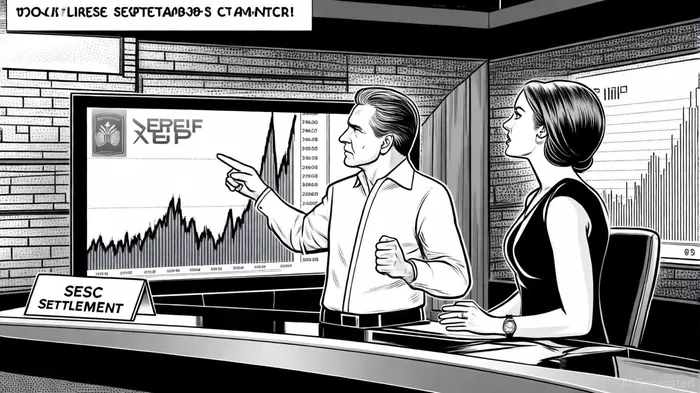
The recent U.S. Securities and Exchange Commission (SEC) settlement with Ripple Labs in September 2025 marked a pivotal moment for XRPXRP--, reclassifying it as a utility token and unlocking institutional participation. However, this regulatory clarity is not a panacea. While the ruling removed a critical legal barrier, XRP remains vulnerable to shifting regulatory priorities, inconsistent enforcement, and market-driven risks tied to its newfound legitimacy. For investors, understanding these vulnerabilities and deploying strategic hedging mechanisms is essential to navigating the token's uncertain trajectory.
Regulatory Clarity and Lingering Uncertainties
The SEC's decision to classify XRP as a utility token for retail transactions, while treating institutional sales as securities, created a fragmented legal framework, according to The Currency Analytics analysis. This duality introduces operational complexity for exchanges and custodians, who must now differentiate between retail and institutional transactions. The Currency Analytics warns this distinction could lead to regulatory arbitrage, where bad actors exploit loopholes to circumvent compliance requirements. Furthermore, the $125 million fine imposed on Ripple for past institutional sales, as detailed in a CryptoNews report, underscores the SEC's willingness to enforce penalties retroactively-a precedent that could extend to other tokens if regulatory standards evolve.
While the settlement resolved the immediate dispute, it did not eliminate the risk of future regulatory overreach. The SEC's updated ETP listing rules, which expedite approvals for spot crypto ETFs, may signal a more innovation-friendly stance, but that shift aligns with the current administration's priorities and could be reversed under different leadership. For instance, the European Union's MiCA framework, which imposes stringent compliance requirements on utility tokens, demonstrates how divergent regulatory approaches can destabilize market confidence, as discussed in a CoinPaper analysis.
Institutional vs. Retail Dynamics: A Double-Edged Sword
The separation of XRP into institutional and retail categories creates asymmetric risks. Institutional investors, now permitted to engage with XRP via ETFs like the REX-Osprey XRP ETF (XRPR), are expected to inject $1–2 billion into the market, according to The Currency Analytics. This influx could stabilize XRP's price and enhance liquidity. Yet, it also ties the token's performance to the volatility of institutional portfolios. If macroeconomic conditions deteriorate or ETF redemptions surge, XRP could face outsized sell-offs.
Conversely, retail investors remain exposed to the token's speculative nature. CoinPaper indicates that retail trading volumes on public exchanges have surged post-settlement, but this activity is often driven by sentiment rather than fundamentals. A regulatory crackdown on retail trading-such as restrictions on leverage or margin requirements-could exacerbate price swings.
ETF-Driven Volatility and Liquidity Risks
The launch of the first U.S. spot XRP ETF and subsequent approvals for products by Grayscale and Bitwise represent a structural shift in XRP's market dynamics. However, ETFs are not immune to systemic risks. For example, the 2022 collapse of TerraUSD highlighted how interconnected crypto assets can amplify contagion effects. If XRP ETFs face redemption pressures or liquidity constraints during a market downturn, the token's price could plummet faster than its underlying fundamentals justify.
Moreover, the SEC's expedited approval process may lead to an oversaturation of XRP ETFs, diluting their individual impact and creating competitive pressures. This scenario could force ETF providers to lower fees, reducing their ability to absorb market shocks-a risk that investors must monitor closely.
Strategic Hedging for XRP Exposure
Given these vulnerabilities, investors should adopt a multi-layered hedging strategy:
- Diversification Across Asset Classes: Allocating a portion of XRP holdings to regulatory-resistant assets (e.g., gold, stablecoins, or equities in blockchain infrastructure firms) can mitigate sector-specific risks.
- Derivative Instruments: Utilizing futures or options contracts to hedge against short-term volatility. For instance, short-dated put options could limit downside exposure during regulatory uncertainty.
- Focus on Real-World Utility: XRP's On-Demand Liquidity (ODL) service and cross-border payment partnerships provide a floor for demand. Investors should prioritize projects that leverage XRP's utility over speculative trading.
- Active Monitoring of Regulatory Signals: Subscribing to real-time updates from the SEC, FinCEN, and international regulators can help anticipate shifts. For example, the EU's MiCA implementation timeline could influence U.S. policy indirectly.
Conclusion
XRP's regulatory journey in 2025 has transformed it from a contested asset to a mainstream financial tool. Yet, the token's dual classification, reliance on ETF-driven liquidity, and exposure to institutional risk factors necessitate a cautious approach. By combining diversification, derivatives, and a focus on utility, investors can navigate XRP's regulatory crossroads while safeguarding against potential reversals. In a market where policy shifts can redefine value overnight, strategic hedging is not just prudent-it is imperative.






Comentarios
Aún no hay comentarios