
XRP's Regulatory Clarity and Institutional Adoption: A Catalyst for 2029 Price Surge
Regulatory Clarity: The Foundation for Institutional Confidence
The dismissal of the SEC's case against Ripple in 2024 marked a watershed moment. By classifying XRP as a utility token rather than a security, courts removed a decade-long overhang, enabling the launch of spot XRP ETFs, according to a Coinotag report. These products, now in the final stages of approval, are expected to inject billions into the market. For instance, Bitwise's XRP ETF, with a 0.34% fee and a NYSE listing, and the ProShares Ultra XRP ETF (UXRP), which attracted $1.2 billion in inflows within its first month, according to a Bitget analysis, demonstrate institutional confidence.
The regulatory clarity also spurred the CME GroupCME-- to introduce XRP options, expanding hedging tools for professional traders, according to a Coinotag report. This infrastructure development, combined with Ripple's strategic partnerships with banks and payment providers in Asia and the Middle East, according to a Coinfomania forecast, has transformed XRP from a speculative asset into a regulated, institutional-ready product.
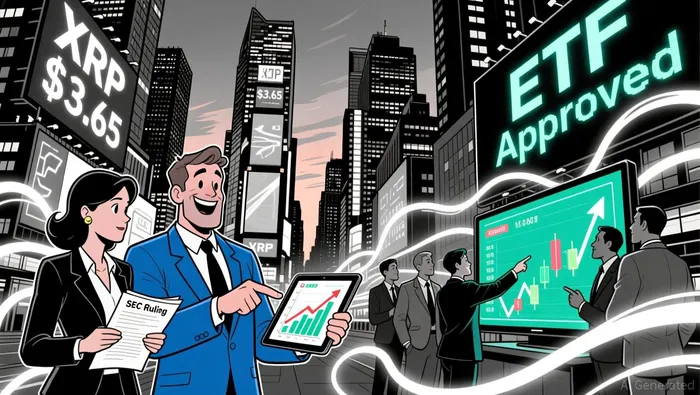
Institutional Adoption: ETFs, Liquidity, and Network Effects
Institutional adoption has accelerated post-2025, with 11 XRP spot ETFs projected to launch by year-end, potentially injecting $4.3–$8.4 billion into the market, according to a Bitget analysis. The REX-Osprey XRP ETF (XRPR) alone surpassed $100 million in assets under management by October 2025, according to a Coinotag report, signaling robust demand for compliant exposure.
Ripple's technical advancements further bolster institutional interest. The XRP Ledger (XRPL) now supports zero-knowledge proofs and onchain credential systems, aligning with compliance requirements for regulated financial players, according to a Bitcoin.com analysis. Additionally, Ripple's USD-pegged stablecoin, RLUSD, has grown to a $88.8 million market cap on the XRPL, enhancing the network's liquidity and utility, according to a Bitcoin.com analysis.
Historical data underscores the correlation between institutional inflows and price performance. In 2025, institutional investors purchased over $1 billion in XRP tokens, according to a Nasdaq article, coinciding with a 29% surge in the asset's circulating market cap to $170.3 billion, according to a Bitcoin.com analysis. Analysts project that continued ETF-driven liquidity could push XRP to $5–$8 by 2026, according to a Coinfomania forecast, with further upside potential by 2029.
Long-Term Projections: Tokenized Assets and the Clarity Act
Looking ahead, XRP's role as a liquidity bridge for tokenized assets could unlock unprecedented value. Finance commentator Zach Rector estimates that $20–30 trillion in real-world assets (RWAs)-including real estate, stocks, and commodities-could migrate to blockchains over the next decade, according to a Coinpedia article. XRP's efficiency in cross-border payments and stablecoin settlements positions it to facilitate these transactions, much like how BitcoinBTC-- and EthereumETH-- underpin DeFi ecosystems.
The proposed Clarity Act in the U.S. could further accelerate adoption by providing a federal framework for digital assets, according to a Coinpedia article. Ripple's partnerships with Mastercard, WebBank, and Gemini, according to a Coinpedia article, are already leveraging the XRPL for tokenized asset settlements, reinforcing XRP's infrastructure role. However, as Rector notes, true demand will hinge on real-world usage, notNOT-- just speculative tokenization, according to a Coinpedia article.
Strategic Investment Timing: When to Enter the XRP Bull Run
For investors, timing is critical. The 2025–2026 period represents a key inflection point, with ETF approvals and regulatory clarity creating a flywheel effect. By 2029, XRP's price could surge on three pillars:
1. ETF-Driven Liquidity: Spot ETFs could attract $10+ billion in institutional capital, according to a FinanceFeeds prediction.
2. Network Utility: RLUSD's expansion and cross-border payment partnerships will drive demand, according to a PMin Insights analysis.
3. Tokenized Asset Growth: XRP's role in bridging traditional and digital finance could see it become a foundational asset, according to a Coinpedia article.
Technical indicators also support a bullish case. A neutral RSI and tightening Bollinger Bands in late 2025 suggested a breakout above key resistance levels, according to a Coinfomania forecast, with analysts projecting $3–$4 by Q4 2025 and $5–$8 by 2026. By 2029, assuming continued adoption and macroeconomic tailwinds, XRP could trade in the $10–$15 range.
Conclusion
XRP's journey from regulatory uncertainty to institutional adoption exemplifies how clarity and infrastructure can transform a digital asset into a mainstream financial product. With ETFs, liquidity enhancements, and tokenized asset growth as catalysts, the asset is uniquely positioned to deliver outsized returns by 2029. For investors, the key is to act before the next wave of institutional inflows and regulatory milestones-because in crypto, as in traditional markets, early movers reap the greatest rewards.





Comentarios
Aún no hay comentarios