
XRP's Rally to $3.90: A Buying Opportunity or a Correction Warning?
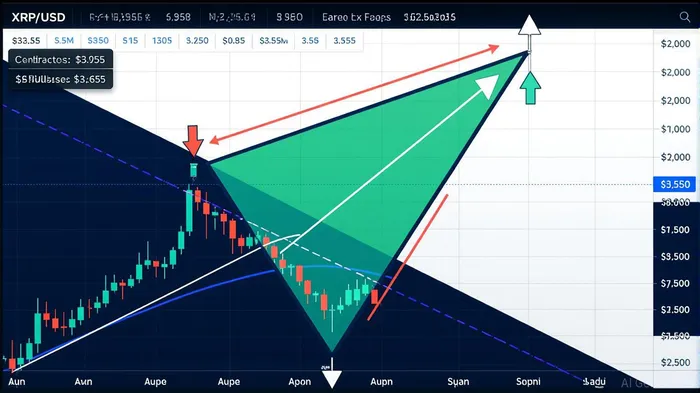
The XRPXRP-- price action around $3.90 has ignited a critical debate among investors: Is this a sustainable bullish breakout or a precursor to a sharp correction? To answer this, we must dissect the interplay of technical indicators and regulatory developments shaping XRP's trajectory.
Technical Analysis: A Bullish Setup with Caveats
XRP's recent consolidation within a contracting Elliott Wave triangle since July 2025 has positioned it at a pivotal juncture. Analysts like Matthew Dixon highlight two potential paths: an immediate breakout above the upper trendline toward $3.90 or a pullback to $2.655 before resuming the upward trend[1]. The RSI at 58.40 and a positive MACD histogram (0.0360) suggest neutral to bullish momentum, despite a 2.29% recent decline[1].
Key resistance levels at $3.05–$3.15 and support at $2.655 remain critical. A close above $3.077–$3.13 could confirm a bullish breakout, with $3.30 as an intermediate target[3]. However, a breakdown below $2.77 would signal bearish control, potentially dragging XRP toward $2.55[3]. The 9-week DEMA at $3.10 and RSI at 70.76 further underscore strong market interest, though traders must remain cautious of overbought conditions[3].
Notably, historical backtests of XRP's price patterns reveal a critical nuance: no classic triangle formations (as defined by standard technical analysis rules) have emerged for XRP since 2022. This absence suggests that the current contracting Elliott Wave triangle may represent a novel or rare setup for XRP, potentially amplifying its significance as a breakout catalyst. However, it also underscores the need for caution—without prior historical validation of triangle patterns for XRP, their predictive power remains untested in this asset class.
Regulatory Risk: Clarity and Lingering Uncertainty
The SEC's May 2025 settlement with Ripple brought partial clarity, declassifying XRP on public exchanges as a security while restricting institutional sales[1]. This resolution lifted trading restrictions and spurred a surge in institutional adoption, with over 300 financial institutionsFISI-- already utilizing RippleNet[1]. However, the SEC's ongoing appeal of programmatic sales introduces lingering uncertainty, prolonging market volatility[4].
Globally, XRP faces a more favorable regulatory landscape. The EU's MiCA framework and the UK's classification of XRP as an exchange token provide clearer compliance pathways[1]. Meanwhile, Japan and Singapore's supportive stances on cross-border XRP transactions reinforce its utility as a settlement asset[1]. These developments suggest that regulatory risks are mitigating, though U.S. legal outcomes remain a wildcard.
Balancing the Scales: Opportunity or Warning?
The $3.90 level represents a psychological and technical inflection point. A successful breakout would validate the bullish Elliott Wave scenario, potentially propelling XRP toward $4.50–$11, depending on institutional adoption and ETF approvals[3][4]. Conversely, a failure to hold above $2.655 could trigger a retest of key support levels, with $2.51 (200-day SMA) as a critical floor[1].
Investors must weigh the technical strength—evidenced by MACD divergence and RSI resilience—against regulatory tail risks. While the SEC's appeal is expected to conclude by late 2025, political shifts (e.g., a Trump-led regulatory overhaul) could accelerate clarity[4]. For now, XRP's rally to $3.90 appears more aligned with a buying opportunity for long-term holders, provided risk management strategies (e.g., stop-loss orders at $2.655) are in place.
Conclusion
XRP's journey to $3.90 is a testament to the interplay of technical momentum and regulatory evolution. While the immediate technical setup favors bulls, the broader market remains sensitive to U.S. legal outcomes. Investors should monitor the $3.077–$3.13 breakout zone and institutional adoption trends, treating $3.90 as a catalyst rather than a destination. In a landscape where clarity and volatility coexist, disciplined risk management will separate opportunity from caution.






Comentarios
Aún no hay comentarios