
XRP's Quiet Revolution: How Institutional Fintech Is Reshaping the Crypto Narrative
In 2025, the crypto landscape is no longer a binary battle between BitcoinBTC-- and altcoins. XRPXRP--, the token underpinning Ripple's cross-border payment network, has carved out a unique niche in institutional fintech—a space where Bitcoin maximalists often dismiss it as a “vaporware ponzi” or a “psychological operation”[4]. Yet, the data tells a different story.
Regulatory Clarity: A Game Changer
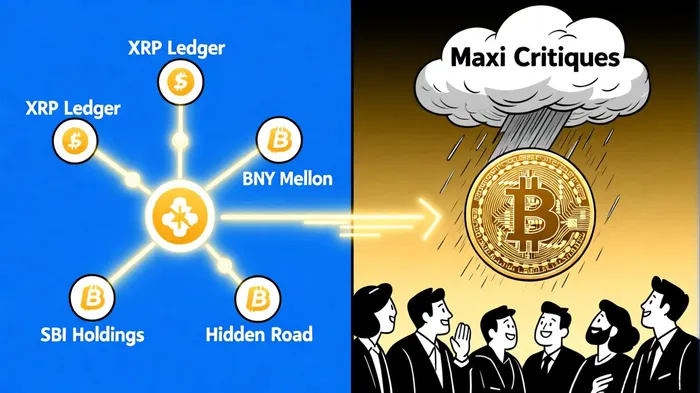
The SEC's 2025 resolution of its lawsuit against Ripple Labs marked a watershed moment. By ruling that XRP is not a security for public exchange sales, the court provided the legal clarity needed to unlock institutional adoption[5]. This distinction allowed Ripple to forge partnerships with financial giants like BNY Mellon, SBI Holdings, and Santander, integrating XRP into their cross-border payment infrastructures[1]. By Q2 2025, Ripple's On-Demand Liquidity (ODL) service had processed $1.3 trillion in transactions, with Santander reporting a 40% increase in Q3[3].
Bitcoin maximalists, however, argue that XRP's centralized governance and pre-mined supply make it inherently flawed. Critics like Robert Breedlove and Jonnie King label it a “vaporware ponzi,” citing Ripple's control over 55% of the token supply via escrow[4]. But this narrative ignores the practical realities: XRP's utility in real-time, low-cost international transfers is now a proven use case, not a speculative promise.
On-Chain Utility: Beyond the Hype
The XRP Ledger (XRPL) has evolved into a hybrid chain, blending DeFi capabilities with payment infrastructure. In Q3 2025, the ledger processed 70 million monthly transactions, with decentralized exchange (DEX) volumes growing 21% month-over-month, driven by Ripple's RLUSD stablecoin[2]. A 2025 upgrade added EthereumETH-- Virtual Machine (EVM) compatibility, enabling 1,400 Ethereum-style smart contracts to deploy within days[2]. This technical flexibility positions XRP as a bridge between traditional finance and decentralized systems.
Bitcoin maximalists counter that XRP's consensus model—a Unique Node List (UNL)—lacks the decentralization and security of Bitcoin's proof-of-work (PoW). While true, this critique overlooks XRP's design philosophy: speed and efficiency for institutional use. With 1,500 transactions per second and near-zero fees, XRP outperforms Bitcoin in scenarios requiring rapid settlement, such as cross-border remittances[4].
Institutional Confidence: Whales and ETFs
XRP's institutional appeal is further evidenced by whale activity. Large holders added 310 million XRP in Q3 2025, pushing their total holdings to 8.11 billion tokens[2]. This accumulation, coupled with XRP futures volume surpassing $1 billion on CME, signals growing professional confidence[2]. Meanwhile, XRP ETFs and tracker funds launched in regulated markets, offering institutional investors a compliant on-ramp[1].
Bitcoin maximalists dismiss these developments as “short-term hype,” arguing that XRP's lack of scarcity (unlike Bitcoin's 21 million cap) makes it a poor store of value. Yet, XRP's value proposition lies not in scarcity but in utility. As Ripple CEO Brad Garlinghouse argues, a national crypto reserve should include diverse assets like XRP to ensure stability and diversification[5].
The Maxi Counterattack: Fear of a Diversified Ecosystem
Bitcoin maximalists frame XRP as a threat to Bitcoin's dominance, claiming it undermines the “digital gold” narrative. Critics like Rajat Soni argue that XRP's centralized control and regulatory ambiguity make it a “psychological operation” to confuse retail investors[2]. However, Ripple's legal victories, including Judge Analisa Torres' ruling that retail XRP sales are not investment contracts, have provided clarity[5].
Ripple CTO David Schwartz has pushed back, stating that Bitcoin maximalists fear a diversified crypto ecosystem where XRP's cross-border utility coexists with Bitcoin's store-of-value role[3]. This ideological clash reflects broader debates about the future of finance: centralized efficiency versus decentralized scarcity.
Conclusion: A New Era for Institutional Fintech
XRP's 2025 trajectory demonstrates that institutional fintech is no longer a zero-sum game. By combining regulatory clarity, technical innovation, and real-world utility, XRP has positioned itself as a critical infrastructure asset for global payments. While Bitcoin maximalists may cling to ideological purity, the market is voting with its feet—allocating capital to solutions that address real-world problems.






Comentarios
Aún no hay comentarios