
XRP's Quiet Revolution in DeFi: Cross-Chain Lending Protocols Redefine Institutional Finance
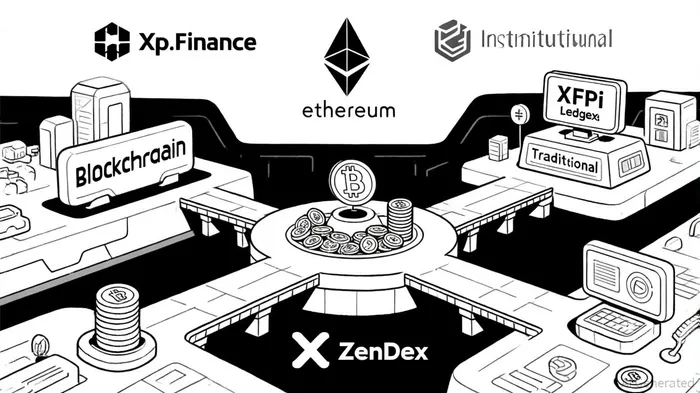
In 2025, the XRPXRP-- Ledger (XRPL) is quietly reshaping the decentralized finance (DeFi) landscape—not through hype, but through institutional-grade infrastructure and cross-chain lending innovations. As traditional finance grapples with the inefficiencies of legacy systems, XRPL's focus on speed, compliance, and programmability is attracting a new wave of institutional players. This article unpacks how XRP's ecosystem is leveraging cross-chain lending protocols to bridge the gap between decentralized markets and traditional finance, and why this matters for investors.
The Rise of Institutional DeFi on XRPL
Ripple's 2025 roadmap positions the XRP Ledger as a platform for institutional DeFi, with a credit-based lending protocol at its core. This protocol allows financial institutionsFISI-- to tokenize real-world assets (RWAs) like treasuries and real estate, enabling automated, onchain lending with stablecoins such as RLUSD [1]. By integrating with Ripple Payments, the native decentralized exchange (DEX), and automated market makers (AMMs), the system streamlines loan origination and returns while embedding KYC checks directly into the protocol [2].
The key differentiator? Speed and compliance. Unlike Ethereum's gas-guzzling smart contracts, XRPL's sub-second settlement times and low fees make it ideal for high-volume institutional transactions. For example, XpXP--.Finance—a non-custodial lending platform launching in Q3 2025—lets users access over-collateralized loans without intermediaries, leveraging XRPL's efficiency to offer NFT bonds and multi-asset lending [3]. This isn't just DeFi 2.0; it's DeFi for institutions.
Cross-Chain Lending: Bridging Ecosystems
XRPL's cross-chain lending innovations are gaining traction through partnerships and protocol upgrades. XenDex, the first trustless lending platform on XRPL, allows users to lend XRP and XDX to earn yield or borrow against their holdings via audited smart contracts [4]. Meanwhile, the XLS-66d protocol—a modular on-chain lending framework—enables off-chain loan agreements to be recorded onchain, reducing friction for borrowers and lenders [5].
What's driving adoption? Interoperability. The XRP Ledger's EVM sidechain, launched in Q2 2025, allows EthereumETH-- developers to deploy dApps on XRPL, creating a bridge between Ethereum's liquidity and XRPL's speed [6]. This is critical for cross-chain lending, where assets like ETHETH-- or USDCUSDC-- can be tokenized and used as collateral on XRPL-based platforms. For instance, a borrower could lock ETH on Ethereum, mint a tokenized version on XRPL, and use it to secure a loan in RLUSD—all while maintaining compliance with onchain KYC tools [7].
Programmability and Tokenization: The Next Frontier
XRPL's 2025 roadmap isn't just about lending—it's about redefining asset ownership. The introduction of Multi-Purpose Tokens (MPTs) lets institutions tokenize structured products like bonds and share classes, embedding metadata for compliance [8]. This aligns with the $30 trillion tokenized RWAs market, where XRP's low-cost infrastructure becomes a competitive edge.
Meanwhile, Extensions—a new layer of programmable functionality—lets developers build features like automated escrows and AMMs without full smart contracts, balancing flexibility with security [9]. For example, a lender could use an Extension to create a custom AMM for FX swaps, automating interest rate adjustments based on market conditions. This level of customization is rare in traditional finance and could attract hedge funds and asset managers.
Why This Matters for Investors
For XRP holders, these developments signal a shift from speculative utility to enterprise-grade infrastructure. The XRP Ledger's focus on institutional compliance—via decentralized identifiers (DIDs) and tokenized KYC—addresses a major pain point for traditional finance [10]. As cross-chain lending protocols mature, XRP's role as a bridge between DeFi and traditional markets could drive demand for its native token, particularly as more institutions tokenize assets on XRPL.
Conclusion
The XRP Ledger's 2025 roadmap isn't just about catching up to Ethereum—it's about redefining what DeFi can do for institutions. By combining cross-chain lending protocols, tokenization, and compliance tools, XRPL is creating a parallel financial system that's faster, cheaper, and more scalable. For investors, this means XRP is no longer just a payment token; it's the backbone of a new institutional DeFi ecosystem.







Comentarios
Aún no hay comentarios