
XRP Price Volatility and Institutional Adoption: Why the $2 Level Is a Strategic Buying Opportunity
In the ever-shifting landscape of cryptocurrency, XRPXRP-- has emerged as a compelling case study in the interplay between regulatory clarity, institutional adoption, and price volatility. As of late 2025, the token is trading near the psychologically significant $2 level, a price point that has become a battleground for bulls and bears alike. This article examines why the current environment-marked by landmark regulatory developments and surging institutional demand-positions XRP as a strategic buying opportunity, despite its recent struggles.
Regulatory Clarity: A Catalyst for Institutional Confidence
The most transformative development for XRP in 2025 has been the U.S. Securities and Exchange Commission (SEC) dropping its appeal against Ripple Labs, effectively ending a years-long legal battle. This resolution, coupled with the passage of the Genius Act and the Digital Asset Market Clarity Act, has created a more defined legal framework for XRP and other digital assets. These legislative wins have not only reduced regulatory uncertainty but also signaled to institutional investors that XRP is no longer a speculative liability but a legitimate asset class.
The approval of U.S.-listed spot XRP ETFs in mid-November 2025 further amplified this shift. According to a report by Investing.com, these ETFs attracted over $1.07 billion in net inflows across 25 consecutive days, a testament to the growing appetite for XRP among institutional players. This influx of capital has been critical in stabilizing the token's price, even as macroeconomic headwinds persist.
Institutional Adoption: Accumulation Amid Volatility
Despite XRP's recent correction below $2, on-chain data reveals a quiet but significant trend: institutional accumulation. Exchange balances for XRP have dropped by 45%, with 1.35 billion XRP moved into custody accounts, suggesting that large investors are locking in long-term positions. This contrasts sharply with retail-driven panic-selling cycles observed in prior bear markets, where liquidity dried up rapidly.
The XRP Ledger's real-world utility also bolsters its institutional appeal. Ripple's CTO highlighted that the network processed four billion transactions in 2025, underscoring its role in cross-border payments and decentralized finance (DeFi) ecosystems. This operational resilience-combined with the token's low energy consumption and high throughput-makes XRP an attractive option for institutions seeking exposure to blockchain infrastructure without the volatility of pure-play speculative assets.
Technical Analysis: The $2 Level as a Support Zone
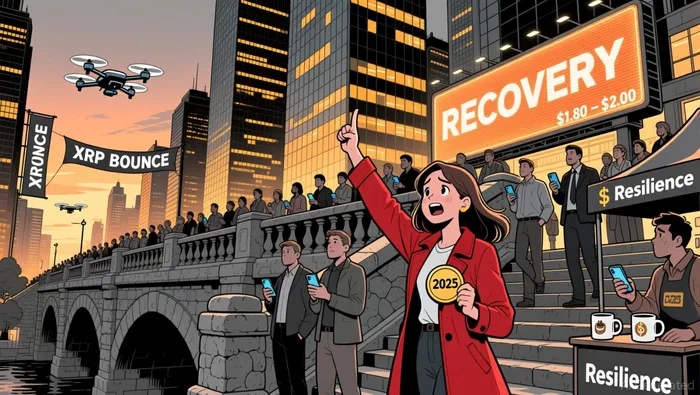
From a technical perspective, XRP's price action around the $2 level is telling. The token has been consolidating within a descending channel and triangle formation, with the $1.80–$2.00 range acting as a critical support zone. While the price briefly dipped below $1.80 in late 2025, it rebounded sharply, indicating strong buyer interest at these levels.
The Relative Strength Index (RSI) has shown bullish divergence, a technical indicator that often precedes reversals. Additionally, on-chain metrics suggest that 52% of XRP's circulating supply is in profit, with whale addresses reducing exposure-a sign that long-term holders are not capitulating according to Coinpedia analysis. If institutional demand continues to outpace selling pressure, a breakout above $2.10 could trigger a test of the $2.60 resistance level, a key psychological barrier.
Market Sentiment: Cautious OptimismOP-- in a Risk-Off Environment
Market sentiment for XRP remains mixed. While the token has underperformed BitcoinBTC-- and EthereumETH-- in 2025, its 13% decline pales in comparison to the broader altcoin sell-off. Analysts are divided on its 2026 prospects, with optimistic forecasts ranging from $3 to $8. The cautious tone stems from macroeconomic factors, including global risk-off rotations into gold and Bitcoin, which have siphoned liquidity from altcoins.
However, the approval of XRP ETFs and the token's growing institutional adoption provide a counterbalance. As noted by CoinDesk, buyers have stepped in at the $2.00 floor, building a foundation for potential upside if macro conditions improve. The key question is whether XRP can break out of its current range without a significant shift in global risk appetite.
Strategic Buying: Balancing Risk and Reward
For investors, the $2 level represents a unique inflection point. On one hand, the token's technical indicators and institutional buying patterns suggest a high probability of support holding. On the other, macroeconomic risks and competition from stablecoins remain unresolved according to Nasdaq analysis. A strategic approach would involve dollar-cost averaging into XRP at the $1.85–$1.90 range, with a stop-loss below $1.80 to mitigate downside risk.
The long-term case for XRP hinges on two factors: sustained ETF inflows and further regulatory clarity. If the Genius Act and similar legislation gain traction in 2026, XRP could see a surge in adoption from traditional financial institutions. Conversely, a failure to break above $2.10 in the near term may prolong its consolidation phase.
Conclusion
XRP's journey to $2 is a microcosm of the broader crypto market's evolution. Regulatory clarity has unlocked institutional demand, while technical and on-chain data suggest a resilient base at the $2 level. For investors willing to navigate the volatility, this price point offers a compelling entry opportunity-one that balances the risks of macroeconomic uncertainty with the rewards of a token poised for long-term growth.






Comentarios
Aún no hay comentarios