
XRP's Price Trajectory: Corporate Strategy and Market Sentiment in the Wake of Ripple's $1 Billion Buyback
Ripple Labs' recent $1 billion XRPXRP-- buyback plan, structured through a Special Purpose Acquisition Company (SPAC), has ignited significant speculation about the token's price trajectory. This initiative, aimed at creating a Digital AssetDAAQ-- Treasury (DAT), represents a strategic shift from controlling XRP supply to generating institutional demand. By consolidating XRP into a centralized reserve, Ripple is positioning itself as a key player in bridging traditional finance and blockchain, a move that could structurally alter XRP's market dynamics.
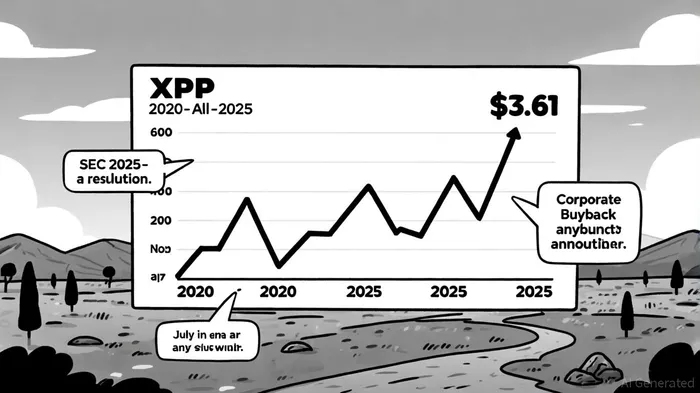
Corporate Strategy: From Supply Control to Demand Creation
Ripple's DAT will serve as a long-term vehicle to accumulate and manage XRP, with funds raised via the SPAC and Ripple's existing holdings. The company already holds 4.74 billion XRP (valued at ~$11 billion) and an additional 35.9 billion in escrow, giving it substantial leverage to influence liquidity conditions. By deploying a buy-and-hold treasury model, Ripple aims to reduce circulating supply and create a predictable buyer for XRP, potentially stabilizing its price. According to a Blocknews report, the DAT could absorb up to 0.75% of XRP's total supply at current prices, with execution over 90 days potentially triggering 8–15% price lifts before market adjustments.
This strategy is further bolstered by Ripple's acquisition of GTreasury, a $1 billion deal that provides infrastructure for managing digital asset treasuries, stablecoins, and tokenized deposits. By integrating blockchain with traditional treasury operations, Ripple is targeting the multi-trillion-dollar corporate finance sector, offering real-time liquidity management and cross-border payment solutions as outlined in Ripple's press release. Analysts at CryptoSlate argue that this expansion into corporate treasury services could drive institutional adoption of XRP as a reserve asset, amplifying its utility beyond payments.
Historical Precedents: Corporate Buybacks and Price Impacts
Past corporate XRP buybacks provide a framework for understanding potential price effects. For instance, a Webus SEC filing showed Webus International's $300 million XRP treasury strategy, announced in June 2025, coincided with a 32% surge in its stock price and a 78% increase in long positions on XRP perpetuals. Similarly, VivoPower's $121 million XRP-focused treasury, backed by Saudi Prince Abdulaziz bin Turki Al Saud, saw XRP's open interest rise to $8.45 billion, signaling renewed trader confidence, according to a Market Periodical piece. These cases highlight how institutional accumulation can drive speculative optimism and liquidity.
However, the relationship between buybacks and price is not linear. Ripple's own $700 million equity buyback in June 2025, while reinforcing its financial strength, coincided with a 3.5% dip in XRP's price, suggesting that market sentiment is influenced by broader factors such as regulatory clarity and macroeconomic conditions, according to a CoinCentral article. Nevertheless, historical data indicates that buybacks of $300–500 million have historically triggered 30–100% price spikes, followed by corrections over subsequent months, as shown in a Crypto Insights analysis.
Market Sentiment and Regulatory Tailwinds
The DAT's success hinges on Ripple's ability to execute its buyback efficiently and transparently. At current prices (~$2.41), a $1 billion reserve would equate to ~435 million XRP, or 0.75% of the 60 billion in circulation. If deployed over 90 days, this could represent 20% of visible order-book depth on major exchanges, potentially triggering short-term price lifts, according to a Yahoo Finance report. However, execution speed, OTC channels, and regulatory developments will be critical.
Regulatory clarity has already played a pivotal role in XRP's recent rally. The SEC's mid-2024 ruling, which clarified XRP's non-security status, catalyzed a 200% price surge from $0.80 to $2.87 by July 2025, as detailed in a CoinDesk article. With the DAT and GTreasury acquisition, Ripple is further signaling its commitment to compliance, which could attract risk-averse institutional investors. The odds of a spot XRP ETF approval have also risen to 92% as of June 2025, according to a GenFinity analysis.
Price Trajectory: Technical and Fundamental Drivers
Technically, XRP is consolidating above key support levels, with a symmetrical triangle pattern suggesting a potential breakout toward $4.70, according to a Gate technical analysis. Analysts at The Market Periodical note that the token's on-chain metrics—such as a 78% long position ratio on perpetuals and a 30% increase in stablecoin-backed liquidity—reinforce bullish sentiment, as discussed in a JU blog analysis.
Fundamentally, Ripple's DAT and GTreasury integration could drive XRP's adoption as a reserve asset. If the DAT expands to $10 billion, XRP's price could reach $12.60 by 2025, driven by continued institutional demand and yield-generating strategies, according to a CCN analysis. However, this scenario assumes no major regulatory setbacks and sustained market absorption of large buybacks.
Conclusion
Ripple's $1 billion XRP buyback represents a bold bet on the token's long-term utility and institutional adoption. By combining supply-side management with demand-side innovation, the company is creating a self-reinforcing cycle that could stabilize and elevate XRP's price. While historical precedents and technical indicators suggest a bullish trajectory, investors must remain vigilant about execution risks and regulatory headwinds. For now, the DAT and GTTreasury acquisition underscore Ripple's ambition to redefine XRP as a cornerstone of global digital finance.





Comentarios
Aún no hay comentarios