
Is XRP's Recent Price Drop a Buying Opportunity or a Black Swan Risk?
The Technical and Psychological Crossroads
XRP's recent 4.7% drop to $2.85 on October 8, 2025, was a textbook technical breakdown. The price collapsed below a critical support zone between $2.92 and $2.90, triggering stop-loss orders and long liquidations that accelerated the sell-off, according to a CoinPedia analysis. This breakdown invalidated an ascending triangle pattern formed since August, pushing XRPXRP-- toward the 78.6% Fibonacci retracement level at $2.81-a key short-term support zone, according to a Bitrue analysis. Meanwhile, on-chain data reveals a troubling trend: active XRP addresses have fallen 54% from July's peak to 23,000, and new wallet creation has plummeted to 3,500 as of June 2025, compared to 15,823 in January, according to Bitrue. These metrics suggest weakening retail participation, compounding the bearish narrative.
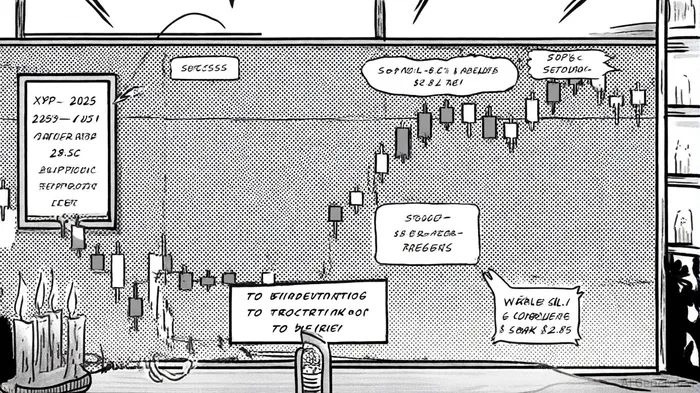
However, technical breakdowns often create buying opportunities for contrarian investors. Historically, periods of extreme fear-such as the current Fear & Greed Index reading of 27-have preceded market recoveries, as noted in an Economic Times warning. For example, during the April 2025 tariff panic, XRP's price rebounded sharply after hitting a similar fear threshold. The question is whether XRP can stabilize above $2.81 or face a deeper correction toward $2.60–$2.70, a scenario discussed in Bitrue's analysis.
A historical analysis of XRP's performance after breaking below $2.81 reveals mixed signals. While six such events occurred since 2022 (limited statistical significance), the average return turned positive in the first two weeks, peaking near +4% after ~10 days, before drifting lower and underperforming the benchmark after three weeks, according to Bitrue. This suggests that while short-term contrarian entries might capture temporary rebounds, holding beyond two weeks carries higher uncertainty.
Regulatory Clarity and Lingering Uncertainties
The August 2025 resolution of the Ripple vs. SEC lawsuit-a $50 million settlement with no criminal charges-provided critical regulatory clarity, as reported by CoinPedia. This outcome allowed XRP to trade as a digital currency in public markets while institutional sales remained subject to securities laws. The ruling also paved the way for XRP futures and ETFs, with six spot XRP ETF approvals expected between October 18 and 25, a catalyst highlighted by CoinPedia. If successful, these products could inject institutional capital, potentially pushing XRP toward $3.60–$3.62, a projection covered in the same CoinPedia piece.
Yet, regulatory risks persist. Ripple's application for a U.S. national banking charter remains under review by the OCC, and XRP's legal status in primary markets-as a security-still creates ambiguity, according to Bitrue. A black swan event could emerge if the SEC reverses its stance or if global regulators impose stricter cross-border payment regulations. For now, Ripple's partnerships with SWIFT via Thunes and its role in real-time gross settlement systems provide a buffer, according to a OneSafe report.
Macroeconomic Headwinds and Market Competition
The U.S. economy's bifurcated growth in Q3 2025-1.3% annual GDP expansion but below-trend Q4 projections-adds macroeconomic risk, a point raised by the Economic Times. A potential recession could trigger liquidity crises, disproportionately affecting speculative assets like XRP. Additionally, XRP faces stiff competition from stablecoins and CBDCs, which benefit from established regulatory frameworks, as noted in the OneSafe report.
Despite these challenges, XRP's utility in cross-border payments remains unmatched. Ripple's $50 million in institutional XRP sales per day-while exacerbating volatility-also signals growing adoption, a dynamic covered in the Economic Times piece. The key question is whether this utility will outweigh macroeconomic and regulatory headwinds.
Investor Sentiment: Fear, Whales, and ETF Hopes
Retail sentiment for XRP has turned bearish, with the Fear & Greed Index at 27 and a bullish-to-bearish commentary ratio below 1.0 in late October, observations summarized in the OneSafe report. However, institutional confidence is rising: $210 million flowed into XRP-related products in September, and over 439 million XRP were withdrawn from exchanges, signaling long-term holding strategies, according to OneSafe. Whale activity is mixed-while $50 million in daily selling pressures the market, 120 million XRP ($340 million) have been accumulated recently, suggesting strategic positioning, as noted in a Currency Analytics note.
The upcoming ETF decisions are a double-edged sword. Approval could drive XRP toward $3.60–$3.62, but delays or rejections might prolong bearish pressure, an outcome explored by CoinPedia.
Conclusion: Balancing Opportunity and Risk
XRP's recent price drop reflects a confluence of technical breakdowns, regulatory uncertainty, and macroeconomic headwinds. For risk-tolerant investors, the 78.6% Fibonacci level at $2.81 offers a compelling entry point if XRP stabilizes-a scenario supported by historical contrarian patterns. However, the risks of a deeper correction to $2.60–$2.70, coupled with potential regulatory shifts or macroeconomic shocks, cannot be ignored.
The coming weeks will be pivotal. If XRP holds above $2.81 and the SEC approves ETFs, the asset could reclaim its July 2025 highs of $3.40. A breakdown below $2.81, however, would signal a high-probability test of $2.40–$2.51, as discussed in Bitrue. Investors must weigh their risk appetite against the interplay of technical, regulatory, and macroeconomic forces-a reminder that in crypto, even the most promising opportunities carry black swan risks.





Comentarios
Aún no hay comentarios