
XRP's Price Decline and Bearish Technical Signals: A Short-Term Investor's Playbook
The Bear Case: XRPXRP-- at a Crossroads
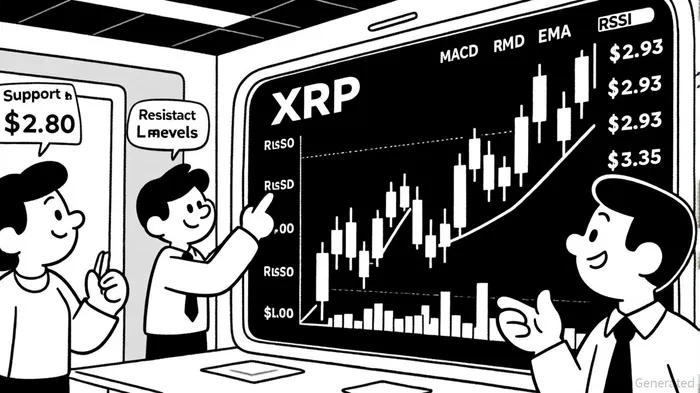
XRP's price action in September 2025 paints a mixed but cautiously bearish picture. The token hovers near critical support at $2.80, a level tested multiple times this year, with RSI on the 30-minute chart at 66—a sign of recovering momentum but not yet overbought territory [3]. However, the MACD remains bearish-neutral, and moving averages (EMA cluster at $2.81–$2.96) act as a ceiling, capping upward potential [3]. On-chain data reveals a tug-of-war between accumulation and distribution: large investors have added 1.7 million XRP tokens this month, while net whale inflows of $8.52 million on September 2 suggest strategic buying [3].
The 50-day MA at $2.96 offers a glimmer of bullish hope, but the 20-day MA at $2.935410 signals short-term weakness [2]. A clean break above $2.93 could reignite bullish control, but a breakdown below $2.80 risks testing support at $2.60, with further declines to $2.50 possible [4]. Analysts are split: some predict a 10% drop to $2.50–$2.60, while others see a rebound to $3.60 or higher [4][5].
Risk Management: Protecting Capital in a Volatile Market
For short-term traders, managing risk is paramount. Technical indicators like RSI and MACD can act as guides. For instance, setting stop-loss orders below $2.50 while accumulating near $2.70–$3.00 can mitigate downside risks [2]. Swing traders might consider partial profits at resistance levels like $3.70–$4.00, then rebuy dips back to $3.00–$3.20 if momentum holds [2]. Aggressive traders could use trailing stops above $4 with a 10–15% buffer to lock in gains [2].
Portfolio allocation is equally critical. Experts recommend keeping XRP exposure below 15–20% of a broader crypto portfolio to avoid overexposure [2]. In bearish scenarios, strict stop-loss rules prevent a single adverse move from eroding prior gains [2].
Strategic Exit Timing: Staging Profits in a Bearish Climate
Exit strategies must align with XRP's market cycles. Analysts like Maelius argue the token is entering its third wave (W3) of a four-phase cycle (accumulation, uptrend, distribution, downtrend), with key exit points between $10–$13 [1]. A staged approach could look like this:
- $3.50–$4.00: Sell 20% of holdings to secure early gains, leveraging regulatory optimism or ETF speculation [3].
- $5.00–$6.00: Offload 25% as institutional adoption gains traction [4].
- $10.00–$12.00: Sell 30% during mass adoption phases, capitalizing on high volatility [6].
- Above $20.00: Liquidate 15–20% if XRP solidifies its role in cross-border payments [6].
This strategy reduces emotional decision-making during euphoric market phases and ensures profits are locked in at multiple milestones [3].
The Bigger Picture: Regulatory and Macro Risks
While technicals are bearish, regulatory developments could tilt the scales. Ripple's pending banking charter application and the 70% chance of XRP ETF approval in 2025 could inject billions in institutional capital, pushing prices toward $8–$10 [2]. Conversely, a negative SEC ruling or hawkish Federal Reserve policy could exacerbate declines [4][5].
Conclusion: Balancing Caution and Opportunity
XRP's short-term outlook is a balancing act between bearish technical signals and potential catalysts. Traders must prioritize risk management—using stop-losses, trailing stops, and portfolio diversification—while strategically timing exits based on price targets and market cycles. As the token teeters near $2.80, the path forward hinges on whether accumulation by whales and regulatory clarity can outweigh macroeconomic headwinds.





Comentarios
Aún no hay comentarios