
XRP Price at Critical Consolidation Level: Is Now the Time to Enter?
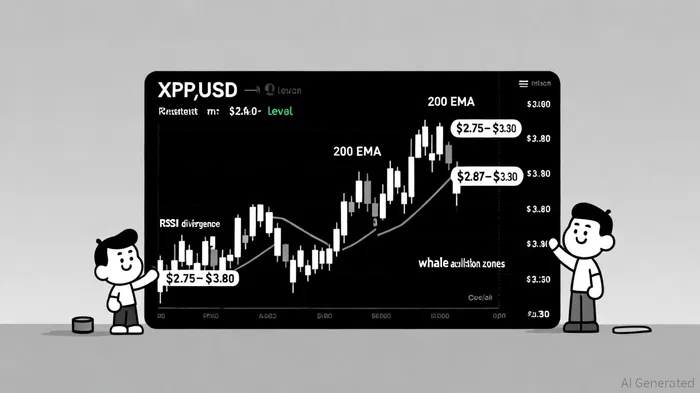
XRP's price action in September 2025 has reached a pivotal inflection pointIPCX--, with the asset teetering near critical technical and psychological support levels. After breaking below the $2.80 threshold—a level that had held for months—XRP now trades at $2.75, testing the resilience of its $2.75–$2.80 consolidation zone[1]. This breakdown has reignited debates about whether the current price represents a buying opportunity or a warning sign of deeper capitulation.
Technical Analysis: A Bearish Bias with Conditional Catalysts
From a technical perspective, XRP's recent performance paints a mixed but cautiously bearish picture. The breakdown below $2.80 coincided with a surge in trading volume, signaling aggressive short-term liquidations[1]. Glassnode's cost basis analysis underscores the significance of the $2.81–$2.82 level, where 1.71 billion XRPXRP-- were historically accumulated. A sustained close below this zone could trigger a cascade of profit-taking and further downward pressure, potentially driving prices toward $2.50[1]. Historically, a simple strategy of buying XRP when it touched or fell below its first daily support level (S1) from 2022 to 2025 yielded a cumulative return of +35.5%, though with a maximum drawdown of 22.5% and an annualized return of 6.7%.
Momentum indicators reinforce this bearish narrative. The RSI has entered oversold territory (mid-40s), while the MACD on weekly charts shows a bearish crossover, suggesting prolonged selling pressure[1]. However, the 200-day exponential moving average (200 EMA) near current levels could act as a temporary floor. If XRP stabilizes and breaks above the $2.80–$2.87 resistance range, it could rekindle bullish sentiment, with $3.30 as a near-term target—particularly if regulatory tailwinds materialize[1].
Market Sentiment: Whales vs. Institutions
Market sentiment remains fragmented, with divergent signals from whale activity and institutional behavior. Whale wallets have quietly accumulated 340 million XRP in the $3.20–$3.30 range, indicating long-term confidence in the asset's utility and potential ETF-driven demand[1]. This accumulation contrasts sharply with $1.9 billion in institutional liquidations since July, reflecting short-term profit-taking amid broader crypto market weakness[1].
On-chain metrics add nuance to this dynamic. First-time transactions have hit a two-month low, suggesting waning retail interest[2]. Yet, large investors appear undeterred, with their holdings concentrated in the $2.81–$2.82 range—a level that could stabilize the price if XRP avoids a breakdown[1]. The coming weeks will test whether this whale-driven support can offset broader selling pressure.
Macro Factors and Regulatory Uncertainty
Beyond technicals and sentiment, macroeconomic and regulatory developments loom large. The potential approval of XRP-based ETFs from Grayscale, Bitwise, and WisdomTreeWT-- remains a high-impact catalyst[1]. If regulators greenlight these products, institutional demand could surge, creating a floor for the price and potentially propelling XRP toward $5 by year-end[1]. Conversely, delays or rejections would likely exacerbate the current bearish bias.
Meanwhile, the Federal Reserve's September rate decision could influence risk appetite across asset classes. A dovish pivot might buoy crypto markets broadly, while hawkish signals could deepen XRP's decline[2]. Ripple's ongoing development of the XRP Ledger and its RLUSD stablecoin also provide a long-term narrative of utility-driven adoption[2], though these factors are unlikely to offset near-term volatility.
Is Now the Time to Enter?
For investors considering entry, the calculus hinges on risk tolerance and time horizon. A breakout above $2.80–$2.87 would signal a potential short-term recovery, but the path to $3.30 remains contingent on ETF approvals and broader market conditions[1]. Conversely, a breakdown below $2.77–$2.80 could accelerate a decline toward $2.20–$2.26, with the 200 EMA offering limited protection[1].
Whales and long-term holders appear positioned for a rebound, but retail investors should tread carefully. The current consolidation phase is a high-risk, high-reward scenario. Those with a bullish thesis might consider dollar-cost averaging into the $2.50–$2.80 range, while hedging against further downside. For now, patience and close monitoring of key levels—and regulatory news—will be paramount.






Comentarios
Aún no hay comentarios