
XRP Price Action and On-Chain Indicators: Strategic Entry Points in the Post-Regulatory Uncertainty Era
The resolution of the U.S. Securities and Exchange Commission (SEC) vs. Ripple case in August 2025 marked a pivotal moment for XRPXRP--, reshaping its regulatory landscape and unlocking new opportunities for institutional and retail adoption. With the legal battle concluded and XRP officially cleared as a non-security in secondary market sales, the token's price and on-chain activity have exhibited dynamic patterns that warrant a nuanced analysis for strategic entry points.
Regulatory Clarity and Market Reactions
The August 2025 settlement, which imposed a $125 million fine and restricted institutional sales of XRP, provided long-awaited clarity for market participants. According to a report by Coinpaper, this resolution allowed U.S. exchanges to resume XRP trading with renewed confidence, directly contributing to a post-settlement price surge to $3.30 and a 5% increase in trading volume[1]. Institutional confidence further solidified with the launch of the ProShares Ultra XRP ETF in July 2025 and the filing of additional ETF applications by major asset managers[3].
However, the immediate aftermath of the settlement saw a brief 5% price drop to $3.20 due to profit-taking and whale selling, as noted by CoinDesk[1]. This volatility underscores the importance of analyzing on-chain metrics and technical indicators to identify strategic entry points amid evolving market dynamics.
On-Chain Metrics: A Surge in Activity
Post-settlement, XRP's on-chain activity has surged, reflecting growing utility and adoption. Data from XRP Authority indicates that active XRP addresses reached 295,000—far exceeding the three-month average of 40,000[2]. This spike suggests increased participation from both retail and institutional investors. Additionally, payment volumes on the XRP Ledger (XRPL) exploded by 500% on August 18, 2025, with 844 million tokens processed in a single day[3]. Such activity highlights the network's maturation beyond speculative trading, with 70% of daily transactions now tied to cross-border settlements and enterprise use cases[2].
Whale activity has also played a critical role in shaping short-term price movements. A report by Benzinga notes that 470 million XRP tokens were offloaded over ten days post-settlement, likely signaling profit-taking by large holders[3]. Conversely, sustained accumulation by whales during earlier price dips—amounting to $360 million in XRP—suggests a potential repositioning ahead of broader market shifts[3].
Technical Analysis: RSI, MACD, and Fibonacci Levels
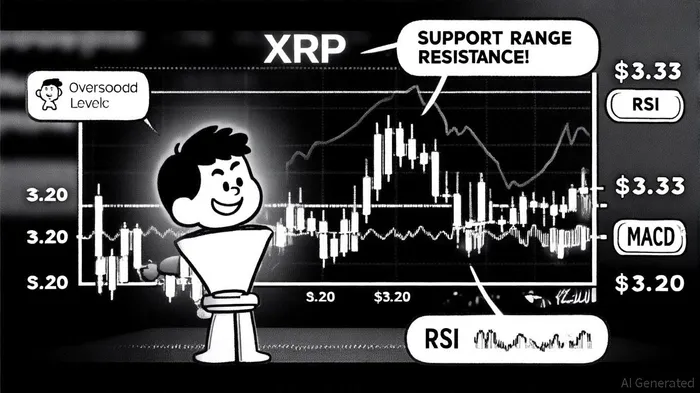
From a technical perspective, XRP has formed a defined trading range between $3.20 (support) and $3.33 (resistance), with 5.24% intraday volatility observed[1]. The Relative Strength Index (RSI) currently stands at 58.61, indicating neutral momentum with room for further bullish movement[4]. Meanwhile, the Moving Average Convergence Divergence (MACD) histogram shows a slight bearish divergence at -0.0017, hinting at a possible consolidation phase[1].
Fibonacci extension levels provide additional guidance. If XRP breaks the $3.60 resistance, analysts project a long-term target of $6.19[3]. Conversely, a breakdown below $3.00 could trigger a bearish shift, potentially targeting $2.60 or $2.26[3]. A bull flag pattern forming above $3.28 further suggests upside potential if the $3.33 resistance is breached[1].
Strategic Entry Points and Risk Management
Given these dynamics, strategic entry points for XRP appear at key support levels. The $3.20 support has held as a critical psychological barrier, with buyers defending it post-settlement[1]. A breakout above $3.33 could validate the bull flag pattern and open the door to $3.60. Traders might consider long positions near $3.20–$3.25, with stop-loss orders below $3.00 to mitigate downside risk.
For risk-averse investors, the recent approval of the ProShares Ultra XRP ETF and Japan's SBI Holdings' Bitcoin-XRP ETF filing[1] offer indirect exposure to XRP's growth potential without direct token ownership. These products could further stabilize XRP's price by attracting institutional capital.
Conclusion
The post-SEC settlement era has transformed XRP into a regulated, utility-driven asset with clear institutional adoption pathways. While short-term volatility persists due to whale activity and profit-taking, the underlying fundamentals—surging on-chain activity, ETF approvals, and a robust technical setup—position XRP for long-term growth. Investors should closely monitor key price levels, whale movements, and macroeconomic conditions to capitalize on strategic entry points in this evolving landscape.






Comentarios
Aún no hay comentarios