
XRP's Potential to Outperform Bitcoin in 2026: A Technical Breakout and Fractal Analysis
The cryptocurrency market in 2026 is witnessing a pivotal shift in dynamics, with XRPXRP-- emerging as a compelling contender to outperform BitcoinBTC--. This analysis, grounded in technical fractal patterns, relative strength metrics, and on-chain fundamentals, explores how XRP's price structure and institutional adoption could position it for a breakout amid a stabilizing market environment.
Fractal Patterns and Technical Breakout Potential
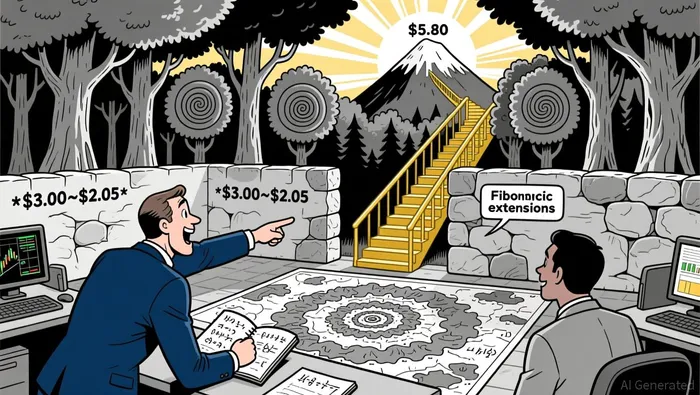
XRP's price trajectory in 2023–2025 has mirrored historical fractal structures, notably the 2017 bullish pattern, which analysts suggest could drive a parabolic surge. According to a report by EGRAG CRYPTO, XRP is currently following a "White Fractal" with 82% accuracy, projecting a 75% probability of reaching $3.20 by late 2025, with decreasing probabilities for higher targets like $8 (65%) and $27 (50%). This fractal model hinges on key resistance levels, including $3.00–$3.05, which, if breached, could trigger a rally toward $3.50–$5.80 based on Fibonacci extensions.
Technical indicators reinforce this outlook. XRP is consolidating within a descending triangle pattern, a bearish continuation signal, but traders are monitoring the $2.30 weekly pivot point as a critical support level. A sustained break above $3.00 would validate the fractal's bullish case, while a drop below $1.60 would invalidate the model entirely.
Relative Strength vs. Bitcoin: A Structural Asymmetry
XRP's relative strength against Bitcoin has shown divergent trends. While the XRP/BTC ratio remains in a relative downtrend (20 EMA below 50 EMA), recent data indicates early expansion on the daily timeframe, suggesting a potential shift in capital allocation. This asymmetry is amplified by XRP's smaller market cap ($120 billion vs. Bitcoin's $2 trillion), making it more susceptible to institutional inflows. For instance, U.S.-listed XRP ETFs attracted $1.15 billion in inflows by early 2026, outpacing Bitcoin's stabilized ETF flows.
Bitcoin's dominance has fluctuated between 58.19% and 67.0057% in 2026, reflecting a tug-of-war between altcoins and the leading cryptocurrency. XRP's outperformance-gaining 25% in early 2026 compared to Bitcoin's 6%- is attributed to its utility in cross-border payments and declining exchange balances on platforms like Binance, signaling long-term holding. However, Bitcoin retains a defensive edge in risk-off environments, where its maturity and liquidity make it a safer harbor.
On-Chain Fundamentals and Institutional Adoption
XRP's on-chain activity underscores its growth narrative. The XRP Ledger processed over 1 million daily transactions in early 2026, a 2022-era milestone, while Ripple's partnerships with Japanese financial institutions highlight its real-world utility. Institutional adoption is further bolstered by ETF inflows, which have transformed XRP into a "less crowded trade" compared to Bitcoin or EthereumETH--.
A critical catalyst in October 2025 was the SEC's decision on spot XRP ETFXRPI-- approvals. If approved, these ETFs could replicate Bitcoin's institutional adoption trajectory, enabling broader retail and institutional access. Analysts project that capturing even 1% of the global remittance market could justify a $5 milestone for XRP by 2026.
High-Probability Entry Points and Risk Management
For traders seeking entry points, XRP's technical structure offers clear thresholds. The $2.30 pivot point and $2.00 support level (aligned with the 200 EMA) are critical for short-term buyers, while a breakout above $3.00–$3.05 could trigger a rally toward $3.50–$5.80. RSI at 42 and bearish MACD divergence suggest caution, but volume consolidation around key support zones indicates latent buying interest.
However, risks persist. A sustained drop below $1.60 would undermine the fractal model, while macroeconomic uncertainty could see Bitcoin outperform as a safe-haven asset. Diversification across both XRP and Bitcoin remains prudent for sophisticated investors.
Conclusion
XRP's potential to outperform Bitcoin in 2026 hinges on a confluence of technical, structural, and institutional factors. While fractal patterns and ETF-driven adoption present a bullish case, Bitcoin's defensive profile and market maturity cannot be ignored. For investors, the key lies in balancing exposure to XRP's growth narrative with Bitcoin's stability, leveraging high-probability entry points as the market structure stabilizes.





Comentarios
Aún no hay comentarios