
XRP's Potential ETF Inclusion and Price Catalysts by 2035: A Regulatory and Institutional Breakthrough
The resolution of the U.S. Securities and Exchange Commission (SEC) lawsuit against Ripple Labs in August 2025 marked a watershed moment for XRPXRP--. By ruling that secondary market sales of XRP to retail investors are not securities, the court provided the token with regulatory clarity, enabling its relisting on exchanges and boosting investor confidence[1]. This outcome not only cleared the path for XRP's potential inclusion in ETFs but also established a precedent for distinguishing between retail and institutional transactions in crypto regulation[2]. With Ripple agreeing to a $125 million civil penalty—far below the SEC's original $2 billion demand—the token's legal status has shifted from a regulatory gray area to a more defined asset class[6].
ETF Inclusion: A Mechanism for Market Cap Expansion
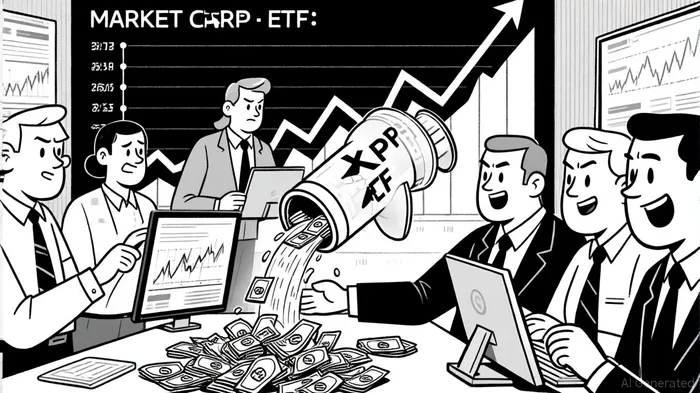
The approval of XRP ETFs could mechanically transform the token's liquidity and market dynamics. According to a report by CoinCentral, 16 ETF applications from major asset managers—including Grayscale, Bitwise, and WisdomTree—have an 87% likelihood of approval[5]. If realized, these ETFs could trigger $5–8 billion in inflows within the first month alone, significantly expanding XRP's market depth[5]. This influx would mirror the trajectories of BitcoinBTC-- and EthereumETH-- ETFs, which have attracted $50 billion and $27.6 billion in assets, respectively[5]. However, XRP's smaller daily trading volume (~$5 billion) compared to Bitcoin's (~$30 billion) could amplify volatility during periods of market stress[2].
The CME Group's XRP futures, which hit $1 billion in open interest, further underscore institutional confidence in the token's liquidity potential[4]. Analysts project that if XRP becomes a fixture in U.S. ETF baskets by 2035, its price could reach $50–$100, translating to a $3 trillion–$6 trillion market cap, assuming sustained adoption and regulatory support[1]. This growth would be driven by ETF-driven demand, real-world utility in cross-border payments, and Ripple's expanding partnerships[5].
Institutional Adoption: From Payments to Portfolios
Institutional adoption of XRP has accelerated post-2025, driven by its role in Ripple's On-Demand Liquidity (ODL) platform. For instance, Ripple's expanded custody partnership with BBVA in Spain, compliant with MiCA standards, highlights growing trust in XRP as a regulated digital asset[1]. The ODL platform, which processed $1.3 trillion in cross-border payments in Q2 2025, offers financial institutionsFISI-- tangible benefits like reduced funding costs and faster settlement times[5]. These use cases position XRP as a bridge asset in global remittances, where average fees remain high (~6%)[1].
Moreover, over 60 institutions have integrated XRP for treasury and cross-border operations, including banks like SBI Remit and Onafriq[5]. This adoption is not merely speculative; it reflects XRP's utility in solving real-world financial infrastructure challenges. As Ripple CEO Brad Garlinghouse noted, the post-2025 resolution allows the company to focus on expanding XRP's utility in cross-border corridors[6].
Price Projections and Risk Factors
Long-term price projections for XRP by 2035 vary widely. Conservative models suggest $10–$15 under moderate market conditions[3], while more aggressive forecasts from platforms like Telegaon envision $69.37–$87.49[5]. These divergences hinge on key variables:
1. Regulatory Clarity: Sustained legal certainty is critical. While the 2025 settlement resolved immediate concerns, future regulatory shifts—such as changes in SEC enforcement or international standards—could reintroduce uncertainty[6].
2. Competition: Stablecoins and central bank digital currencies (CBDCs) pose a threat to XRP's role in remittances[1]. Ripple's own RLUSD stablecoin could even cannibalize XRP's adoption as a bridge asset[1].
3. Technological Execution: The XRP Ledger's introduction of native automated market makers (AMMs) aims to improve liquidity, but technical execution risks remain[1].
Despite these challenges, XRP's ETF inclusion could create a self-reinforcing cycle. Institutional demand via ETFs would increase liquidity, which in turn would attract more institutional participation—a dynamic observed in Bitcoin and Ethereum's ETF-driven growth[5].
Conclusion: A Compelling Long-Term Investment
XRP's regulatory progress and institutional adoption trends make it a compelling long-term investment ahead of potential 2035 milestones. The token's unique position as both a utility asset (via ODL) and a speculative ETF candidate creates dual drivers of value. While risks such as regulatory shifts and competition exist, the post-2025 settlement has already de-risked a significant portion of XRP's profile. For investors seeking exposure to a crypto asset with clear regulatory progress, institutional traction, and a defined utility, XRP's ETF inclusion could serve as a catalyst for multi-year price appreciation.





Comentarios
Aún no hay comentarios