
XRP's Potential Breakout Amid Shifting Regulatory Narratives
The XRPXRP-- ecosystem is undergoing a transformative phase as regulatory clarity and institutional adoption converge to reshape its market dynamics. Following the U.S. Securities and Exchange Commission's (SEC) landmark rulings in 2025, which affirmed XRP's non-security status in secondary markets[1], the token has emerged as a focal point for institutional investors seeking exposure to utility-driven digital assets. This analysis explores strategic entry points for institutional capital in the post-SEC enforcement environment, emphasizing technical indicators, regulatory tailwinds, and macroeconomic catalysts.
Regulatory Clarity: A Catalyst for Institutional Confidence
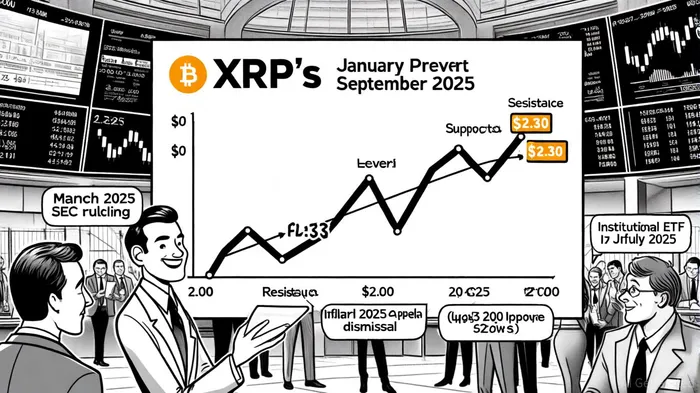
The SEC's March 2025 ruling, which distinguished XRP's secondary market transactions from institutional sales[2], marked a pivotal shift in the token's legal narrative. By rejecting the SEC's motion to reclassify XRP as a security in public exchanges, Judge Analisa Torres provided a clear framework for distinguishing between primary and secondary market activities[3]. This decision not only shielded retail investors but also created a regulatory safe harbor for institutional players.
The August 2025 dismissal of appeals by both Ripple and the SEC[4] further solidified this clarity. With the court's approval pending, the settlement—requiring Ripple to pay a $125 million fine for past institutional sales—has effectively decoupled XRP's utility from securities law constraints[5]. As a result, institutional investors can now evaluate XRP based on its intrinsic value as a cross-border payment solution and governance token, rather than its regulatory status.
Institutional Adoption: From ETFs to On-Demand Liquidity
The post-ruling environment has spurred rapid institutional adoption. The ProShares Ultra XRP ETF (UXRP), launched in July 2025, attracted $1.2 billion in inflows within its first month[6], signaling robust demand for regulated exposure. Similarly, the REX-Osprey XRPR ETF secured $33.57 million in assets under management within a week[7], underscoring XRP's appeal as a liquid, high-utility asset.
Beyond ETFs, Ripple's On-Demand Liquidity (ODL) service has become a cornerstone of institutional strategy. By processing $1.3 trillion in cross-border transactions in Q2 2025[8], ODL has positioned XRP as a cost-effective alternative to traditional SWIFT transfers. Strategic partnerships with global banks like Santander and Standard Chartered[9] further validate its role in real-world applications. Additionally, the Flare Network's FXRP token has enabled $236 million in Total Value Locked (TVL) for staking and lending[10], expanding institutional avenues for yield generation.
Technical Analysis: Key Levels and Breakout Potential
From a technical perspective, XRP's price action in Q3 2025 has formed a symmetrical triangle pattern, with critical support at $2.00 and resistance near $2.30[11]. A breakout above $2.30 could trigger a rally toward $2.92, with a Fibonacci extension target of $3.65[12]. Analysts have highlighted growing volume in late June 2025 as a sign of renewed buyer interest[13], while bullish indicators like RSI and MACD suggest momentum is building.
Institutional investors should monitor liquidity gaps and price compressions as potential precursors to a parabolic move. If XRP fails to hold above $2.00, a pullback to $1.80 or $1.61 could occur[14], but a sustained breakout above $3.08 may open the door to $5.85–$6.19[15]. The approval of spot XRP ETFs in October 2025[16] is expected to act as a catalyst, potentially injecting $8.4 billion into the market[17].
Historical data from past breakout events at $2.30 reveals mixed outcomes for a simple buy-and-hold strategy. Between 2022 and 2025, 16 instances of XRP closing above $2.30 were analyzed, with a median 30-day return of +1.8%—significantly lower than the buy-and-hold benchmark of +7.9%. The win rate for these breakouts was 37% (6 winners vs. 10 losers), suggesting that while the $2.30 level is technically significant, it does not guarantee consistent outperformance. Notably, the highest average out-performance occurred on day 9 (+3.9 ppt vs. benchmark), but this was not statistically significant at the 95% confidence level. These findings underscore the importance of combining technical signals with risk controls, such as shorter holding periods or stop-loss mechanisms, to refine entry strategies.
Strategic Entry Points and Risk Management
For institutional investors, strategic entry points should align with both technical and fundamental catalysts. Key levels to consider include:
1. Support Zone Accumulation: Accumulating near $2.00–$2.18 with stop-loss strategies below $2.90[20].
2. Breakout Confirmation: Entering above $2.30 with a target of $2.92–$3.65[21].
3. ETF-Driven Inflows: Positioning ahead of October 2025 ETF approvals, leveraging expected liquidity surges[22].
Risk management frameworks must account for macroeconomic headwinds, such as the U.S. Producer Price Index (PPI), which could temporarily dampen demand[23]. Diversifying exposure across XRP-based ETFs, stablecoins (e.g., RLUSD), and tokenized funds (e.g., BlackRock's BUIDL) can mitigate volatility while capitalizing on XRP's dual role as a payments asset and investment vehicle[24].
Conclusion
XRP's regulatory resolution has unlocked a new era of institutional participation, driven by utility, liquidity, and governance. As the final court approval nears, investors should prioritize strategic entry points aligned with technical breakouts and ETF-driven demand. While risks remain—particularly around Ripple's governance structure and macroeconomic volatility—the token's role in cross-border settlements and RWA tokenization positions it as a bridge between traditional finance and blockchain innovation. For institutions, the current environment offers a rare combination of regulatory clarity and market momentum, making XRP a compelling addition to diversified portfolios.






Comentarios
Aún no hay comentarios