
XRP's Potential Breakout Amid Bullish Indicators and Liquidity Clusters
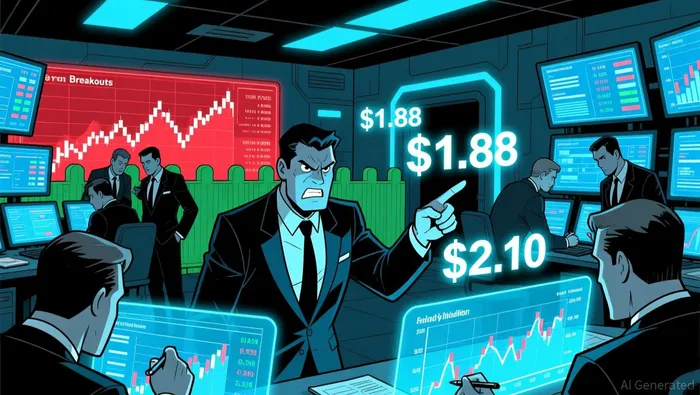
XRP, the native token of the XRPXRP-- Ledger, has entered a critical juncture in its price trajectory, marked by a confluence of technical and on-chain signals that suggest a potential reversal. As the token consolidates near $1.88–$2.10, historical patterns, liquidity clusters, and divergences in key metrics paint a nuanced picture of market dynamics. This analysis explores how XRP's current positioning-coupled with institutional inflows and shifting on-chain behavior-could foreshadow a breakout, despite lingering bearish pressures.
Technical Indicators: A Fragile Equilibrium
XRP's technical landscape reveals a tug-of-war between bullish and bearish forces. The token has been trading within a descending channel, with the Parabolic SAR indicator reinforcing its range-bound nature. However, the Relative Strength Index (RSI) has yet to cross above the neutral 50 threshold, signaling cautious momentum. More intriguingly, the MACD has shown bearish divergence, as price attempts to rise lack corresponding volume, raising questions about the sustainability of any near-term rally.
Historically, XRP has demonstrated explosive breakouts after prolonged consolidations. For instance, after a 10-month consolidation near $0.50–$0.60 in 2024–2025, XRP surged to $3.65 in July 2025 before retreating to $1.88 by December. The current consolidation phase mirrors this pattern, with liquidity clusters forming between $1.90 and $2.03. These levels often attract reactive buying, suggesting a short-term rebound toward $2.10 could materialize.
On-Chain Signals: Accumulation Amid Selling Pressure
On-chain data reveals a mixed narrative. While exchange inflows-particularly on Binance-have surged, with deposits ranging between 35 million and 116 million XRP since mid-December, this activity signals positioning for selling rather than accumulation. Conversely, sustained outflows from exchanges indicate long-term holders are accumulating, tightening liquidity and historically preceding price appreciation.
Liquidity clusters near $3.4–$3.8 remain a focal point, with Coinglass data highlighting dense order activity in this range. This suggests that traders are actively positioning for a potential rebound, even as the token trades far below these levels. The Market Value to Realized Value (MVRV) ratio has fallen to 1.26, placing XRP in a historically favorable zone for rebounds. However, the token's low volatility relative to BitcoinBTC-- underscores divergent market behavior, complicating traditional crypto benchmarks.
Wallet Distribution: Centralization and Retail Constraints
XRP's wallet distribution highlights structural challenges. The top 0.01% of wallets-just 734 accounts-hold over 48 billion XRP, a 7-year high. Meanwhile, the number of wallets holding 100 million or more tokens has dropped by 20.6% in eight weeks, yet remaining large wallets now control a larger share of the supply. This centralization raises questions about liquidity availability and price elasticity.
For retail investors, the cost of 1,000 XRP has risen from $500 to $1,750 in a year, making large-scale accumulation increasingly difficult. Over 6 million wallets hold 500 XRP or fewer, but these accounts collectively control a small fraction of the total supply. This dynamic could amplify price swings as retail demand struggles to counterbalance institutional activity.
Historical Precedents and Institutional Tailwinds
XRP's historical behavior offers a roadmap for potential outcomes. In 2025, a consolidation phase between $0.50–$0.60 led to a 48% pullback after a $3.65 peak. The current consolidation between $1.88–$2.10 mirrors this setup, with Fibonacci targets at $3.40 and $5.85 projected by Egrag Crypto. Institutional adoption, including the OCC's conditional approval of Ripple's bank charter and growing ETF interest, further supports a bullish backdrop.
However, macroeconomic risks persist. The crypto derivatives market saw $150 billion in liquidations in 2025, driven by crowded long positions and trade policy shifts. While XRP's volatility has been lower than Bitcoin's, this could change if macroeconomic shocks intensify.
Conclusion: A High-Probability Setup?
XRP's technical and on-chain signals suggest a fragile equilibrium, with bullish divergence in RSI and MACD hinting at weakening bearish momentum. Liquidity clusters near $3.4–$3.8 and historical consolidation patterns reinforce the case for a potential breakout. Yet, exchange inflows and macroeconomic risks cannot be ignored.
For investors, the key lies in monitoring the $2.10 resistance level and the MVRV ratio's trajectory. A sustained break above $2.10 could reignite institutional demand, while a failure to hold above $1.88 might extend the downtrend toward $1.25. Given the interplay of accumulation, liquidity, and institutional tailwinds, XRP's next move could redefine its 2026 outlook.






Comentarios
Aún no hay comentarios