
XRP's Post-Ripple CTO Transition: Leadership Shifts and Token Resilience in a Volatile Market
Leadership Transitions and XRP's Market Dynamics: A Post-Transition Analysis
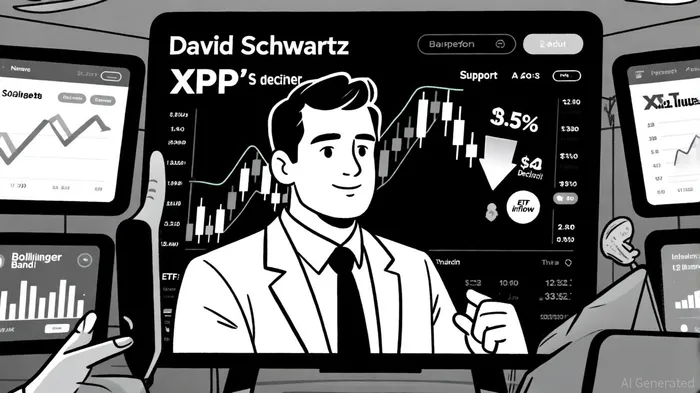
Ripple's October 2025 leadership transition, marked by David Schwartz's shift from Chief Technology Officer to CTO Emeritus, has sparked renewed scrutiny of XRP's market dynamics. While the move signals a strategic pivot for the company, it also introduces short-term uncertainty that has rippled through investor sentiment. According to a report by Coin Tribune, XRP's price dropped 3.5% in the immediate aftermath, testing the critical $2.40 support level as traders grappled with questions about technical leadership continuity. This reaction mirrors broader patterns observed in the crypto sector, where leadership changes often trigger volatility, albeit with varying degrees of severity.
The Ripple Effect: Contextualizing the Transition
David Schwartz's 13-year tenure as CTO positioned him as a linchpin in the development of the XRPXRP-- Ledger (XRPL). His transition to a board-level advisory role, while ensuring strategic oversight, has raised concerns about the execution of Ripple's roadmap. CEO Brad Garlinghouse emphasized Schwartz's legacy as a "true OG in crypto" and highlighted Dennis Jarosch's appointment as a seamless continuation of technical leadership. However, market participants remain cautious. As noted by Coin Tribune, the shift coincided with broader macroeconomic headwinds, including a 5% BitcoinBTC-- selloff, compounding downward pressure on XRP.
The token's technical indicators further underscore fragility. XRP approached the lower Bollinger Band at $2.34, a level often associated with bearish breakdowns, while analysts projected a short-term price prediction of $2.87–$3.25 for October 2025. These dynamics highlight the delicate balance between institutional confidence and market skepticism.
Comparative Insights: Leadership Transitions in the Crypto Ecosystem
To contextualize XRP's response, it is instructive to examine how similar transitions have impacted other tokens. For instance, Binance's 2024 leadership change-when Changpeng Zhao stepped down-triggered a sharp but temporary 12% decline in BNB's price, reflecting heightened volatility in centralized projects. Conversely, Uniswap's 2023 CEO transition had a muted effect on UNI, suggesting that decentralized governance models can mitigate leadership risks.
Ripple's hybrid model-combining centralized corporate governance with decentralized ledger technology-appears to occupy a middle ground. While Schwartz's board-level role provides continuity, the absence of a fully decentralized governance framework leaves XRP exposed to leadership-driven uncertainty. This contrasts with BNB's resilience, which has been bolstered by its deflationary token burn mechanism and expanding DeFi utility.
Institutional Confidence and Regulatory Catalysts
Despite the near-term volatility, XRP's institutional adoption trajectory remains robust. September 2025 saw $210 million in inflows into XRP-related ETFs, signaling sustained long-term demand. This aligns with Ripple's strategic pivot toward expanding the XRP Ledger beyond payments, including NFTs and DeFi use cases, as David Schwartz announced his departure from the CTO role. Moreover, the anticipation of SEC decisions on XRP ETF approvals between October 18 and 25 has created a binary catalyst: a potential green light could unlock billions in institutional capital, propelling XRP toward $3.25.
Regulatory clarity post-litigation has also strengthened XRP's fundamentals. Following Ripple's partial victory against the SEC, the token's market cap surged 246% in Q4 2024, reaching $119.5 billion, and the reduced minimum reserve requirements on the XRP Ledger (from 10 XRP to 1 XRP) spurred a 382% increase in new addresses. Such developments underscore XRP's utility-driven appeal, which may buffer it against leadership-related headwinds.
The Road Ahead: Balancing Risks and Opportunities
For XRP to regain bullish momentum, Ripple must demonstrate continuity in its technical roadmap and accelerate real-world adoption. The appointment of Dennis Jarosch, a seasoned engineer with deep expertise in XRPL, is a positive signal. However, the market will closely scrutinize his ability to innovate in areas like cross-border payments and institutional partnerships.
In the broader market, XRP faces competition from stablecoins and settlement alternatives, but its institutional-grade use cases-such as Ripple's On-Demand Liquidity (ODL) network-offer a unique value proposition. Analysts project that XRP's price will hinge on three factors: (1) regulatory outcomes in late October, (2) adoption of ETFs, and (3) execution on the XRP Ledger's expansion.
Conclusion
Ripple's CTO transition has introduced short-term volatility, but XRP's long-term trajectory remains anchored in institutional adoption and regulatory progress. While the token's market resilience lags behind BNB's DeFi-driven growth, its role in cross-border payments and strategic board-level continuity provide a counterbalance. Investors must weigh the immediate uncertainty against the potential for ETF-driven inflows and XRPL's expanding utility. As the crypto market navigates a pivotal regulatory phase, XRP's ability to adapt to leadership shifts will be a critical determinant of its future performance.






Comentarios
Aún no hay comentarios