
XRP's Post-Crypto Crash Recovery Potential: Regulatory Clarity and Institutional Adoption as Catalysts for Price Resurgence
The cryptocurrency market's 2022-2023 crash left scars across the industry, but 2025 has emerged as a pivotal year for XRPXRP--. With the U.S. Securities and Exchange Commission (SEC) case against Ripple Labs finalized in August 2025, XRP's legal status has been redefined, unlocking a new era of institutional adoption and market optimism. This analysis explores how regulatory clarity and institutional infrastructure are positioning XRP as a prime candidate for sustained price recovery and long-term growth.
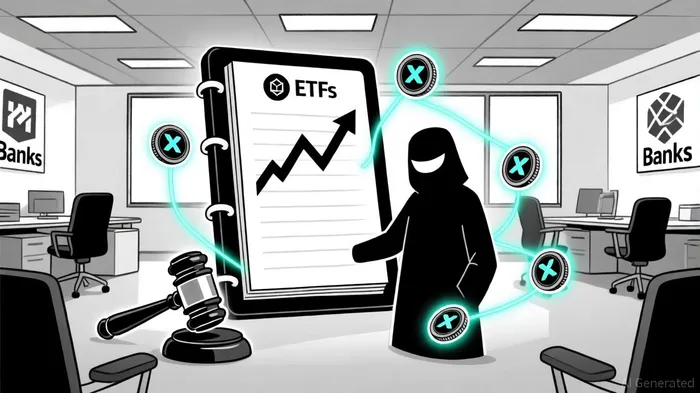
Regulatory Clarity: A Game-Changer for XRP's Market Viability
The August 2025 resolution of the Ripple-SEC dispute marked a watershed moment. By dismissing all appeals and cross-appeals, the court affirmed that XRP traded on public exchanges is not a security, according to a Currency Analytics report. This distinction removed a decade-long legal overhang, enabling XRP to transition from a speculative asset to a utility-driven digital asset with clear regulatory boundaries.
The implications are profound. For the first time, institutional investors can engage with XRP without the risk of regulatory scrutiny. As stated by The Currency Analytics in a post-resolution report, "This clarity has transformed XRP into a mainstream financial instrument, with Ripple's On-Demand Liquidity (ODL) services now operating under a stable legal framework." The settlement also included a $125 million payment from Ripple to the SEC, a symbolic but necessary step to close the chapter on past conflicts.
Institutional Adoption: ETFs and Liquidity as Catalysts
The most immediate evidence of institutional confidence is the launch of the first U.S.-listed spot XRP ETF, REX-Osprey XRPR, on September 18, 2025. According to Financial Content, the ETF attracted over $1.2 billion in trading volume within its first week, signaling robust demand from institutional and retail investors alike. Analysts project that the ETF could draw $5–$11 billion in inflows during its first year, driven by its low-cost structure and XRP's role in cross-border payments.
This momentum is further amplified by Ripple's strategic acquisition of Hidden Road, a leading institutional custody and liquidity provider. By integrating Hidden Road's infrastructure, Ripple has created a seamless bridge between traditional finance and the XRP Ledger (XRPL), enabling banks and payment processors to adopt XRP with minimal friction. The result? A growing ecosystem of institutional participants, including major custodians and asset managers, now treating XRP as a core component of their liquidity strategies.
Market Performance and Future Projections
According to a TradingView report, the token has outperformed Ether (ETH) in key metrics such as transaction volume and network usage, driven by its utility in fast, low-cost cross-border transactions. The removal of regulatory uncertainty has also spurred renewed developer activity on the XRP Ledger, with decentralized finance (DeFi) and NFT projects gaining traction, as noted by Financial Content.
Looking ahead, the SEC's upcoming decisions on multiple spot XRP ETF applications (October 18–25, 2025) could act as a tailwind. If approved, these ETFs could further institutionalize XRP's market presence, mirroring the ETF-driven bull runs seen with BitcoinBTC-- and EthereumETH--.
Conclusion: A New Paradigm for XRP
The confluence of regulatory clarity and institutional adoption has redefined XRP's trajectory. No longer constrained by legal ambiguity, the token is now poised to capitalize on its core strengths: speed, scalability, and utility in global finance. For investors, this represents a rare opportunity to participate in a digital asset with both speculative and fundamental value.
As the crypto market continues to mature, XRP's 2025 resurgence serves as a case study in how regulatory resolution can unlock institutional capital and drive long-term price appreciation.






Comentarios
Aún no hay comentarios