
Why XRP Is Poised for a Major Bull Run in 2026
Market Structure: A Foundation of Resilience
XRP's on-chain metrics tell a story of cautious optimism. In October 2025, the XRP Ledger saw a 60% surge in daily activations, with over 5,000 new accounts created, according to a Coinotag report. This growth in user activity, however, contrasts with declining transaction volumes - that Coinotag report also noted volumes dropping from one million to under that thresholdT-- since early October. The divergence suggests a shift in user behavior: retail investors are increasingly treating XRP as a speculative asset, while whales are capitalizing on price dips to accumulate or liquidate positions. For instance, whale-to-exchange transactions spiked in October 2025, triggering short-term corrections, according to a CoinEdition analysis.
Technically, XRP is perched on a knife's edge. The token must hold above $2.30 to retest key resistance levels at $2.76 and $3.54, per CoinEdition. A break above $3.65 could propel it toward an all-time high. However, the RSI at 38 indicates weak momentum, and the XRP burn rate-a proxy for deflationary pressure-has plummeted to 741 XRP per day, down from 4,500 in August, according to a Coinotag burn-rate update. This suggests that while retail demand is alive, institutional forces are now the primary drivers of price action.
Institutional Catalysts: The New Engine of Growth
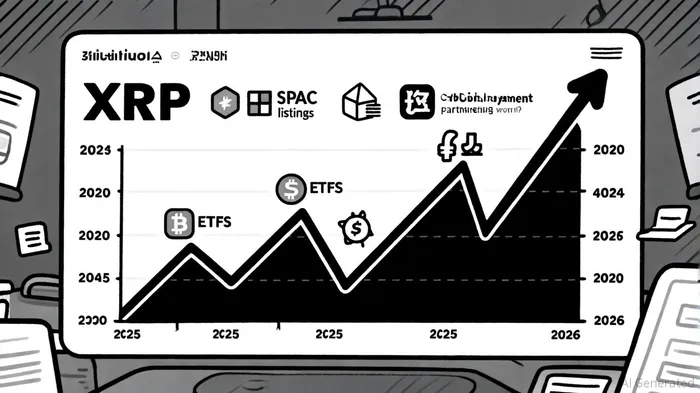
The real fireworks begin with institutional adoption. In Q3 2025, the REX-Osprey XRP ETF surpassed $100 million in assets under management, offering a regulated on-ramp for institutional investors, as covered by Coinotag. This was followed by CME Group launching XRP options contracts, expanding hedging tools and liquidity, a development noted in that Coinotag coverage. Meanwhile, Evernorth-a newly formed XRP-focused treasury firm-accumulated 261 million XRP tokens between October 20 and 24, 2025, with plans to raise $1 billion and list on Nasdaq as "XRPN" in Q1 2026, according to a Markets article. These moves signal a shift from speculative trading to strategic, long-term positioning.
Regulatory clarity has also been a game-changer. The U.S. SEC's August 2025 dismissal of its lawsuit against Ripple reclassified XRP as a commodity, unlocking over $1.1 billion in institutional purchases, a development highlighted in a Coinotag ETF milestone. That legal victory has enabled XRP to deepen partnerships with Santander, SBI Holdings, and American Express, leveraging Ripple's On-Demand Liquidity (ODL) service to process $1.3 trillion in annual transactions, as noted in the same Coinotag piece. The hybrid infrastructure-combining blockchain with legacy systems-has slashed remittance costs by up to 90% and settlement times to sub-5 seconds, according to a BitJournal analysis.
Cross-Border Payments and AMM Innovations: The Utility Play
XRP's utility in cross-border payments is no longer theoretical. Partnerships like SBI Remit's instant transfers between Japan and the Philippines were documented by Currency Analytics, Tranglo's expansion across 20–25 Asia-Pacific corridors was reported by Invezz, and Pyypl's Middle East remittance service was also covered by Invezz; together these integrations have turned XRP into a real-world liquidity solution. Ripple's RLUSD stablecoin, integrated with DeFi platforms, has already tokenized $300 million in real-world assets (RWAs), a figure highlighted in that Coinotag ETF milestone.
On the technical front, the XRP Ledger's Q3 2025 upgrades-such as the Multi-Purpose Token (MPT) standard and a native lending protocol-have positioned it as a DeFi hub for institutions, as detailed in a Coin-Views deep dive. These features enable tokenized bonds, structured products, and privacy-preserving collateral management, all while adhering to KYC/AML standards. The result? A platform that bridges the gap between traditional finance and blockchain innovation.
The 2026 Bull Case: A Perfect Storm
For XRP to break out in 2026, three conditions must align:
1. Regulatory Tailwinds: Continued clarity on XRP's commodity status will attract more ETFs and institutional treasuries.
2. Institutional Liquidity: Evernorth's Nasdaq listing and CME options will deepen market depth, reducing volatility.
3. Utility Expansion: Cross-border partnerships and AMM upgrades will drive real-world demand, creating a flywheel of adoption.
The risks are real-competition from projects like Remittix (RTX) and macroeconomic headwinds could delay the bull run, as one analyst warned in a Coinotag design piece. But XRP's first-mover advantage in institutional corridors, coupled with its hybrid infrastructure, gives it a unique edge. As one analyst put it, "XRP isn't just a bridge between fiat and crypto; it's a bridge between legacy finance and the future."
Conclusion
XRP's 2026 bull case hinges on its ability to leverage institutional adoption, regulatory clarity, and real-world utility. With a market cap near $176 billion and a growing list of institutional partners, the asset is no longer just a speculative play-it's a strategic bet on the future of global finance. For investors, the question isn't whether XRP will rise, but how quickly it will outpace the competition.






Comentarios
Aún no hay comentarios