
Is XRP Poised for a Major Breakout in 2026?
The cryptocurrency market has always thrived on extremes-fear, greed, and the occasional contrarian bet that defies the noise. XRPXRP--, Ripple's native token, is now at a crossroads. On-chain data, institutional flows, and regulatory clarity are converging to create a setup that feels both fragile and explosive. For investors willing to look beyond the headlines, the risk-reward profile of XRP in 2026 is compelling.
Whale Accumulation: A Tale of Two Signals
XRP's whale activity in 2025 tells a story of consolidation and caution. Whale and shark holders now control a seven-year high of 48 billion XRP, despite a 20.6% drop in the number of 100M+ wallets over the past eight weeks according to data. This suggests a shift toward fewer, larger entities-likely institutions or sophisticated investors-hoarding the asset. Such concentration is often seen as bullish, as it reduces immediate selling pressure and signals long-term confidence according to market analysis.
However, the data isn't uniformly positive. The Whale to Exchange Flow metric has surged over the past 30 days, with Binance alone seeing 2.66 billion XRP ($6.5 billion) moved to exchanges according to reports. This could indicate a distribution phase, where large holders are preparing to offload their positions. Meanwhile, dormant XRP supply has reactivated at its highest level since July 2025, hinting that long-term holders are exiting rather than weathering volatility according to analysis.
The contradiction here is key. While whale accumulation suggests a bottoming process, the uptick in exchange inflows and reactivated supply raises red flags. The market is in a tug-of-war between accumulation and distribution, and the outcome will likely determine XRP's trajectory in 2026.
ETF Inflows: The Institutional Liquidity Sink
XRP's institutional adoption has been nothing short of meteoric. U.S.-listed XRP ETFs, including Franklin Templeton's XRPZ and Grayscale's GXRP, have driven $628 million in assets under management by late 2025, with projections of $6.7 billion by 2026 if inflows continue according to analysis. These ETFs have effectively reduced XRP's liquid supply on major exchanges by 29%, with Binance's XRP reserves dropping to 2.7 billion tokens over the last 30 days according to data.
This trend is critical. Institutional investors now hold 0.5% of the global circulating supply through ETFs according to market reports, creating a liquidity sink that stabilizes price and reduces volatility. The SEC's "Project Crypto" initiative has further legitimized XRP by enabling compliant ETF listings, a move that mirrors Bitcoin's post-ETF trajectory according to regulatory updates.
Technically, XRP is consolidating in a descending channel between $2.17 and $2.24 according to technical analysis. A breakout above $2.60 could trigger a rally toward $3.60, with institutional wallets holding 10M+ XRP increasing their positions by 8% since October 2025 according to market data. The ETF-driven demand is not just speculative-it's structural.
Legal Clarity: The Unseen Catalyst
Ripple's legal battle with the SEC has been a shadow over XRP for years. But 2025 brought clarity: the SEC's approval of generic listing standards for commodity-based trust shares according to regulatory updates has removed the existential threat of a securities ruling. This shift has unlocked institutional adoption, particularly in cross-border payments, where XRP's utility as a bridge currency is unmatched according to market analysis.
The ripple effect (pun intended) is significant. Financial institutions now view XRP as a regulated, compliant asset, not a legal risk. Ripple's launch of its dollar-pegged stablecoin, RLUSD, further cements its role in the global payments ecosystem according to industry reports. For investors, this legal clarity is a foundational catalyst-something that AI models often overlook in favor of short-term volatility.
Macroeconomic Tailwinds and Contrarian Bets
The broader macroeconomic environment is a mixed bag. The Federal Reserve's hawkish stance has kept interest rates elevated, making risk-free Treasury yields more attractive than crypto's speculative returns according to market analysis. Yet XRP's role in cross-border payments offers a unique value proposition: efficiency in an inflationary world.
Meanwhile, global crypto regulations are trending toward normalization. The U.S. is no longer the outlier; jurisdictions like Singapore and the EU are adopting frameworks that favor innovation according to regulatory developments. This creates a tailwind for XRP, which benefits from institutional-grade infrastructure and regulatory alignment.
The contrarian angle here is stark. While retail investors panic over short-term volatility XRP fell 19% in 30 days despite a 39.43% YTD gain, institutions are quietly accumulating. The fear in the market is a buying opportunity for those who understand the structural forces at play.
AI Caution vs. Bullish Analysts: A Battle of Narratives
XRP's price chart over the past year shows sharp corrections followed by rapid recoveries 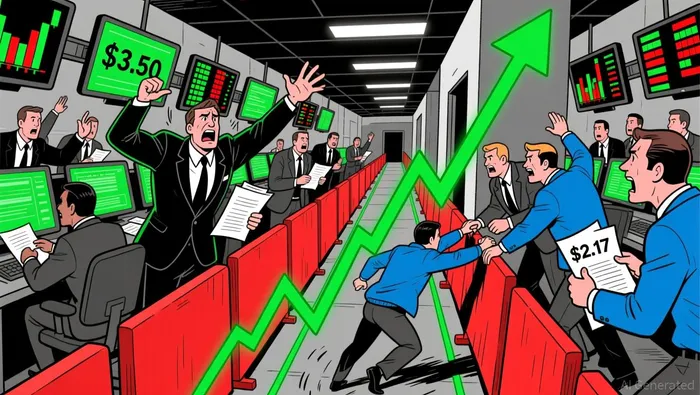 . AI models like ChatGPT predict a cautious $4.40 target for XRP by early 2026 according to AI analysis, citing extreme fear and macroeconomic headwinds. Polymarket traders are even more bearish, assigning a 95% probability that XRP will stay below $3.20 according to market sentiment.
But seasoned analysts are more optimistic. They argue that XRP could hit $5–$6 by 2026, driven by legal clarity, ETF inflows, and Ripple's expansion into new markets according to analyst reports. Technical indicators support this view: a breakout above $2.60 could shift momentum toward $3.60 and beyond according to technical analysis.
The key takeaway is that AI models often overemphasize short-term volatility while underestimating structural changes. For contrarian investors, this divergence between AI caution and analyst bullishness is a green light.
Conclusion: A High-Risk, High-Reward Setup
XRP's path to a 2026 breakout hinges on three factors:
1. Whale accumulation stabilizing the asset while ETF inflows create a liquidity sink.
2. Legal clarity unlocking institutional adoption and cross-border utility.
3. Contrarian timing capitalizing on extreme fear and AI-driven pessimism.
The risk is real-dormant supply reactivation and exchange inflows could derail a rally. But for investors with a multi-year horizon, the reward is asymmetric. If XRP breaks above $2.60 and ETF inflows continue, the next leg higher could be explosive.
In a market where fear is the dominant narrative, XRP's institutional-driven momentum offers a compelling counterpoint. For those willing to bet against the noise, the risk-reward setup is hard to ignore.







Comentarios
Aún no hay comentarios