
Is XRP Poised to Disrupt SWIFT in 2026? A Deep Dive into Institutional Adoption and Strategic Market Positioning
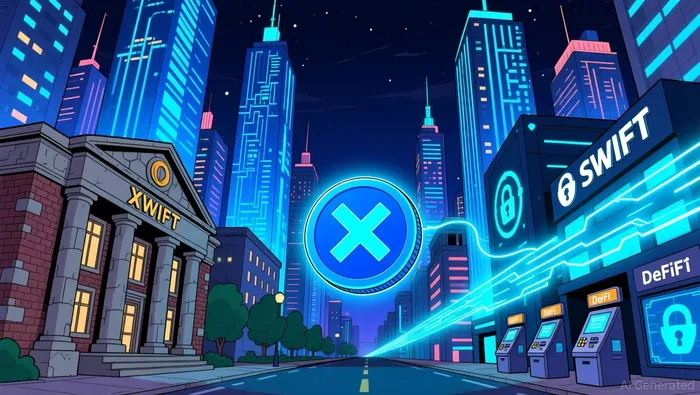
The global financial landscape is on the cusp of a seismic shift, driven by the convergence of blockchain technology and institutional-grade infrastructure. At the heart of this transformation lies XRPXRP--, Ripple's native asset, which has emerged as a formidable contender in the cross-border payments arena. With a series of strategic moves in late 2025-including a landmark SEC settlement, a $1.25 billion acquisition, and the rebranding of its prime brokerage arm-Ripple has positioned XRP as a bridge currency capable of challenging traditional systems like SWIFT. This article examines the institutional adoption dynamics, market positioning, and regulatory clarity that could propel XRP to a pivotal role in 2026.
Institutional Adoption: A Catalyst for XRP's Growth
Ripple's institutional push in late 2025 was marked by a $125 million SEC settlement, which immediately bolstered confidence among financial institutions. This legal clarity allowed banks to integrate XRP into their systems without regulatory hesitation. The acquisition of Hidden Road, rebranded as Ripple Prime, further solidified Ripple's institutional footprint. By offering clearing, financing, and OTC trading, Ripple Prime became the first crypto-owned global prime brokerage, directly competing with traditional Wall Street firms.
The ProShares XRP ETF, launched on July 18, 2025, and the integration of XRP with ISO 20022 standards by August 2025 underscored the token's alignment with global financial infrastructure. By December 2025, RippleNet had expanded to over 300 institutions, with XRP's role in DeFi beginning to take shape through smart contracts and liquidity provisioning. These developments, combined with partnerships like the on-chain settlement of Gemini credit card payments via RLUSD (a stablecoin pegged to the U.S. dollar), demonstrated XRP's real-time settlement capabilities.
Strategic Market Positioning: From Legal Clarity to Liquidity Moves
 Chris Larsen's $26 million XRP liquidity move in late 2025 further signaled institutional confidence. While Larsen's associated wallet still holds 2.58 billion XRP, valued at $8.8 billion, his liquidity initiatives helped stabilize the token's price amid growing institutional demand. This move coincided with Ripple's $500 million investment at a $40 billion valuation, secured during Swell 2025, which brought in heavyweights like Citadel Securities and Fortress Investment Group.
The Swell 2025 event in New York City became a turning point, merging discussions on tokenized assets, cross-border payments, and stablecoin custody. High-profile attendees, including BlackRock's Maxwell Stein and Nasdaq's Adena Friedman, highlighted the growing acceptance of XRP-based investment products. The event also announced the first Spot XRP ETF in the U.S., signaling a shift from speculative interest to tangible adoption.
Disrupting SWIFT: XRP's Competitive Edge
Ripple's XRP Ledger (XRPL) offers a compelling alternative to SWIFT by enabling transactions to settle in seconds, with thousands of transactions per second and minimal fees. The On-Demand Liquidity (ODL) service bypasses the need for pre-funded accounts in multiple jurisdictions, unlocking over $27 trillion in liquidity globally. This efficiency is further amplified by RLUSD, which facilitates instant U.S. dollar settlements for institutions like Braza Bank, Zand Bank, and Corpay.
Ripple's strategic acquisitions-such as Palisade for custody solutions and GTreasury for treasury management-have positioned it to offer end-to-end financial services. CEO Brad Garlinghouse emphasized that these moves create a complementary system to SWIFT rather than a direct replacement. By leveraging the XRP Ledger, Ripple streamlines post-trade processes and enables 24/7 instant settlements, accelerating the convergence of traditional finance and blockchain technology.
The Investment Case: Pre-Swell 2026 Momentum
With Swell 2026 scheduled for October 27–29, 2026, in New York City, the stage is set for a unified gathering of financial leaders and developers. This event aims to bridge institutional adoption with on-chain innovation, creating a cohesive platform for advancing XRP's utility. Analysts predict three potential outcomes for XRP: a bullish scenario driven by ETF approvals and RLUSD adoption, a base scenario of sideways trading as ETF timelines stretch into 2026, and a bearish scenario tied to historical price patterns.
The recent $26 million liquidity move by Larsen and Ripple's institutional partnerships-such as DBS Bank's use of Ripple Custody and BlackRock's tokenization efforts on the XRP Ledger-underscore the token's growing infrastructure. These developments, combined with XRP's ISO 20022 compliance and the expansion of RippleNet to 300+ institutions, suggest a critical inflection point is approaching.
Conclusion: A Compelling Pre-Swell 2026 Investment
XRP's institutional adoption and strategic market positioning have created a robust foundation for disrupting SWIFT in 2026. The convergence of regulatory clarity, liquidity support, and institutional partnerships-coupled with the XRP Ledger's technical advantages-positions the token as a bridge asset in a blockchain-driven global economy. As Ripple prepares for Swell 2026, investors should closely monitor ETF approvals, RLUSD adoption, and the token's performance against historical patterns. For those seeking exposure to the next wave of financial innovation, XRP offers a compelling case ahead of what could be a defining year for cross-border payments.







Comentarios
Aún no hay comentarios