
Is XRP Poised for a 330% Surge to $8 by 2026?
The cryptocurrency market has long been a theater of volatility, but XRP's trajectory in 2025 and early 2026 suggests a unique confluence of institutional adoption and regulatory tailwinds that could propel the asset to unprecedented heights. With a price target of $8 by year-end 2026 gaining traction among analysts, the question is no longer if XRPXRP-- can achieve this milestone, but how the interplay of institutional demand, regulatory clarity, and strategic infrastructure will shape its path.
Institutional Adoption: A Catalyst for Growth
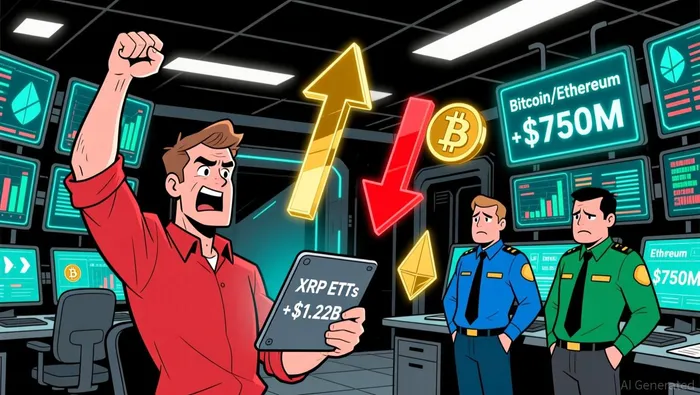
XRP's institutional adoption has accelerated dramatically in late 2025 and early 2026, driven by the launch of spot XRP ETFs and a $500 million equity funding round led by traditional finance (TradFi) heavyweights like Citadel and Fortress according to reports. These ETFs have attracted $1.22 billion in cumulative net inflows since their mid-November 2025 debut, with total net assets reaching $1.47 billion- 1.16% of XRP's market capitalization. This inflow trend is particularly striking given that Bitcoin and Ethereum ETFs faced combined outflows of $750 million during the same period.
The institutional appetite for XRP is further underscored by Ripple's strategic partnerships, including its collaboration with Mastercard and Gemini as reported. These alliances, coupled with the company's $40 billion valuation post-funding round, signal a shift in institutional perception from skepticism to strategic integration. Ripple's focus on regulated stablecoin infrastructure, exemplified by its RLUSD stablecoin, has positioned XRP as a bridge between traditional finance and blockchain innovation according to analysis.
Regulatory Clarity: A Foundation for Legitimacy
Regulatory uncertainty has historically been a drag on XRP's institutional adoption. However, the SEC's August 2025 settlement- resolving a four-year legal battle for $125 million-has removed a critical overhang. This resolution, combined with the anticipated passage of the Clarity Act in 2026, is expected to create a legal framework that legitimizes XRP for institutional portfolios.
The Clarity Act, if passed, would provide a clear regulatory pathway for digital assets, reducing compliance risks for asset managers. This legislative progress has already enabled XRP's re-listing on U.S. exchanges and spurred nine asset managers to file spot XRP ETF applications. Analysts project these ETFs could attract $5–$7 billion in inflows by 2026, further amplifying institutional demand.
Strategic Expansions and Market Dynamics
Ripple's ecosystem expansion has also bolstered XRP's utility. Acquisitions of firms like Hidden Road, Rail, and GTreasury have enhanced its offerings in prime brokerage, stablecoin infrastructure, and corporate treasury solutions. These moves align with the growing demand for institutional-grade digital asset tools, particularly in cross-border payments-a sector where XRP's compliance-focused approach has long been a differentiator.
From a technical perspective, XRP's price action in early 2026 has been bullish. A 25% rally to $2.40 in January 2026, followed by a pullback to key support levels, suggests a maturing market dynamic. Exchange balances for XRP are at multi-year lows, indicating a shift from speculative trading to long-term holding-a trend often seen in assets with strong institutional backing.
Addressing Skepticism
Critics argue that XRP's limited developer activity and competition from faster blockchains could hinder its growth. Brian Huang of Glider, for instance, has highlighted XRP's absence from builder mindshare metrics. However, these concerns are increasingly outweighed by the asset's institutional traction. The XRP Army's community-driven advocacy, combined with Ripple's strategic infrastructure investments, has created a flywheel effect: regulatory clarity attracts institutional capital, which in turn drives price appreciation and further adoption.
The Path to $8
Standard Chartered's $8 price target for XRP by 2026 is not a mere extrapolation but a reflection of tangible drivers. At $8, XRP would represent a 330% surge from its $1.85 price in early 2026. This target hinges on three key factors:
1. Continued ETF inflows: Sustained institutional demand through regulated investment vehicles.
2. Clarity Act passage: Legislative validation of XRP's utility and compliance framework.
3. Macro conditions: A broader risk-on environment in 2026, which could amplify digital asset allocations.
While conservative estimates peg XRP at $2.30–$2.50, the broader consensus among bullish analysts remains anchored to the $8 threshold. This optimism is further reinforced by XRP's outperformance against BitcoinBTC-- and EthereumETH-- in 2025, despite a 13% annual decline.
Conclusion
XRP's journey to $8 by 2026 is not a speculative gamble but a calculated bet on institutional adoption and regulatory progress. With a $40 billion valuation, a $500 million funding round, and a growing ecosystem of regulated infrastructure, Ripple has positioned XRP as a cornerstone of the digital asset revolution. While challenges remain, the alignment of institutional demand, legal clarity, and strategic innovation makes a compelling case for XRP's 330% surge. For investors, the question is whether they will ride the wave-or be left behind.






Comentarios
Aún no hay comentarios