
Why XRP is Poised for a 2026 Breakout Amid ETF Adoption and Strategic Ecosystem Expansion
The cryptocurrency market in 2026 is witnessing a paradigm shift, driven by institutional-grade catalysts and structural supply-demand dynamics that position XRPXRP-- for a breakout year. While BitcoinBTC-- and EthereumETH-- grapple with macroeconomic headwinds and regulatory uncertainty, XRP has emerged as a unique asset class, leveraging ETF adoption, regulatory clarity, and a tightening supply narrative to attract capital inflows. This analysis examines the institutional forces and ecosystem developments underpinning XRP's trajectory.
Institutional Adoption: ETFs as a Gateway to Mainstream Capital
XRP's institutional adoption has accelerated in 2025, with spot ETFs becoming a critical on-ramp for traditional investors. According to a report by Yahoo Finance, XRP ETFs absorbed $483 million in net inflows during December 2025, despite a 15% decline in XRP's spot price from $2.22 to $1.77. This outperformed Bitcoin and Ethereum ETFs, which recorded outflows of $1.09 billion and $564 million, respectively, during the same period. The cumulative inflows into XRP ETFs reached $1.3 billion in just 50 days of trading, marking the fastest adoption rate for any altcoin ETF.
This surge is attributed to regulatory clarity following the August 2025 SEC settlement with Ripple, which resolved the long-standing legal dispute and reclassified XRP as a non-security. As stated by industry analysts, this development removed compliance risks for institutions, enabling mandate-driven allocations to XRP ETFs during their initial launch window. The ProShares Ultra XRP ETF (UXRP), approved by the SEC in July 2025, served as a catalyst, paving the way for applications from major asset managers like Grayscale and Franklin Templeton. By Q4 2025, the probability of spot XRP ETF approval was estimated at 95%, reflecting the SEC's evolving stance on digital assets.
Supply-Demand Dynamics: A Structural Tailwind
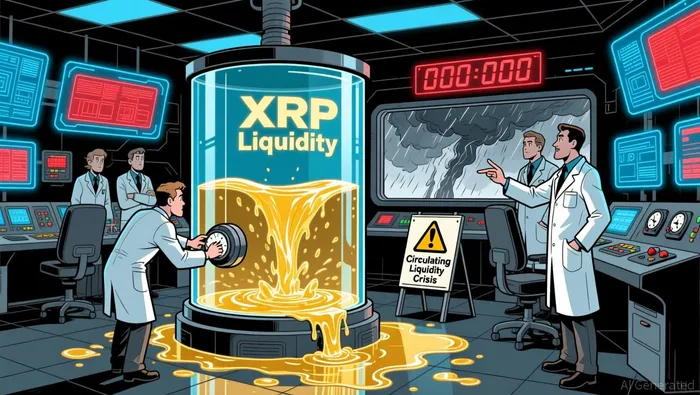
XRP's supply-side fundamentals are equally compelling. Data from 247WallSt indicates that exchange-held XRP balances fell by 45% over 60 days, from 3.95 billion to 2.6 billion tokens. By early 2026, this trend accelerated, with 1.35 billion XRP removed from exchanges in less than two months, signaling a 7-year low in circulating liquidity. This tightening of supply, combined with sustained ETF demand, creates a classic imbalance favoring price appreciation.
The reduction in exchange balances is driven by both institutional accumulation and strategic token burns. Ripple's enterprise partnerships and cross-border payment solutions have also incentivized XRP holders to lock tokens for utility rather than speculative trading. Unlike Bitcoin's store-of-value narrative, XRP's role in real-time gross settlement systems (e.g., RippleNet) and stablecoin ecosystems (e.g., RLUSD) provides a functional use case that justifies long-term holding.
Macroeconomic and Regulatory Tailwinds
The macroeconomic environment in 2026 further amplifies XRP's appeal. Goldman Sachs forecasts two additional Federal Reserve rate cuts in 2026, bringing rates to 3-3.25%. Historically, such monetary easing boosts risk assets, and XRP's low market cap relative to Bitcoin makes it particularly sensitive to liquidity injections.
Regulatory progress also remains a key driver. The potential passage of the U.S. Market Structure Bill in Q1 2026 could formalize XRP's status as a regulated asset, reducing compliance barriers for institutional portfolios. Meanwhile, Ripple's application for a federal banking charter in December 2025 opens the door for direct access to the Federal Reserve, attracting pension funds and insurance companies seeking diversified exposure.
Strategic Ecosystem Expansion
Beyond institutional flows, XRP's ecosystem expansion is gaining momentum. Ripple's partnerships with global financial institutions and the adoption of RLUSD (a stablecoin pegged to the U.S. dollar) are expanding XRP's utility in cross-border transactions. As noted by Trefis, this real-world demand creates a flywheel effect, where increased utility drives token value, which in turn attracts more institutional capital.
Risks and Conclusion
While the case for XRP is compelling, risks persist. Regulatory reversals, macroeconomic downturns, or whale distribution could disrupt the current trajectory. However, the confluence of ETF-driven institutional adoption, tightening supply, and macroeconomic tailwinds suggests that XRP is uniquely positioned to outperform in 2026. With price targets of $4–$5 already discussed by analysts, the asset's breakout potential hinges on maintaining the momentum in institutional flows and regulatory progress.







Comentarios
Aún no hay comentarios