
XRP's Path to All-Time High Amid Shifting Crypto Dynamics
The Institutional Adoption Revolution
XRP's institutional adoption in 2025 has reached unprecedented levels, driven by Ripple's strategic infrastructure upgrades and regulatory clarity. Following the resolution of its SEC lawsuit in August 2025, XRPXRP-- transitioned from a contested asset to a fully compliant utility token, enabling widespread integration into institutional workflows. Ripple's On-Demand Liquidity (ODL) service processed $1.3 trillion in Q2 2025 alone, with daily institutional inflows averaging $25 million [1]. Over 60 financial institutionsFISI--, including JPMorganJPM-- and SBI Holdings, now leverage XRP for cross-border settlements, treasury operations, and remittance corridors [2]. This adoption is further amplified by Ripple's XRP Ledger (XRPL) enhancements, such as automated market makers (AMMs) and tokenized U.S. Treasuries via Ondo Finance, which position XRP as a bridge between traditional finance and digital assets [3].
Network Utility: Speed, Cost, and Scalability
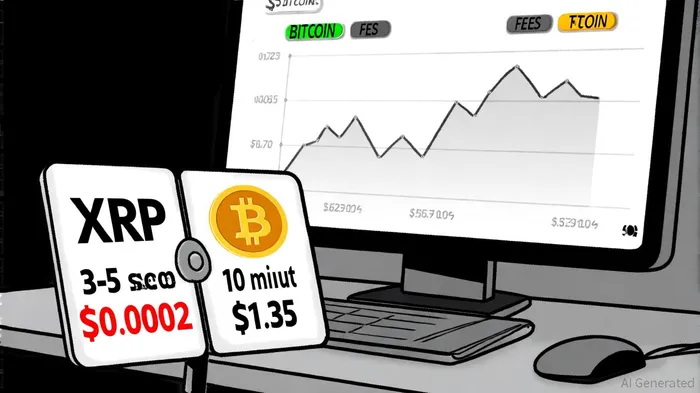
XRP's network utility metrics underscore its competitive edge. The XRP Ledger processed 2.14 million daily transactions in 2025, with 60% classified as payments—far outpacing Bitcoin's 300,000 daily transactions [4]. XRP's average transaction fee of $0.0002 contrasts sharply with Bitcoin's $1.35, while its settlement time of 3–5 seconds versus Bitcoin's 10-minute average makes it ideal for real-time cross-border transactions [5]. Beyond payments, XRP's ecosystem has expanded into tokenization of real-world assets, institutional-grade stablecoins (e.g., RLUSD), and decentralized finance (DeFi) applications [6]. These innovations have attracted partnerships with global payment providers and central banks, reinforcing XRP's role as a scalable infrastructure layer for financial systems [7].
Bitcoin's Enduring Dominance and XRP's Niche
Bitcoin remains the dominant store of value, with its market cap stabilizing at $2.19 trillion in 2025. Institutional adoption has surged through spot ETF approvals, which injected $14.7 billion into the market in H1 2025 [8]. However, Bitcoin's utility as a payment solution is constrained by its high fees and slower settlement times, limiting its appeal for institutional use cases requiring real-time liquidity [9]. Analysts project BitcoinBTC-- to reach $120,000–$220,000 by year-end 2025, but its growth is tied to macroeconomic factors rather than transactional utility [10].
XRP, by contrast, is carving out a niche in the global payments sector. Ripple's partnerships with over 200 financial institutions and the integration of XRP into regulated stablecoins like RLUSD and USDCUSDC-- have created a flywheel effect: increased adoption drives network effects, which in turn attract more institutional participants [11]. This dynamic is reflected in XRP's market cap growth, which rose 1.9% in Q1 2025 to $121.6 billion—outperforming Bitcoin, EthereumETH--, and SolanaSOL-- during a broader market downturn [12].
The Road to All-Time Highs
With institutional adoption accelerating and network utility expanding, XRP is positioned for a breakout. Analysts project a price range of $5–$7 by year-end 2025, with potential to reach $12.50 by 2028 if ETF approvals and corridor expansion materialize [13]. Key catalysts include:
1. Regulatory Tailwinds: The SEC's withdrawal of its appeal in August 2025 has cleared the path for XRP-based ETFs, expected to attract institutional capital.
2. Ecosystem Growth: Ripple's acquisition of Hidden Road and the launch of the XRPL EVM Sidechain testnet signal long-term infrastructure bets [14].
3. Macro Trends: As global remittances and cross-border trade rebound post-pandemic, XRP's cost efficiency becomes increasingly attractive.
While Bitcoin's dominance as a store of value is unlikely to wane, XRP's focus on utility and institutional integration positions it to capture market share in the payments sector. If Ripple's vision of a “borderless financial system” gains traction, XRP could see its market cap surge to $1.5 trillion—a 27% share of the crypto market [15].





Comentarios
Aún no hay comentarios