
XRP's Path to Outperforming Bitcoin in 2026: Technical and Institutional Catalysts
The cryptocurrency landscape in 2026 is poised for a seismic shift, with XRPXRP-- (Ripple's native token) emerging as a compelling alternative to BitcoinBTC--. While Bitcoin's dominance remains unchallenged in the store-of-value narrative, XRP's unique technical advancements and institutional adoption metrics position it to outperform in a risk-on environment. This analysis unpacks the catalysts driving XRP's breakout potential, contrasting it with Bitcoin's 2026 challenges.
Technical Catalysts: XRP Ledger's Evolution
The XRP Ledger (XRPL) has undergone transformative upgrades in 2025, setting the stage for 2026 dominance. By December 2025, XRPL version 3.0.0 was released, introducing a native lending protocol that enables protocol-level credit markets according to MEXC. This innovation, coupled with confidential multi-purpose tokens launching in Q1 2026, addresses institutional demands for privacy and collateral management as reported.
Privacy enhancements are central to XRP's roadmap. Zero-knowledge (ZK) proofs will be implemented to enable programmable privacy without compromising regulatory compliance according to 247WallSt. Ripple engineer J. Ayo Akinyele emphasized that these upgrades will attract developers and expand use cases in tokenized finance as MEXC reported. Meanwhile, XRPL's interoperability with cross-chain protocols like WormholeW-- reinforces its role as a bridge asset in cross-border settlements according to MEXC.
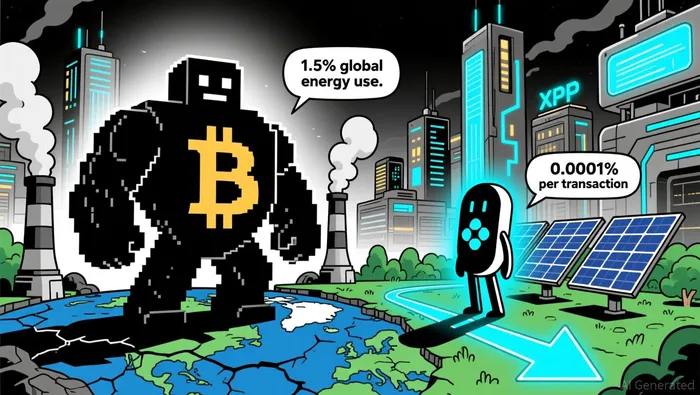
In contrast, Bitcoin's scalability limitations persist. Despite the 2024 halving event, Bitcoin's ~7 TPS and reliance on energy-intensive mining remain bottlenecks for mass adoption as noted. XRP's energy efficiency-consuming 99.99% less energy per transaction than Bitcoin according to LinkedIn-positions it as a superior solution for ESG-conscious enterprises.
Institutional Adoption: Regulatory Clarity and Real-World Utility
XRP's 2025 institutional adoption surge was catalyzed by the SEC settlement in August 2025, which confirmed XRP's non-security status for public exchange sales as AOL reported. This regulatory clarity enabled the launch of XRP ETFs, which absorbed $1.3 billion in 50 days in late 2025, with 43 consecutive days of positive inflows according to 247WallSt.
Enterprise partnerships have further solidified XRP's utility. Over 300 financial institutions, including Santander and Standard Chartered, leverage RippleNet for cross-border payments as Financial Planning Association noted. The launch of RLUSD, a U.S. dollar-backed stablecoin on XRPL, has boosted transaction volume and liquidity according to PM Insights. Developer activity also accelerated, with active XRP Ledger addresses growing 142% quarter-over-quarter in 2025 as PM Insights reported.
Ripple's strategic acquisitions, such as the $1.25 billion purchase of Hidden Road, have integrated XRP into institutional finance, enabling cross-margining and decentralized finance applications according to CME Group. These moves contrast with Bitcoin's reliance on ETFs and macroeconomic sentiment, offering XRP asymmetric upside potential due to its smaller market cap ($120 billion vs. Bitcoin's $2 trillion) according to 247WallSt.
Bitcoin's 2026 Challenges: Halving and Scalability
Bitcoin's 2026 halving event, while historically bullish for price, may not offset its structural limitations. The post-halving period could see increased scarcity-driven demand, but Bitcoin's throughput (~7 TPS) and energy consumption remain obstacles for real-time use cases as MEXC reported. Off-chain solutions like the Lightning Network mitigate some issues but lack the native efficiency of XRPL's 3–5 second settlement times and negligible fees according to LinkedIn.
In a risk-off scenario, Bitcoin's store-of-value narrative would likely outperform XRP. However, in a risk-on environment-driven by institutional adoption of real-world assets and DeFi-XRP's utility and regulatory progress provide a stronger catalyst according to 247WallSt.
Conclusion: XRP's Asymmetric Upside
XRP's 2026 trajectory hinges on its ability to leverage technical upgrades and institutional adoption. With ZK privacy layers, native lending protocols, and cross-chain interoperability, XRPL is evolving into a robust infrastructure for institutional-grade finance. Meanwhile, Bitcoin's scalability challenges and macroeconomic sensitivity create a tailwind for XRP's outperformance.
As Grayscale notes in its 2026 Digital Asset Outlook, bipartisan crypto legislation will further integrate public blockchains into mainstream finance according to LinkedIn. For XRP, this means a unique confluence of regulatory clarity, real-world utility, and technical innovation-factors that could propel it to new heights in 2026.






Comentarios
Aún no hay comentarios