
XRP's Path to a Major Bull Run: What Institutional Adoption Means for Ripple's Future
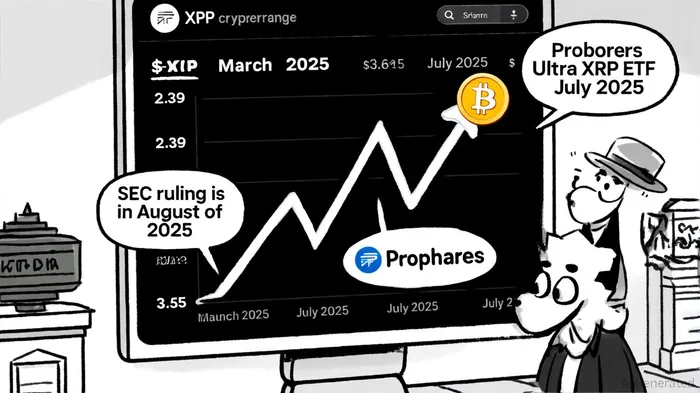
The cryptocurrency market has long awaited a catalyst capable of breaking through the noise of volatility and skepticism. For XRPXRP--, that catalyst arrived in August 2025, when the U.S. Securities and Exchange Commission (SEC) officially classified XRP as a utility token, resolving a five-year legal battle and aligning it with BitcoinBTC-- and EthereumETH-- under CFTC oversight[1]. This regulatory clarity, combined with a surge in institutional adoption, has positioned XRP as a prime candidate for a major bull run.
Regulatory Clarity: A Foundation for Growth
The SEC's August 2025 ruling marked a watershed moment. By affirming XRP's status as a utility token, the agency removed the cloud of regulatory uncertainty that had stifled institutional participation for years[1]. This decision not only validated XRP's role in cross-border payments but also opened the door for spot ETF approvals. The ProShares Ultra XRP ETF (UXRP), launched in July 2025, raised $1.2 billion in its first month, signaling robust institutional demand[1]. Analysts now project that 11 additional XRP spot ETFs could be approved by year-end, potentially injecting $4.3–$8.4 billion into the market[1].
The implications are profound. With XRP now treated as a digital commodity, financial institutionsFISI-- can integrate it into their portfolios without fear of regulatory reprisal. Ripple's acquisition of Hidden Road and the development of Ripple Custody further align XRP with global compliance standards, enhancing trust among institutional players[1].
Institutional Onboarding: Scaling XRP's Utility
Regulatory clarity has been the spark, but institutional adoption is the fuel. Ripple's On-Demand Liquidity (ODL) service processed $1.3 trillion in cross-border transactions in Q2 2025, with 75% of clients using XRP for real-time settlements and tokenized real estate[1]. Partnerships with SantanderSAN--, Standard Chartered, and SBI Holdings have cemented XRP's role in global payment systems[1].
The XRP Ledger's “Credentials” upgrade in September 2025 added another layer of institutional appeal. By enabling built-in identity checks, the upgrade streamlined compliance processes, making XRP a more attractive option for regulated financial use cases[2]. This innovation, coupled with Ripple's focus on tokenized finance (e.g., real estate and carbon credits), positions XRP as a foundational asset in the evolving digital economy[1].
Technical Momentum and Market Sentiment
From a price perspective, XRP's trajectory has been nothing short of explosive. The token surged to $3.65 in July 2025 following the SEC ruling, and as of September 11, 2025, it trades around $3, with key resistance levels at $3.12 and $3.36[2]. Technical analysts argue that a breakout above $3 could signal a move toward $5 in the short term, driven by ETF inflows and institutional buying[1].
Historically, breakouts above the 50-day high have shown a favorable follow-through pattern. A backtest of XRP's resistance-level breakouts from 2022 to 2025 revealed that 36 valid events occurred, with an average cumulative return peaking near +18% around Day 17 and a win rate above 50% for most of the first two weeks after a breakout[2]. These findings suggest that a simple buy-and-hold strategyMSTR-- following a confirmed breakout could yield meaningful returns, provided the broader market conditions remain supportive.
However, risks remain. Delays in ETF approvals or a shift in regulatory priorities could dampen momentum. Additionally, competition from stablecoins and central bank digital currencies (CBDCs) poses a long-term challenge[1]. That said, the current trajectory suggests XRP is well-positioned to capitalize on its unique value proposition: fast, low-cost cross-border transactions and a growing institutional ecosystem.
The Road Ahead
XRP's bull run hinges on two key factors: sustained institutional onboarding and regulatory tailwinds. With the SEC's “Clarity Act” and potential ETF approvals on the horizon, the stage is set for XRP to transition from a niche payment token to a mainstream asset class[2].
For investors, the message is clear: XRP is no longer just a speculative bet. It's a utility-driven asset with institutional-grade infrastructure and regulatory validation. As the crypto market matures, XRP's role in bridging traditional finance and digital innovation could prove to be one of the most compelling investment stories of the decade.






Comentarios
Aún no hay comentarios