
XRP's Path to Mainstream Adoption in 2025: Institutional Sentiment and Regulatory Clarity Drive On-Demand Utility and Market Value
The year 2025 marks a pivotal inflection pointIPCX-- for XRPXRP--, as regulatory clarity and institutional adoption converge to redefine its role in global finance. After years of legal uncertainty, the U.S. Securities and Exchange Commission (SEC) lawsuit against Ripple Labs reached a definitive resolution in August 2024, with a settlement that affirmed XRP's status as a non-security in public transactions [3]. This legal victory, coupled with strategic regulatory milestones in Singapore, the UAE, and the UK, has catalyzed a surge in institutional engagement, positioning XRP as a cornerstone of cross-border payments and tokenized finance.
Regulatory Clarity: A Catalyst for Institutional Reentry
The August 2024 settlement, which required Ripple to pay a $125 million fine but avoided a blanket classification of XRP as a security, provided the legal certainty institutions had long demanded. A critical precedent was set in July 2023 when U.S. District Judge Analisa Torres ruled that programmatic sales of XRP on public exchanges did not constitute securities offerings [1]. This decision dismantled a key legal barrier, enabling custodians like Apex and CoinbaseCOIN-- to resume XRP support and OTC liquidity providers to re-enter the market [1].
Globally, Ripple's proactive compliance strategy has further solidified XRP's legitimacy. By October 2023, the company secured a Major Payments Institution (MPI) license from Singapore's Monetary Authority of Singapore (MAS), a critical endorsement for Asia-Pacific financial corridors [1]. Additional milestones include UAE VARA registration for cross-border payments and temporary FCA registration in the UK [1]. These licenses have enabled XRP to underpin regulated use cases such as tokenized stablecoin issuance and real-time settlement systems, as demonstrated by Ripple's collaboration with the Republic of Palau to launch a USD-backed stablecoin on the XRP Ledger (XRPL) [1].
Institutional Adoption: From Compliance to Utility
The regulatory tailwinds have translated into tangible institutional adoption metrics. In 2025 alone, institutions purchased $1.1 billion worth of XRP, driven by its role in Ripple's On-Demand Liquidity (ODL) solution [3]. ODL's ability to settle cross-border payments in seconds—compared to traditional SWIFT transfers that take days—has attracted banks like SantanderSAN-- and American ExpressAXP--, which now use XRP to reduce liquidity costs and improve operational efficiency [1].
The XRP Ledger itself has evolved to meet institutional demands. The XLS-30 automated market makerMKR-- (AMM) upgrade, implemented in Q1 2025, introduced decentralized liquidity pools, allowing institutions to swap assets without relying on centralized intermediaries [2]. This innovation, combined with native token issuance and KYC-layer smart contracts, has enabled regulated stablecoin projects like Ripple's RLUSD (backed by BNY Mellon) to gain traction [4].
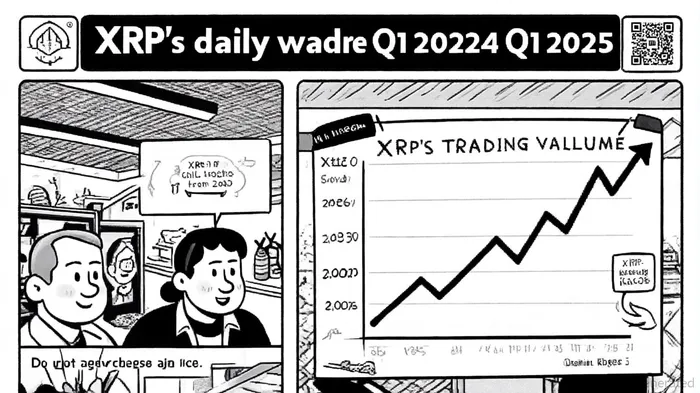
Data from Q1 2025 underscores XRP's growing utility: the XRP Ledger processed an average of 2.14 million daily transactions, with total volume exceeding $1.73 billion per day—a 22% increase from 2024 [1]. On Coinbase, XRP/USD trading volume accounted for 25.16% of the platform's total XRP activity, reflecting renewed investor confidence [1].
Challenges and the Road Ahead
Despite these advancements, challenges persist. The SEC's ongoing appeals regarding institutional XRP sales and jurisdictional discrepancies in asset classification remain unresolved [1]. Additionally, XRP's price volatility—while mitigated by its growing utility—requires robust risk modeling for large-scale adoption [1].
However, the trajectory is undeniably positive. Ripple's acquisition of Hidden Road for $1.25 billion in 2025 has further strengthened its institutional infrastructure, while ETF applications from firms like ProShares and Bitwise could unlock billions in inflows if approved [3]. Analysts project that XRP's market cap could rival Bitcoin's by 2030, driven by its dual role as a bridge currency and a programmable asset in tokenized ecosystems [4].







Comentarios
Aún no hay comentarios