
XRP's Path to Mainstream Adoption in 2025: A Critical Inflection Point for Institutional Exposure
Regulatory Clarity: A Foundation for Institutional Confidence
The U.S. Securities and Exchange Commission's (SEC) August 2025 resolution of its five-year legal battle with Ripple Labs marked a watershed moment for XRPXRP-- and the broader crypto industry. By jointly dismissing all appeals and accepting a $50 million penalty, the SEC effectively acknowledged the distinction between secondary market XRP transactions (non-securities) and institutional sales (securities) under the Howey test, according to a CCN report. This legal clarity has eliminated a critical overhang, enabling institutions to engage with XRP without fear of regulatory reprisal. Ripple's CEO, Brad Garlinghouse, emphasized that the settlement "creates a clear framework for digital assets, paving the way for innovation and investor trust," as reported by The Currency Analytics.
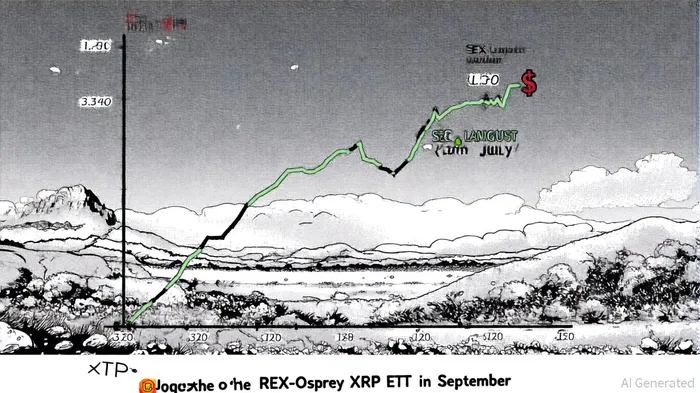
The resolution also catalyzed immediate market action. XRP's price surged to $3.40 in July 2025, with a 15% 30-day gain, as the first U.S.-listed spot XRP ETF, REX-Osprey XRPR, launched on September 18, 2025, attracting $2.1 billion in trading volume within its first week, per a Deseret News report. Analysts project that institutional inflows via ETFs could drive XRP to $13–$30 by 2026, mirroring Bitcoin's ETF-driven rally, according to The Currency Analytics analysis.
Cross-Border Payment Disruption: XRP's Core Value Proposition
XRP's utility in cross-border payments has solidified its role as a bridge currency, leveraging the XRP Ledger's (XRPL) speed and cost efficiency. The XRPL processes over 2.14 million daily transactions, with an average settlement time of under five seconds and a fee of just $0.0002 per transaction, according to XRP statistics. RippleNet, Ripple's global payment network, now connects 300+ financial institutions across 45+ countries, facilitating $1.3 trillion in cross-border settlements via SBI Remit alone in Q2 2025, as noted in a BreakingCrypto report.
Ripple's On-Demand Liquidity (ODL) service has been a game-changer for institutions seeking to bypass pre-funded accounts. By using XRP as a liquidity intermediary, banks reduce costs by up to 70% and settlement times from days to minutes, according to an OKX guide. For example, Santander's use of ODL for remittances between the U.S. and Mexico has cut processing fees by 40% while improving transparency, per Technology Innovators.
Moreover, Ripple's collaboration with central banks on Central Bank Digital Currency (CBDC) interoperability highlights its strategic vision, according to a Coincub timeline. The XRP Ledger's ability to facilitate real-time, low-cost transactions across jurisdictions positions it as a potential backbone for global CBDC networks.
Institutional Partnerships and the ETF Catalyst
The REX-Osprey XRP ETF's success has demonstrated the appetite for regulated exposure to XRP. With institutional investors now able to allocate capital via ETFs, demand for XRP is expected to rise sharply. CoinShares and Grayscale's pending ETF applications, if approved by late October 2025, could further amplify this trend, as noted by The Crypto Basic.
Ripple's institutional partnerships have also expanded. In 2025, the company secured contracts with 12 new banks in Southeast Asia and Latin America, leveraging XRP's efficiency to undercut traditional SWIFT transfers, according to CoinEdition. Additionally, Ripple's application for a U.S. national bank charter-awaiting a decision from the Office of the Comptroller of the Currency (OCC) by late October-could unlock access to the U.S. dollar stablecoin market, bolstering its RLUSD product, per The Coin Republic.
Risks and the Road Ahead
While the regulatory and market tailwinds are strong, risks persist. A government shutdown in October 2025 delayed the SEC's ETF approval timeline, creating short-term uncertainty . Additionally, macroeconomic factors, such as interest rate hikes, could dampen risk-on sentiment. However, the broader crypto market's resilience-driven by Bitcoin's ETF-driven rally-suggests that XRP's fundamentals will remain robust.
Looking ahead, Ripple's focus on stablecoin development, CBDC integration, and U.S. banking ambitions positions it to capitalize on the post-SEC clarity environment. If the OCC approves its charter, Ripple could become a full-service financial institution, further blurring the lines between traditional and digital finance.
Conclusion: A New Era for XRP
The convergence of regulatory clarity, cross-border payment innovation, and institutional adoption has positioned XRP at a critical inflection point. With the SEC lawsuit resolved, ETFs approved, and global partnerships expanding, XRP is no longer a speculative asset but a foundational component of the modern financial infrastructure. For investors, the next 12–18 months present a unique opportunity to participate in a digital asset that is redefining global payments and institutional exposure.





Comentarios
Aún no hay comentarios