
XRP's Path to Institutional Utility and the Implications for Price Surges
Institutional Adoption: ODL as a Game-Changer
Ripple's ODL service has emerged as a cornerstone of institutional adoption, offering a frictionless alternative to traditional cross-border payment mechanisms. Financial institutions are increasingly leveraging ODL to bypass the operational and financial overhead of pre-funded nostro/vostro accounts. For instance, SBI Remit in Japan processes billions of dollars in remittances using XRP, targeting the Filipino diaspora-a demographic that sends over $30 billion annually to the Philippines. Similarly, Intermex has slashed costs by 70% and reduced settlement times to near-instant for transactions to Mexico via ODL.
In the Middle East, Zand Bank and Mamo in the UAE have integrated Ripple's technology to expand their cross-border offerings, while Santander continues to use RippleNet for real-time international payments. These case studies underscore a critical shift: institutions are no longer experimenting with XRP but scaling it as a core component of their liquidity strategies. By unlocking up to $27 trillion in dormant liquidity globally, ODL is not just a cost-saving tool but a systemic reimagining of how capital flows across borders.
Tokenization and the XRP Ledger's Competitive Edge
Ripple's strategic focus on tokenization has further solidified XRP's institutional utility. The XRP Ledger's ability to settle transactions in 3–5 seconds at a cost of fractions of a penny per transfer contrasts starkly with SWIFT's 2–5 day timelines and $10–$50 fees. This efficiency has attracted central banks and financial institutions exploring tokenization for cross-border settlements. Ripple's engagement with over 20 central banks on CBDC pilots-alongside participation in IMF and BIS task forces-positions the XRP Ledger as a potential backbone for interoperable digital currencies.
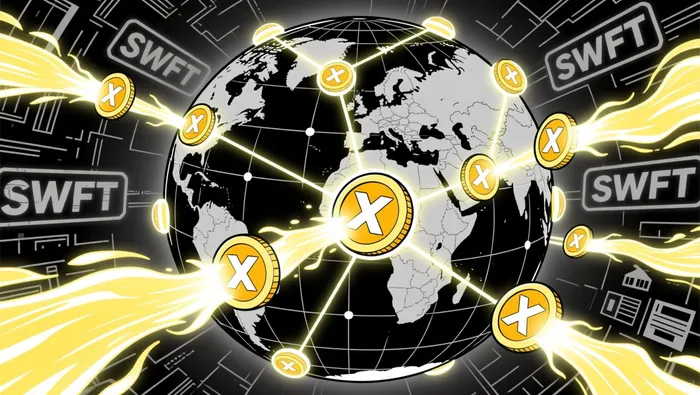
The launch of RLUSD, a USD-pegged stablecoin backed by BNY Mellon, addresses volatility concerns while expanding XRP's ecosystem into DeFi and institutional-grade stablecoin markets. This dual strategy-leveraging XRP's speed and tokenization for stablecoins-creates a flywheel effect: increased adoption of RLUSD drives demand for XRP as a settlement asset, while XRP's utility reinforces RLUSD's credibility.
Regulatory Compliance and Market Validation
Ripple's proactive approach to regulatory compliance has been instrumental in its resurgence. With over 60 licenses secured globally, the company has navigated a fragmented regulatory landscape to integrate XRP into traditional financial systems. The SEC's 2025 settlement, which clarified XRP's status as a non-security, has further de-risked institutional exposure. As a result, RippleNet now connects 300+ financial institutions across 55 countries, including major players like PNC and American Express.
This regulatory clarity has translated into on-chain metrics that signal growing utility. XRP's daily active addresses surged 142% quarter-over-quarter in 2025, while its market capitalization climbed to $126 billion, securing a top-five ranking among digital assets. These metrics suggest that XRP is transitioning from speculative hype to a utility-driven asset with tangible institutional demand.
Price Implications: From Utility to Speculation
The convergence of institutional adoption, tokenization, and regulatory validation raises compelling questions about XRP's price trajectory. Historically, XRP's value has been constrained by its role as a settlement asset with limited speculative appeal. However, the 2025 data paints a different picture: as ODL adoption scales, XRP's demand as a liquidity tool becomes more inelastic, creating upward pressure on its price.
Moreover, the tokenization of cross-border payments and the rise of RLUSD introduce new demand vectors. If central banks adopt the XRP Ledger for CBDCs, XRP could see a surge in demand akin to Bitcoin's role in institutional portfolios. While such scenarios remain speculative, the current trajectory suggests XRP is no longer a "speculative" asset in the traditional sense but a foundational component of a reimagined global payments infrastructure.
Conclusion
Ripple's strategic positioning in global payment infrastructure and tokenization has transformed XRP from a controversial token into a linchpin of institutional finance. The proliferation of ODL use cases, the XRP Ledger's efficiency, and regulatory milestones have created a self-reinforcing cycle of adoption and demand. For investors, the implications are clear: XRP's path to institutional utility is not just a story of technological innovation but a catalyst for price appreciation. As the world moves toward tokenized, real-time settlements, XRP's role in this transition could redefine its value proposition-and its price-well beyond 2025.






Comentarios
Aún no hay comentarios