
XRP's Path to Institutional Adoption and Its Impact on Liquidity and Valuation
The cryptocurrency market's evolution hinges on the integration of digital assets into traditional finance. For XRPXRP--, this journey has been defined by its dual role as a bridge asset for cross-border payments and a collateralizable token for institutional portfolios. As the U.S. ETF market surpasses $11 trillion in assets, the question of XRP's eligibility as collateral in mainstream financial products has become a pivotal determinant of its liquidity and valuation trajectory.
Regulatory Clarity: The Foundation for Institutional Trust
The U.S. Securities and Exchange Commission's (SEC) August 2025 dismissal of appeals in the Ripple case marked a watershed moment. By affirming that XRP sales on public exchanges are not securities, the ruling removed a critical legal barrier for institutional adoption. This clarity has enabled regulated entities to integrate XRP into their operations without fear of regulatory reprisal. As stated by a Forbes analysis, “The 2025 ruling has positioned XRP as a legitimate asset class for institutional portfolios, particularly in cross-border corridors where its speed and cost advantages are unmatched” [1].
Technological Upgrades: Enhancing Collateral Utility
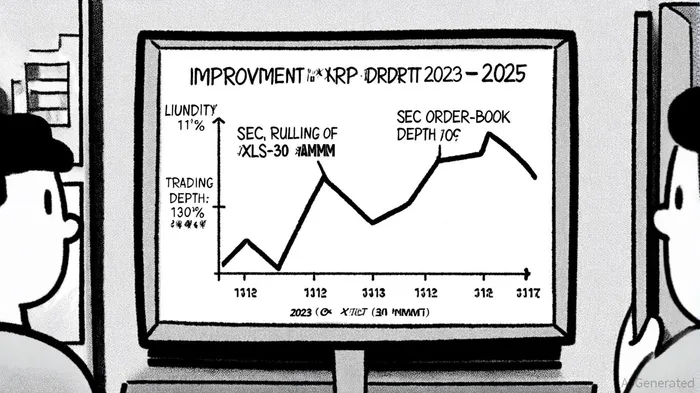
Ripple's XLS-30 automated market maker (AMM) amendment, activated in 2025, has further solidified XRP's collateral usability. By enabling native liquidity provision on the XRP Ledger, the AMM reduces reliance on pre-funded accounts and minimizes slippage for institutional traders. Data from Coinography indicates that XRP's 1% market depth improved by 40% in late 2024, making it more viable for large-scale transactions [2]. This technological leap has also lowered operational costs for banks using XRP in Ripple's On-Demand Liquidity (ODL) service, driving incremental demand for the token [3].
Strategic Partnerships: Bridging Traditional and Digital Finance
Ripple's institutional partnerships have expanded XRP's utility beyond payments. The launch of RLUSD, a U.S. dollar-pegged stablecoin, in 2025 created a hybrid on-ramp for institutional clients. A collaboration with Singapore's DBS Bank and Franklin Templeton, for instance, allows accredited investors to tokenize money market funds and seamlessly convert between cash and yield-bearing assets via RLUSD [4]. Such integrations position XRP as a collateral asset in tokenized finance, enhancing its demand dynamics.
ETF Potential: A Catalyst for Liquidity and Valuation
The prospect of U.S. spot XRP ETFs, likely to be approved by late 2025, could mirror the capital inflows seen with BitcoinBTC-- and EthereumETH--. According to a Finder expert panel, XRP's price is projected to rise from $2.80 in 2025 to $5.25 by 2030, contingent on ETF adoption and liquidity improvements [1]. If XRP gains inclusion in ETF baskets, its market capitalization could surge, driven by institutional demand for collateralizable assets with real-world utility.
Valuation Implications: Liquidity as a Multiplier
XRP's valuation is increasingly tied to its liquidity profile. With order-book depth strengthening and institutional trading activity rising, the token's price resilience has improved. A Bloomberg report notes that XRP's trading volume on major exchanges grew by 65% in 2024, outpacing many Layer 1 competitors [5]. This liquidity premium, combined with its role in high-cost remittance corridors (e.g., partnerships with SBI Remit and Onafriq), creates a flywheel effect: utility drives demand, which in turn enhances liquidity and valuation.
Conclusion: A New Era for XRP
XRP's path to institutional adoption is no longer speculative—it is operational. Regulatory clarity, technological innovation, and strategic partnerships have transformed it from a niche payment token into a collateral asset with mainstream appeal. As the crypto market matures, XRP's ability to serve as both a bridge currency and a liquidity enhancer will likely cement its role in institutional portfolios. For investors, the key takeaway is clear: XRP's valuation is not just a function of its price but of its growing utility as a collateralizable asset in a rapidly evolving financial ecosystem.






Comentarios
Aún no hay comentarios