
XRP's Path to $8.00–$12.00: Legal, Technical, and Market Catalysts
The cryptocurrency market has long viewed XRPXRP-- as a unique asset, straddling the line between speculative investment and institutional-grade utility. With the resolution of the U.S. Securities and Exchange Commission (SEC) lawsuit in August 2025, XRP has entered a new phase of regulatory clarity and market optimism. This article examines the legal, technical, and market catalysts driving XRP's potential ascent to $8.00–$12.00, offering strategic insights for investors seeking to time their entry into this evolving narrative.
Legal Resolution: A Catalyst for Institutional Confidence
The SEC's dismissal of its case against Ripple Labs in August 2025 marked a watershed moment for XRP. As stated by Ripple's Chief Legal Officer, Stuart Alderoty, the resolution "cleared the legal cloud" and signaled a shift toward a more crypto-friendly regulatory environment, according to Coinpedia analysis. This outcome not only validated XRP's non-security classification but also enabled U.S. exchanges like CoinbaseCOIN-- and Kraken to reinstate XRP trading, unlocking broader institutional and retail participation, as Coinfomania reported.
The immediate market reaction was telling: Coinpedia reported that XRP surged to $2.50 within days of the ruling, with a 24-hour trading volume of $10 billion. This price action reflects renewed confidence in XRP's utility as a cross-border payment solution and its potential for ETF approval. With seven XRP ETF providers awaiting regulatory decisions, Coinpedia projected inflows could range between $4.3B and $8.4B, significantly boosting demand.
Technical Upgrades: Positioning XRP for Institutional Adoption
Ripple's XRP Ledger (XRPL) has undergone critical upgrades in 2025, enhancing its appeal to institutional players. The Token Escrow and Multi-Purpose Token (MPT) amendment now allows stablecoins and tokenized real-world assets to be securely locked and released under programmed conditions, positioning XRPL as a compliance-ready settlement layer for banks and enterprises, as detailed in a BlockNews analysis. Additionally, the introduction of an EVM sidechain brings Ethereum-compatible smart contracts to XRPL, attracting liquidity and developers from Ethereum-based ecosystems.
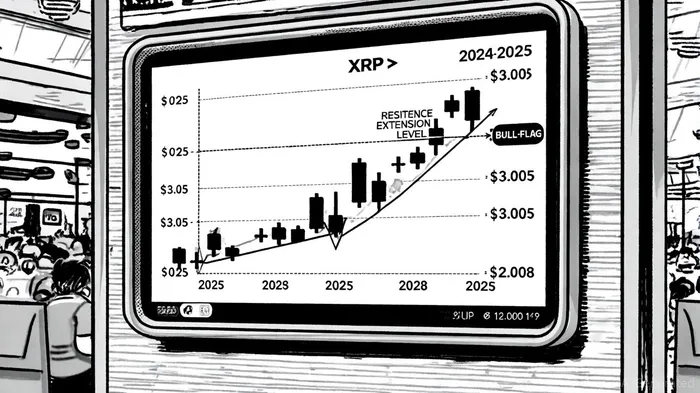
These upgrades are already bearing fruit. For instance, Coinpedia noted partnerships with DBS Bank and Franklin Templeton that indicate early adoption of tokenized money-market funds on the XRP Ledger. Technically, Coinpedia also observed XRP consolidating near key support levels around $2.75, with bullish targets projected between $3–$3.10 if momentum continues. A breakout above $3.65 could trigger a rally toward $5.25, leveraging Fibonacci extension levels and flag patterns, a scenario that BlockNews explored in its analysis.
Historical backtesting of XRP's price behavior around these levels reveals mixed signals. From 2022 to 2025, only four valid crosses of the specified support/resistance levels were detected-a small sample size. However, the average 30-day cumulative return after these events was -9.2%, underperforming XRP's buy-and-hold benchmark of +7.7% over the same windows. Breakouts above resistance often failed to sustain momentum, while breakdowns below support tended to precede deeper declines. These findings suggest that while resistance and support levels can offer directional guidance, they should be combined with volume spikes or momentum filters to improve reliability, as BlockNews noted.
Market Adoption: From Cross-Border Payments to Tokenized Finance
XRP's utility in cross-border payments remains a cornerstone of its value proposition. Coinpedia reported that Ripple's On-Demand Liquidity service processed $1.3 trillion in Q2 2025 alone, underscoring its role as a bridge currency for financial institutions. Coinpedia also highlighted partnerships with JPMorgan, SBI Holdings, and BNY Mellon that further validate XRP's institutional credibility.
Looking ahead, XRP's integration with central bank digital currency (CBDC) initiatives and tokenized finance could unlock new demand drivers. For example, Coinpedia cited Standard Chartered's projection that XRP could reach $5.50 by the end of 2025 and $12.50 by 2028, assuming continued institutional adoption. The potential approval of XRP ETFs, coupled with Ripple's pursuit of a U.S. national bank charter, adds another layer of macroeconomic tailwinds, according to a CoinCentral forecast.
Strategic Investment Timing: When to Enter the XRP Narrative
For investors, timing is critical. The post-SEC resolution rally has already pushed XRP to $2.97 as of October 2025, with key resistance at $3.10 and $3.65, as detailed in a Tecronet analysis. A breakout above $3.65 could trigger a surge toward $5.25, while a sustained move above $5.25 would open the door to $8.00–$12.00 by 2028, a path BlockNews has outlined in its coverage.
However, short-term volatility remains a risk. XRP is currently in a descending triangle pattern, suggesting a potential pullback to $2.75 before a decisive breakout, a dynamic Coinpedia has tracked. Investors should monitor on-chain metrics, such as the $25 million daily inflows into XRP-linked products, as a barometer of institutional participation-a trend Coinpedia has highlighted.
Conclusion: A Confluence of Catalysts
XRP's path to $8.00–$12.00 hinges on a confluence of legal, technical, and market catalysts. The SEC's dismissal of its case has removed a major overhang, while XRPL's upgrades and institutional partnerships are positioning XRP as a bridge between traditional finance and decentralized ecosystems. For investors, the key is to balance short-term volatility with long-term fundamentals, leveraging ETF speculation and macroeconomic trends to time entry points.
As the crypto market evolves, XRP's unique position as both a utility token and a speculative asset makes it a compelling case study in strategic investment timing.





Comentarios
Aún no hay comentarios