
XRP's Path to $3 in 2026: Regulatory Clarity, ETFs, and Institutional Adoption
The cryptocurrency market's focus on XRPXRP-- has intensified in 2025, driven by a landmark SEC settlement, the launch of spot XRP ETFs, and growing institutional adoption. Yet, the token's price performance has defied expectations, closing the year down 13% to $1.88 despite these catalysts. As investors weigh the prospects of XRP reaching $3 by 2026, a nuanced analysis of regulatory, structural, and macroeconomic factors is essential to assess the realism of such a target.
Regulatory Clarity: A Foundation for Growth
The resolution of the SEC's decade-long legal battle with Ripple in late 2025 marked a pivotal turning point. The $125 million civil penalty and dismissal of all claims provided much-needed clarity, with courts affirming that XRP is not a security in secondary markets. This development has unlocked new avenues for institutional participation, including the approval of four spot XRP ETFs from major firms like Franklin Templeton, Grayscale, Bitwise, and Canary Capital according to market reports.
However, regulatory clarity alone has not translated into immediate price gains. While the settlement reduced legal uncertainty, it did not eliminate broader market skepticism. As noted by a report from 247wallst, XRP's 2025 decline underscores the limitations of regulatory wins in isolation: "The token's price action suggests that macroeconomic headwinds and profit-taking by early investors have overshadowed the bullish narrative."
ETF Inflows and Institutional Adoption: Momentum and Mismatch
The introduction of XRP ETFs in November 2025 injects over $1 billion in inflows within weeks, signaling robust institutional interest. These products now manage $941.7 million in assets under management, with analysts like Fabian Dori of Sygnum Bank highlighting their role in improving market structure. Ripple CEO Brad Garlinghouse has further projected that XRP's blockchain could capture 14% of SWIFT's transaction volume within five years, bolstered by the token's utility in cross-border payments.
Yet, the disconnect between ETF inflows and XRP's price remains a critical issue. 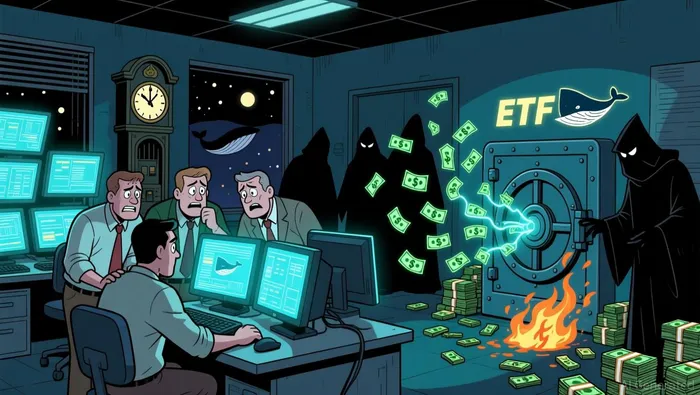 . A key factor is the structure of ETFs themselves: purchases are often executed after trading hours, delaying their impact on spot prices. Additionally, early investors and whales exploited the liquidity spike to exit positions, locking in gains and exacerbating downward pressure. This dynamic has left XRP trapped in a $1.85–$1.90 support band, with resistance at $2.00 acting as a psychological hurdle according to technical analysis.
Macroeconomic and Technical Headwinds
The broader macroeconomic environment has further complicated XRP's trajectory. Rising interest rates, AI-driven market volatility, and risk-off positioning have dampened risk assets, including cryptocurrencies. XRP's loss of the $2.00 support level-a key technical benchmark-has reinforced bearish sentiment, with Fibonacci retracement levels now targeting the $1.63–$1.83 range.
Meanwhile, macroeconomic risks such as U.S. tariff announcements and the unwinding of yen carry trades continue to weigh on the market according to market analysis. Bitcoin's bearish momentum has also drawn capital away from altcoins, including XRP, as investors rotate into perceived safer assets. According to Investing.com, XRP faces a critical decision point: a sustained move above $2.00 could trigger a bullish reversal toward $2.20–$2.30, while a breakdown below $1.83 risks a descent to $1.63.
The $3 Target: Realistic or Overambitious?
Achieving a $3 price tag by 2026 hinges on several interdependent factors. On the bullish side, accelerated ETF adoption, increased utility in real-world assets (e.g., tokenized U.S. Treasuries and Ripple's RLUSD stablecoin), and macroeconomic stabilization could drive demand according to market analysis. Analysts like those at Cryptorank have projected $5 by 2029–2030, assuming widespread adoption of Ripple's payment solutions.
However, bearish forces-including profit-taking, structural ETF delays, and macroeconomic volatility-pose significant challenges. For XRP to reach $3, it would need to:
1. Break above $2.00 and sustain momentum into the $2.20–$2.30 range.
2. Attract further institutional inflows beyond the current 1% of total market cap.
3. Benefit from a broader risk-on environment that reduces pressure on crypto assets.
While these conditions are not impossible, they remain speculative in the short term. A more conservative base-case scenario projects a downside target of $1.64, with upside potential contingent on ETF-driven demand and macroeconomic normalization according to technical analysis.
Conclusion
XRP's path to $3 in 2026 is neither guaranteed nor implausible. The token's regulatory clarity and institutional adoption represent foundational strengths, but macroeconomic headwinds and structural market dynamics currently cap its upside. Investors should approach the $3 target with tempered optimism, recognizing that while the long-term fundamentals are intact, near-term volatility and external risks will likely dictate the pace of progress.







Comentarios
Aún no hay comentarios