
XRP's Path to $27 and the Legal Catalysts Behind It
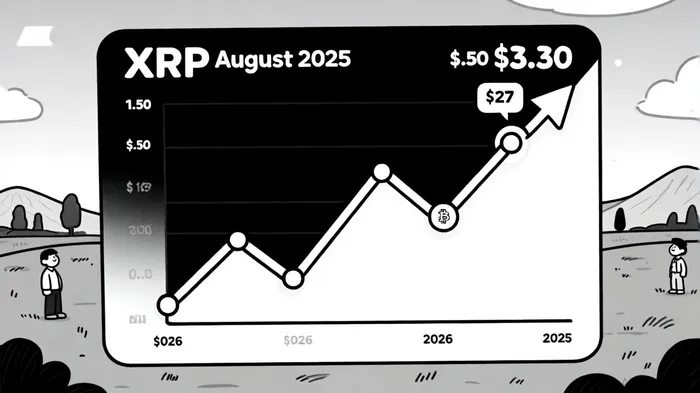
The cryptocurrency market has long been shaped by regulatory uncertainty, but 2025 marks a turning point for XRPXRP--. The resolution of the five-year legal battle between Ripple Labs and the U.S. Securities and Exchange Commission (SEC) has notNOT-- only cleared the air around XRP's classification but also unlocked a new era of institutional adoption and speculative optimism. With the SEC's August 2025 settlement confirming that XRP sold on secondary markets is not a security, the token has surged past $3.30, trading at levels not seen since 2021. Analysts now project a potential $27 price target by mid-2026, driven by regulatory tailwinds, ETF inflows, and a broader shift in U.S. crypto policy.
Regulatory Clarity: The Foundation of XRP's Undervaluation
The SEC's August 2025 settlement with Ripple was more than a legal victory—it was a structural reset for XRP's market dynamics. By affirming that retail sales of XRP on public exchanges do not violate securities laws, the ruling removed a critical overhang that had stifled institutional participation for years[1]. This clarity has already triggered a surge in trading volume, with XRP's 24-hour volume exceeding $12 billion in the wake of the settlement[1].
The legal framework also preserved a key distinction: while institutional sales of XRP remain restricted under the settlement's injunction, secondary market transactions are now free from securities law constraints[1]. This bifurcation has created a regulatory safe harbor for retail investors and exchanges, enabling XRP to function as a utility token rather than a speculative security. As Ripple CEO Brad Garlinghouse noted, the outcome allows the company to focus on its core mission of building the “Internet of Value” through cross-border payment solutions[2].
ETF Inflows and the $27 Price Target
The most immediate catalyst for XRP's next leg higher lies in the approval of spot ETFs. The SEC's mid-September 2025 approval of standardized listing standards for crypto ETFs has streamlined the approval process, eliminating the need for individual filings for each product[3]. This development has already led to the launch of the REX-Osprey XRP ETF (XRPR) on September 18, 2025, which generated $37.7 million in first-day trading volume[3].
Analysts estimate that if pending XRP ETFs from Grayscale and Bitwise are approved, they could attract over $8 billion in annual inflows, mirroring the success of BitcoinBTC-- ETFs[3]. Crypto analyst Egrag Crypto has highlighted this scenario as a key driver for XRP's price, projecting a $27 target if ETF inflows reach $5 billion annually[1]. Historical analogs, such as Bitcoin's 2021 ETF-driven rally, suggest that institutional adoption can amplify price gains exponentially when regulatory hurdles are removed[1].
Technical and Market Momentum
Beyond regulatory and institutional factors, XRP's technical indicators reinforce its bullish trajectory. The token has recently tested key resistance levels near $3.30, with on-chain data showing increased whale accumulation and reduced selling pressure[1]. A joint roundtable between the SEC and CFTC on September 29, 2025, is expected to finalize the derivatives framework for XRP futures, further reducing volatility and attracting risk-averse investors[3].
Moreover, XRP's utility-driven upgrades—such as the XLS-30 amendment introducing a native automated market maker (AMM)—have improved liquidity and execution quality on the XRP Ledger (XRPL)[3]. These developments position XRP not just as a speculative asset but as a foundational component of decentralized finance (DeFi) and cross-border payment systems.
Risks and the Road Ahead
While the regulatory and market tailwinds are strong, risks remain. The SEC's ongoing enforcement actions against other crypto projects could create a patchwork of regulations that complicate XRP's adoption. Additionally, macroeconomic factors such as interest rate hikes or a broader market correction could dampen ETF inflows. However, the legal precedent set by the Ripple case provides a framework for future clarity, reducing the likelihood of prolonged regulatory uncertainty[1].
Conclusion
XRP's journey to $27 is not a speculative leap but a calculated outcome of regulatory clarity, institutional adoption, and technical momentum. The SEC's settlement with Ripple has transformed XRP from a legal liability into a regulated asset, while the approval of ETFs and derivatives frameworks has created a pipeline for sustained institutional demand. As the market digests these developments, investors should view XRP not as a high-risk bet but as a strategic play on the future of regulated digital assets.






Comentarios
Aún no hay comentarios