
XRP's Path to $1000 and the Emerging Rival in the XRP Ecosystem: Navigating Competitive Dynamics and Regulatory Tailwinds
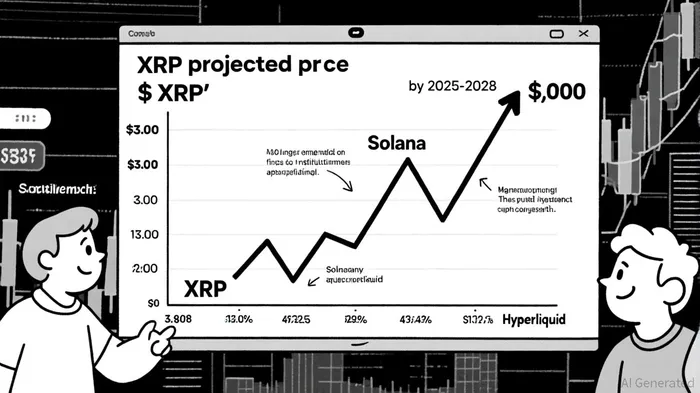
The cryptocurrency landscape in 2025 is defined by a delicate interplay of regulatory clarity, technological innovation, and market competition. For XRPXRP--, the token at the heart of Ripple's cross-border payment network, the path to $1,000 hinges on its ability to leverage regulatory tailwinds while fending off emerging rivals like Hyperliquid (HYPE) and SolanaSOL-- (SOL). These competitors, though distinct in their use cases, are reshaping the blockchain ecosystem, creating both challenges and opportunities for XRP's long-term value proposition.
Regulatory Clarity: A Catalyst for XRP's Institutional Adoption
The most transformative development for XRP in 2025 has been its regulatory reclassification. Following Ripple's five-year legal battle with the SEC, a landmark ruling in 2023 affirmed XRP as a utility token rather than a security in retail markets [1]. This decision has unlocked a floodgate of institutional interest, with XRP-based ETFs now in the approval pipeline. According to a report by Bloomberg, institutional inflows into XRP surged by 86% in Q2 2025, driven by its clear legal status and integration with Ripple's On-Demand Liquidity (ODL) service [2].
This regulatory clarity contrasts sharply with the uncertainty surrounding Solana and Hyperliquid. While Solana's high-speed blockchain has attracted developers, the SEC's ongoing scrutiny of its token (SOL) as a potential unregistered security has created hesitation among institutional investors [3]. Similarly, Hyperliquid's decentralized trading platform, though technologically advanced, faces governance challenges and questions about its compliance with evolving DeFi regulations [4]. For XRP, this regulatory edge positions it as a safer harbor for capital seeking stability in a volatile market.
Competitive Dynamics: Hyperliquid and Solana's Threats and Synergies
The XRP ecosystem's primary rivals in 2025 are Hyperliquid and Solana, each targeting different segments of the blockchain market. Hyperliquid, a Layer 1 blockchain optimized for decentralized perpetual trading, has surged 86.23% year-to-date, capitalizing on its sub-second execution speeds and zero gas fees [5]. Its airdrop strategy and Assistance Fund for token buybacks have further fueled retail adoption, creating a direct challenge to XRP's dominance in niche DeFi use cases [6].
Meanwhile, Solana's focus on high-throughput transactions (100,000 TPS) and low fees ($0.02 per transaction) has made it a preferred infrastructure for developers building decentralized applications (dApps) and NFT platforms [7]. The Alpenglow upgrade, which reduced transaction finality to 150 milliseconds, has solidified Solana's reputation as a scalable solution for consumer-facing blockchain projects [8]. However, Solana's lack of institutional-grade cross-border payment tools—Ripple's core strength—means it remains a complementary rather than a direct competitor to XRP.
Market Fundamentals: XRP's Structural Advantages
Despite these challenges, XRP's fundamentals remain robust. Its on-chain activity has grown by 430% over two years, with weekly payment transactions exceeding 1.3 trillion dollars via ODL [9]. This utility-driven demand is reinforced by whale accumulation patterns, with large holders absorbing 12% of XRP's circulating supply in Q3 2025—a trend reminiscent of Bitcoin's pre-bull market behavior [10].
Moreover, Ripple's strategic acquisitions, such as Rail (a stablecoin payments firm), and its expansion of RLUSD in regulated markets like Japan, have diversified XRP's use cases beyond remittances [11]. These moves position XRP as a bridge between traditional finance and blockchain, a role that neither Hyperliquid nor Solana can fully replicate.
The Road to $1,000: A Convergence of Factors
For XRP to reach $1,000, three conditions must align:
1. Regulatory Momentum: The approval of XRP ETFs by year-end 2025 could inject $10–$15 billion in institutional capital, pushing the token toward $31–$35 in the short term [12].
2. Ecosystem Expansion: Ripple's partnerships with 300+ financial institutions, including Bank of AmericaBAC-- and SantanderSAN--, ensure sustained demand for XRP in cross-border payments [13].
3. Market Sentiment: With 80% of XRP's supply in profit (compared to Ethereum's 61%), bullish conviction among investors is strong, particularly as macroeconomic trends favor risk-on assets [14].
However, the path is not without risks. Hyperliquid's focus on retail traders and Solana's developer ecosystem could erode XRP's market share in DeFi and NFTs. Yet, XRP's institutional-grade infrastructure and regulatory clarity provide a durable moat, making it a unique asset in the crypto space.
Conclusion: A Strategic Bet on XRP's Long-Term Value
The cryptocurrency market in 2025 is a battleground of innovation and regulation. While Hyperliquid and Solana offer compelling alternatives in decentralized trading and high-speed transactions, XRP's role as a cross-border payment utility and its newfound regulatory clarity make it a cornerstone asset. For investors, the key is to balance exposure to XRP's institutional-driven growth with hedging against the disruptive potential of emerging rivals. As the XRP ecosystem continues to evolve, its path to $1,000 will depend not on outpacing competitors, but on leveraging its unique position at the intersection of traditional finance and blockchain.






Comentarios
Aún no hay comentarios