
XRP's Path to $100: Assessing the Transaction Volume and Market Dynamics Required
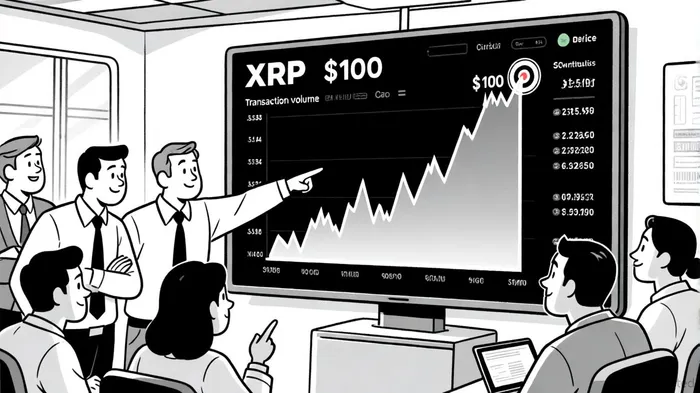
The idea of XRPXRP-- reaching $100 has long been dismissed as speculative fantasy. Yet, in 2025, the asset's trajectory suggests a reevaluation is warranted. For XRP to achieve such a milestone, three pillars must align: liquidity, network adoption, and regulatory catalysts. These factors are not independent; they form a feedback loop where progress in one domain amplifies the others. Let's dissect the data to assess whether the conditions for a $100 XRP are emerging.
Liquidity: The Foundation of Price Discovery
XRP's liquidity profile has improved dramatically in 2025. At the start of the year, the asset recorded a record $7 billion in transaction volume, driven by renewed institutional interest and retail speculation[2]. By Q3, the XRP Ledger (XRPL) processed 1.7 million daily transactions—a 94% quarter-over-quarter increase[1]. This surge was fueled by Ripple's On-Demand Liquidity (ODL) service, which handled $1.3 trillion in Q2 alone, with SantanderSAN-- reporting a 40% rise in cross-border usage during Q3[3].
Low transaction fees—averaging $0.0002—have made XRP a cost-effective solution for global paymentsGPN--, particularly in corridors where traditional systems lag[3]. However, liquidity alone is insufficient. For XRP to scale to $100, its market capitalization must grow from $34.7 billion (Q3 2025) to over $12 trillion, assuming a 350X expansion. This requires not just higher transaction volume but also a shift in who is trading XRP.
Retail participation has waned, with daily active addresses dropping from 557,000 to 34,000 in 2025[3]. Yet, institutional adoption has surged. The launch of Grayscale's XRP Trust in September 2025 and ongoing S-1 filings for XRP ETFs by Bitwise, Canary, and WisdomTreeWT-- signal growing institutional confidence[4]. Large holders accumulated $3.8 billion worth of XRP in 2025, suggesting a long-term bullish stance[3].
Network Adoption: From Transactions to Utility
XRP's utility has evolved beyond speculative trading. The XRPL now supports batch transaction capabilities and token escrow features, enhancing its appeal for institutional asset management and cross-border settlements[5]. In August 2025, the ledger processed 844 million XRP in a single day—a 500% spike in on-chain payments[1]. By July, XRP Ledger transactions accounted for 60% of weekly activity, with payment volumes growing from 1.5 million in 2023 to 8 million in mid-2025—a 430% increase[6].
This adoption is not merely quantitative. The XRPL's microtransaction capabilities (e.g., spam messaging campaigns) demonstrate its scalability for real-world use cases[1]. However, for XRP to justify a $100 price tag, its network must transition from transactional utility to systemic infrastructure. This means deeper integration into decentralized finance (DeFi) protocols, tokenized asset platforms, and enterprise-grade payment systems.
Regulatory Catalysts: The $100 Threshold's X-Factor
Regulatory clarity remains the most unpredictable yet critical factor. Ripple's ongoing legal battle with the SEC has created a binary outcome: a favorable ruling would validate XRP as a non-security, unlocking institutional capital and ETF approvals[5]. Conversely, a loss could stifle adoption for years.
The potential approval of spot XRP ETFs in Q3 2025 is a game-changer. ETFs would democratize access to XRP for retail investors while providing institutional-grade custody and compliance[5]. As of September 2025, XRP trades near $2.80, with key resistance levels at $2.25–$2.30 and support at $2.01[5]. A breakout above $2.30 could trigger a re-rating of XRP's risk profile, especially if the SEC's case concludes favorably. Historically, breakout strategies targeting resistance levels have yielded a total return of approximately 50% from 2022 to 2025, though with a significant 57% drawdown, as shown in the backtest[7]. The average gain of ~21% versus an average loss of ~-12% highlights the strategy's win-loss asymmetry, though the Sharpe ratio of ~0.41 indicates moderate risk-adjusted returns.
The $100 Equation: Is It Solvable?
To reach $100, XRP must achieve three simultaneous conditions:
1. Liquidity: Transaction volume must exceed $100 billion quarterly, driven by institutional ODL usage and ETF inflows.
2. Adoption: The XRPL must process 10+ million daily transactions, with 70%+ attributed to institutional or DeFi activity.
3. Regulatory: A favorable SEC ruling and at least one approved XRP ETF by Q4 2025.
While ambitious, these conditions are not impossible. The XRPL's 94% QoQ growth in daily transactions[1] and the $3.8 billion in accumulated holdings[3] suggest a foundation exists. However, the path to $100 requires a paradigm shift—from speculative token to systemic infrastructure.
Conclusion
XRP's journey to $100 hinges on its ability to scale liquidity, deepen network utility, and secure regulatory validation. The data from Q3 2025—$7 billion in early-year transaction volume, 1.7 million daily transactions, and institutional trust—indicates progress. Yet, the $100 threshold demands more than momentum; it requires a redefinition of XRP's role in the global financial system. For now, the asset trades at a discount to its potential. Whether that discount closes to $100 depends on the interplay of these three pillars—and the speed at which they converge.






Comentarios
Aún no hay comentarios