
XRP News Today: XRP ETFs Surge Past $1B as Price Lags Amid Utility Debate
XRP's Future as a Global Financial Infrastructure Tool
XRP's future as a global financial infrastructure tool has sparked debate among analysts as predictions for a $100 price target continue to circulate. Some argue that XRP's utility in cross-border transactions makes it a strong contender for long-term growth, while others caution that such ambitions remain unrealistic given current market conditions according to analysts. Meanwhile, XRPXRP-- ETFs have seen steady inflows, with assets surpassing $1 billion as institutional demand grows. This divergence between price performance and capital accumulation underscores the complexity of XRP's market dynamics, as investors weigh speculation against real-world utility.
The discussion often centers on the contrast between XRP and BitcoinBTC--, with some analysts framing BTC as a speculative asset and XRP as one built on tangible use. 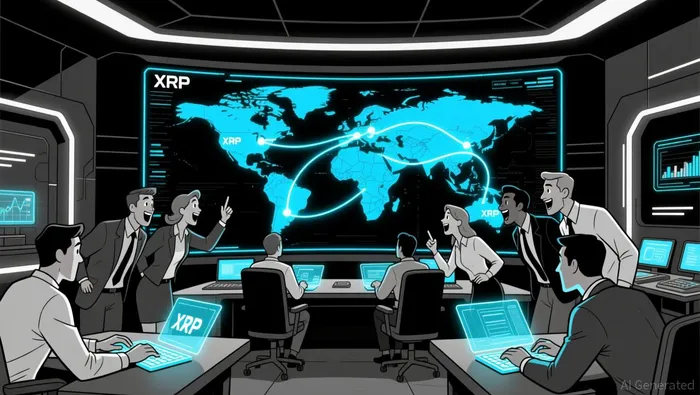 According to one expert, XRP's role in handling trillions in cross-border transactions makes it a foundational component of global financial systems. However, critics argue that XRP's journey to $100 is far from guaranteed, pointing out the need for realistic milestones and structural progress before such targets can be entertained.
Why the Standoff Happened
The debate over XRP's potential is rooted in contrasting narratives about its market role and growth trajectory. Analysts emphasize XRP's unique advantages in liquidity and settlement demand, suggesting it has a more straightforward path to relevance. In contrast, critics warn that the idea of a $100 XRP is premature, especially as the token trades well below $5. These differing views reflect a broader tension between long-term belief in XRP's utility and short-term market realities.
One key factor in this standoff is the math behind a $100 XRP price. At the token's current circulating supply of 50 billion, a $100 price tag would imply a $5 trillion market capitalization, surpassing the value of the largest publicly traded companies. Achieving this level of adoption would require not only widespread acceptance but also a complete overhaul of existing financial infrastructure. While some analysts remain bullish, they caution that real utility often dampens price volatility rather than amplifying it.
What Analysts Are Watching
Institutional adoption and regulatory clarity are two factors analysts closely monitor as potential catalysts for XRP's growth. XRP ETFs, which allow investors to gain exposure to the token through regulated US financial products, have seen consistent inflows. This trend indicates growing institutional interest in XRP, with major providers like Grayscale and Bitwise accumulating assets according to market data. Yet, despite this inflow, XRP's price has not responded accordingly, leading to questions about the relationship between ETF demand and spot prices.
Transaction volume and network adoption also play a critical role in XRP's long-term prospects. Some analysts argue that XRP's survival through multiple market cycles, coupled with its focus on cross-border payments and enterprise integration, places it in a rare category. However, others point out that competing blockchains like Solana and Stellar offer faster settlement and lower fees, which could hinder XRP's growth in this space. Institutional investors, who prioritize stability and liquidity, may also view XRP's volatility as a drawback.
Risks to the Outlook
Despite bullish projections, XRP faces several challenges that could limit its growth potential. One risk is macroeconomic headwinds, which have caused a broader decline in the crypto market. Rising interest rates and concerns over an AI bubble have prompted investors to de-risk their portfolios, leading to outflows from high-beta assets like EthereumETH--. If these conditions persist, they could weigh on XRP's price even as ETF inflows continue.
Another challenge is the psychological impact of unrealistic price targets on retail investors. Analysts warn that exaggerated predictions can distort expectations and lead to poor investment decisions. When investors fail to achieve unrealistic gains, they may become disillusioned and exit the market, potentially weakening demand for XRP. This dynamic is particularly concerning for XRP, which lacks the organic demand drivers seen in other crypto assets.
What This Means for Investors
For investors, the path forward depends on a careful balance of patience and discipline. While XRP's utility in global financial systems is a strong argument for long-term growth, short-term volatility and macroeconomic conditions remain significant hurdles. Those who focus on measurable fundamentals such as transaction volume and institutional adoption, may find themselves better positioned to navigate this uncertainty.
XRP ETFs offer a regulated avenue for gaining exposure to the token, but investors should remain mindful of the disconnect between ETF inflows and spot prices. As the market evolves, alignment between these two metrics may become a key indicator of XRP's trajectory. For now, investors must weigh the potential rewards of XRP's utility-driven growth against the risks of a volatile market and unrealistic expectations.






Comentarios
Aún no hay comentarios